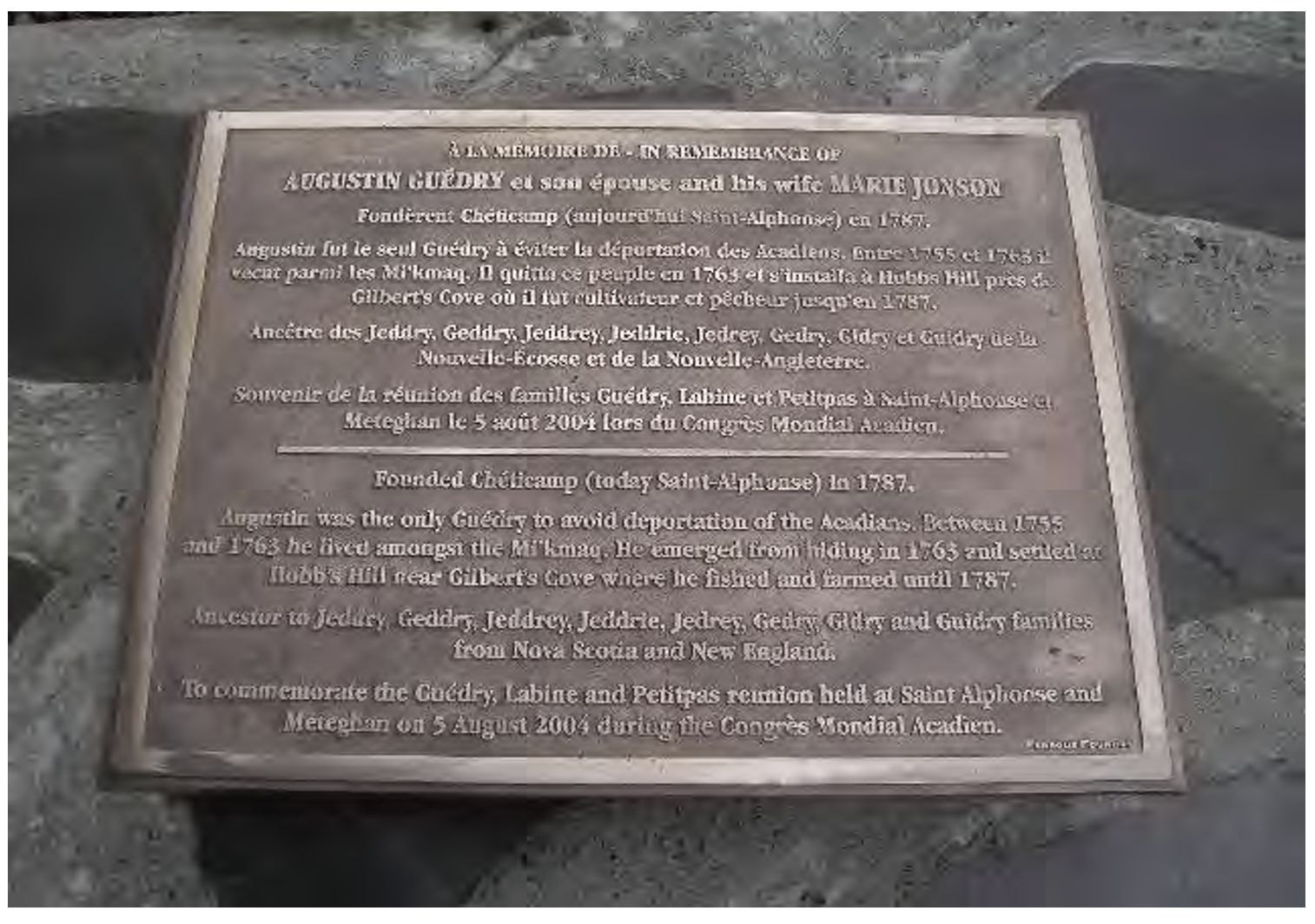
Augustin Guédry dit Grivois Founder of Chéticamp (Saint-Alphonse de Clare)
The youngest son of Pierre Guédry dit Labine and Marguerite Brasseau, Augustin Guédry dit Grivois, born about 1740, founded the village of Chéticamp-de-Clare, Nova Scotia in 1787. In 1932 the village's name was changed to Saint-Alphonse-de-Clare because of confusion with the town of Chéticamp on Cape Breton. Details of the first thirty years of his life are sketchy.
Augustin Guédry dit Grivois first appears in the record on 27 March 1752 at Pointe-à-la-Jeunesse, Ile Royale (today's Grand Narrows area) where he was living with his brother Charles Guédry age 26 years, sister-in-law Madeleine Hébert (25 years), two brothers Joseph (age 20 years) & Jean Femilien (age 17 years) and a sister Aniez (Agnès, age 10 years). Augustin was twelve years old. The family had arrived a Pointe-à-la-Jeunesse in August 1751. The settlers at Pointe-à-la-Jeunesse were struggling as they did not have hay or water for their livestock and they desired to depart from the place. They reported the ground as unsuitable for cultivation - being traversed with rocks that prevented working the ground. 1 , 2 Apparently, Augustin's parents, Pierre Guédry dit Labine and Marguerite Brasseau, had died by early 1752 as Charles Guédry and his wife are caring for his four youngest siblings.
The place of Augustin's birth is unknown, but may have been Annapolis Royal, Nova Scotia. Four of his older siblings were baptized at Saint-Jean-Baptiste Catholic Church in Annapolis Royal between 1723 and 1729. The places of birth/baptism of his other siblings are unknown. It seems probable that Augustin was born at Annapolis Royal or at Merliguèche (today's Lunenburg area) where his father lived during his youth along with many of his aunts, uncles and cousins.
Charles Guédry and his immediate family were captured by the British on Île Royale in 1758 and deported to St. Malo, France - departing Île Royale on 25 November 1758 on the transport "Supply" and arriving at St. Malo on 9 November 1759. 3 , 4 His brother Joseph and his sister Agnès disappear from the record after 1752. His brother Jean Femilien also was deported to France in 1759 where on 14 August 1780 at Saint-Martin de Chantenay Catholic Church he was a witness at the marriage of his nephew Pierre Braud to Geneviève La Garenne. 5
Between 1752 and 1758 Augustin Guédry must have left Île Royale and returned to Nova Scotia - thus avoiding the deportations from Île Royale and île Saint-Jean in 1758-1759. It is uncertain where he was between 1752 and 1763. Family legend indicates that the British captured Augustin possibly at Merliguèche or Annapolis Royal, took him to Goat Island near Annapolis Royal in late 1755 and placed him on a deportation ship. He escaped from the ship and swam to the shore opposite that of the old Port Royal Habitation where he made his way across the Acadian peninsula to Merliguèche or LaHave. Here his family had lived many years among the Mi'kmaq and had good relations with them. He is thought to have lived among the Mi'kmaq for the next eight years and they protected him. Some believe the ship from which he escaped may have been the "Pembroke" since it departed from Goat Island in late 1755. after the end of the French and Indian War in 1763, Augustin emerged from hiding and rejoined the Acadian community eventually settling at Pisiguit near Fort Edward. This family legend has been passed down from generation to generation and is still discussed among the Guédry family in Nova Scotia. Augustin is thought by many to be the only member of the Guédry family to not have been deported. 6 , 13 , 14 No primary source records have been located to date to support this legend although there may be some gems of truth in it.
Ronnie-Gilles LeBlanc, retired archivist at the Centre d'Études Acadiennes at the Université de Moncton (New Brunswick) has hypothesized that Augustin Guédry briefly joined the Acadian refugees at Camp Espérance on the Miramichi River during the winter of 1756- 1757. 7 This was an especially difficult winter as the worn-down refugees experienced famine and contagion that caused many deaths among the approximately 1300 Acadians there. As Mr. LeBlanc stated in personal correspondence to this author, because of the sparsity of actual records concerning the Acadians in the late 1750s, Mr. LeBlanc based his assumptions of who was at Camp Espérance on available documents before 1755 and after 1762 to identify who probably would have been at Camp Espérance. 8 Thus, it is uncertain if Augustin Guédry was at Camp Espérance during the winter of 1756-1757, but there certainly is a probability that he was there during that winter and perhaps even longer.
Between 1753 and 1762 no primary source documents have been located to identify where Augustin Guédry was during this timeframe. In 1763 he was at Port-Royal with approximately 90 other Acadians. At this time he was alone and could not write. Among the families at Port-Royal enumerated in the census were François Comeau, his wife and two children. 9
Placide Gaudet in his Notes states that Augustin Guédry married Anne-Marie Comeau, daughter of François Comeau & Marie-Madeleine L'Or (Lord). Gaudet also states that Anne-Marie Comeau was previously married to Jean Saulnier. She and Jean Saulnier had a son Jean born 8 February 1756 at Petitcodiac and who died at Baie Sainte-Marie. According to Placide Gaudet, Augustin and Anne-Marie had a daughter Marie Guédry who died an old woman at Baie Sainte-Marie. 10 Ronnie-Gilles LeBlanc cites Placide Gaudet when Mr. LeBlanc mentions this marriage of Augustin Guédry. 7
The marriage of Augustin Guédry and Anne-Marie Comeau must have occurred between late 1763 to 1764 - after the Census of Port-Royal in 1763 and allowing for the birth of their daughter Marie and the subsequent marriage of Augustin Guédry to Marie-Françoise Jeanson about 1767. Anne-Marie Comeau apparently died during or shortly after the birth of Marie leaving Augustin Guédry a widower with an infant daughter Marie and a young stepson Jean Saulnier.
It is unfortunate that Placide Gaudet did not provide any sources for his assertions regarding the marriage of Augustin Guédry and Anne-Marie Comeau. Seldom did he provide any sources in his Notes except for an occasional census reference. To date, only one primary source has been identified concerning the marriage of Augustin Guédry and Anne-Marie Comeau or the birth of their daughter Marie. This primary source is the Last Will and Testament of Augustin Guédry père. 31 Additionally, significant circumstantial evidence does exist and is discussed at the end of this article.
Between 1765 and 1768 Augustin Guédry moved from Port-Royal to the Pisiguit area. In April 1768 he was one of 57 Acadians with their wives and children who were willing to take the Oath of Allegiance. Augustin was listed as Augn Grivoir with a woman, two boys and one girl. 11
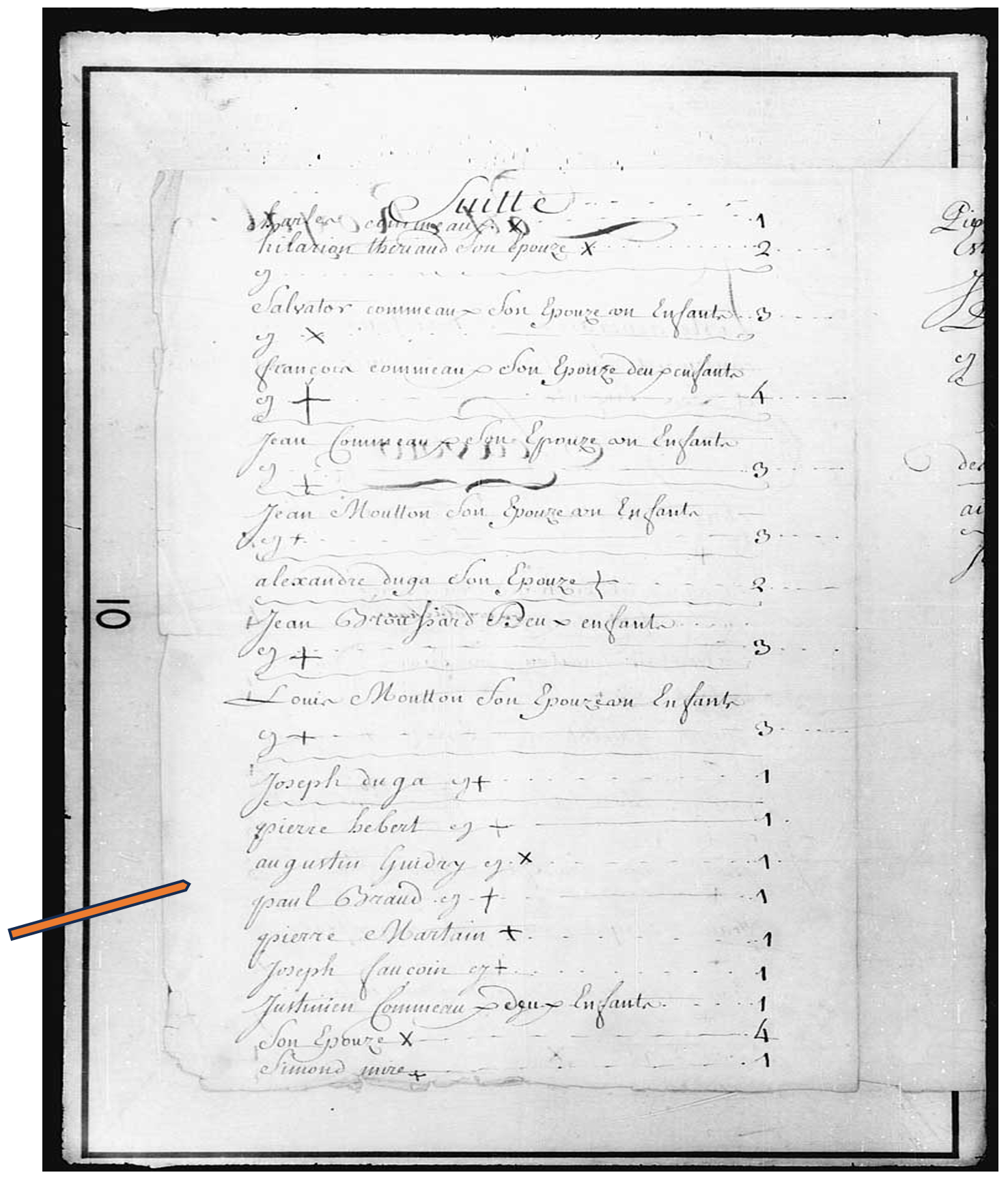
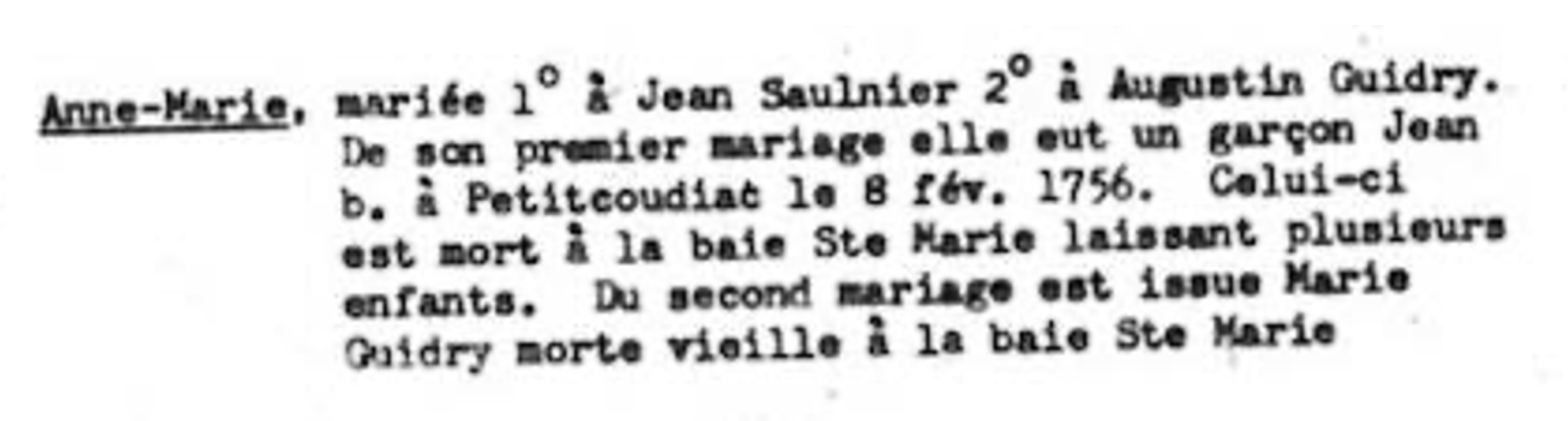
This woman in the April 1768 list was Augustin's second wife Marie-Françoise Jeanson (Johnson) (b. 1744) 28 , whom he married in a civil ceremony in 1767. She was the daughter of Guillaume Jeanson (Johnson) dit Billy and Marie Aucoin. Augustin and Marie-Françoise had a son Hermat Pierre Guédry, born at Pisiguit in December 1767 and baptized on 28 August 1768 by Abbé Charles-François Bailly. 12 The three children listed very likely were Hermat-Pierre Guédry, Augustin's stepson Jean Saulnier and his daughter Marie Guédry. 11 On 1 April 1768 Augustin Guédry (Augustin Gettry) was one of 38 men signing a formal petition to the Lieutenant-Governor requesting that a priest be sent to Pisiguit, that the Acadians be provided with one year's provisions and that a surveyor be sent to survey the lands. He made his mark rather than sign his name. 11 On the 8th of May 1769 Abbé Bailly rehabilitated the marriage of Augustin Guédry and Marie-Françoise Jeanson. 12
After January 1770 Augustin Guédry, Marie-Françoise Jeanson and their young family left Pisiguit and resettled along Baie Sainte-Marie at Hobbs Hill in Digby County. Hobbs Hill is at Gilbert's Cove, Nova Scotia just south of Plympton. 6 , 12 , 13 , 14 On 12 January 1770 at Pisiguit Augustin Guédry served as the parrein during the baptism of Allain Landry, son of René Landry and Marguerite Boudrot. 12 Apparently, Augustin Guédry never received a grant for nor purchased the land at Hobbs Hill. This property was part of 1000 acres granted to James Boutineau Franklin, son of the Honorable Michael Franklin, Lieutenant-Governor of Nova Scotia. Mr. Boutineau received the grant for his services to the county in establishing the earliest settlements in Digby and vicinity. He had been Clerk of the House of Assembly for a long period. James Boutineau Franklin held title to the property until 1802, but apparently never lived on the land. 15 The property where Augustin Guédry settled about 1770 is today 6860 Highway 101 (also called Highway 1 and the Evangeline Trail) in Gilbert's Cove. The house on the property was probably built about 1865.
Augustin and Marie-Françoise had at least nine children while at Hobbs Hill: Joseph-Félix (b. ca. 1769; bapt. 12 Jan 1770) 12 , Augustin fils (b. 20 Jun 1771; bapt. 14 Oct 1774) 16 , Anne (b. 1773), Théotiste, Jean-Dominique (b. 15 Jun 1775; bapt. 30 Nov 1777) 25 , 26 , Marguerite, Philippe (b. ca. 1783), Romain (b. ca. 1784) and Marie-Josephe.
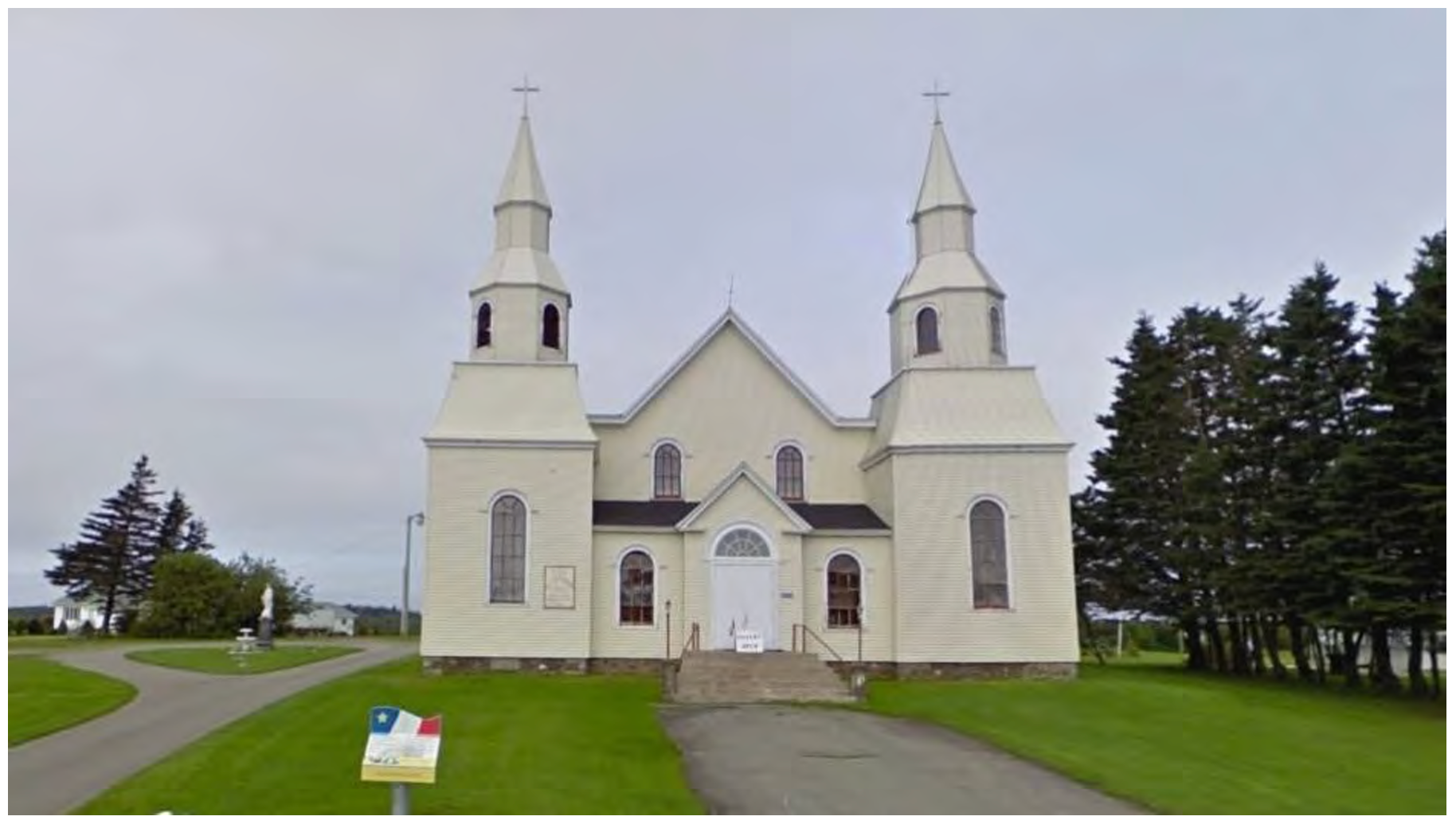
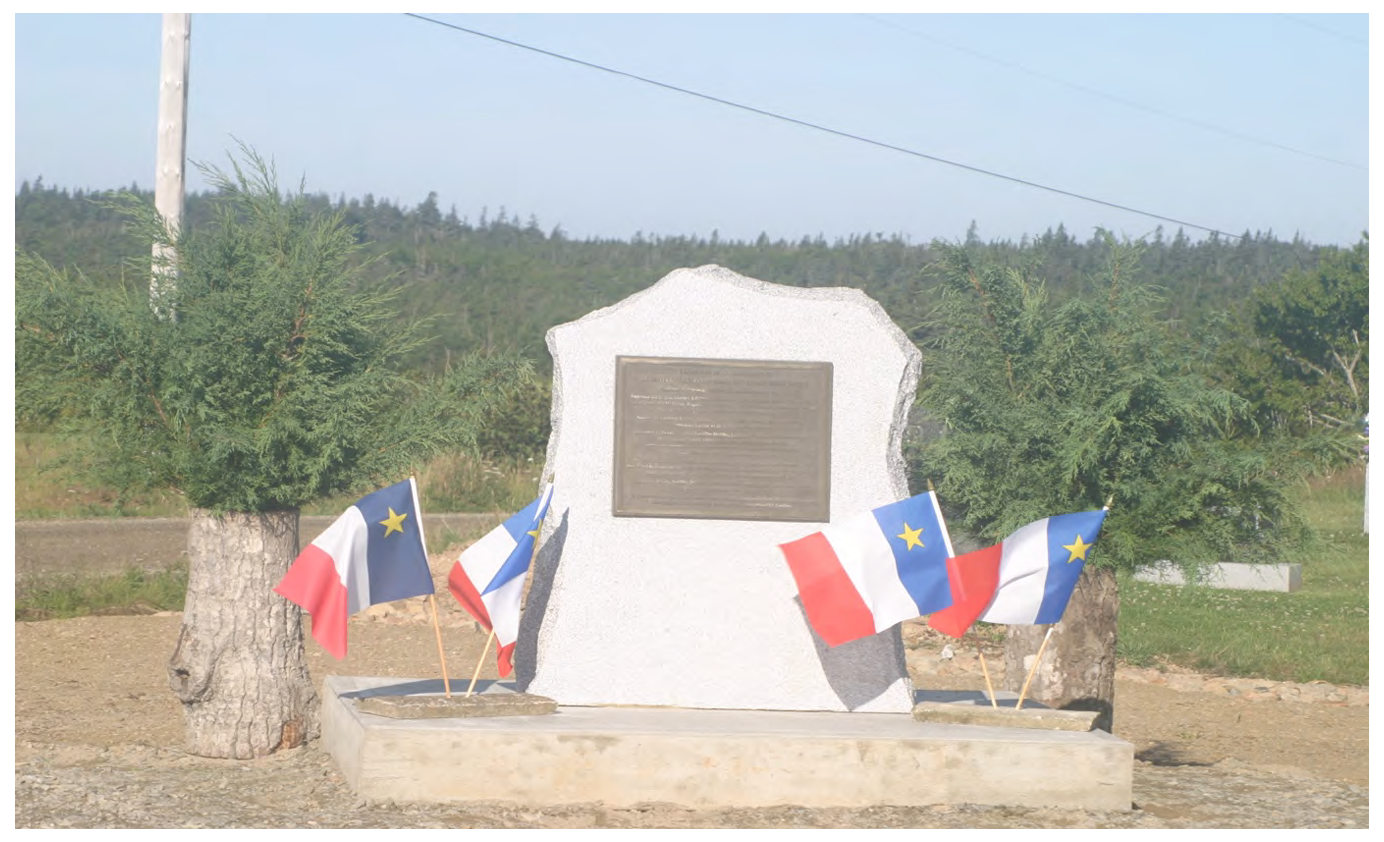
Digby County was divided into two Municipalities - Digby and Clare. Digby Municipality was settled primarily by British while Clare Municipality was settled by Acadians. After almost two decades at Hobbs Hill, Augustin Guédry could feel the pressure of the British beginning to move closer and closer to his land. In 1787 he decided to move south to the Acadian lands in Clare. He loaded his belongings and family into a boat and sailed south on Baie Sainte-Marie - landing at Bear Cove just south of Meteghan. Most of the lands in Clare north of Meteghan had already been settled so this was the first "free" land available. He and his brother-in-law Joseph Comeau were able to secure a grant of 1600 acres of land just south of Guillot Lake (along Highway 1 near today's St. Alphonse Catholic Church). Here he and Marie-Françoise founded the village of Chéticamp where they raised their family. In 1932 the name was changed to Saint-Alphonse de Clare to avoid confusion with the Chéticamp on Cape Breton. 6 , 13 , 14 , 17 , 18 Interestingly, Joseph Comeau was the brother-in-law of Augustin Guédry - both through Joseph's sister Anne-Marie Comeau (the first wife of Augustin Guédry) and through Joseph's wife Marguerite Jeanson, the sister of Augustin's wife Marie-Françoise Jeanson.
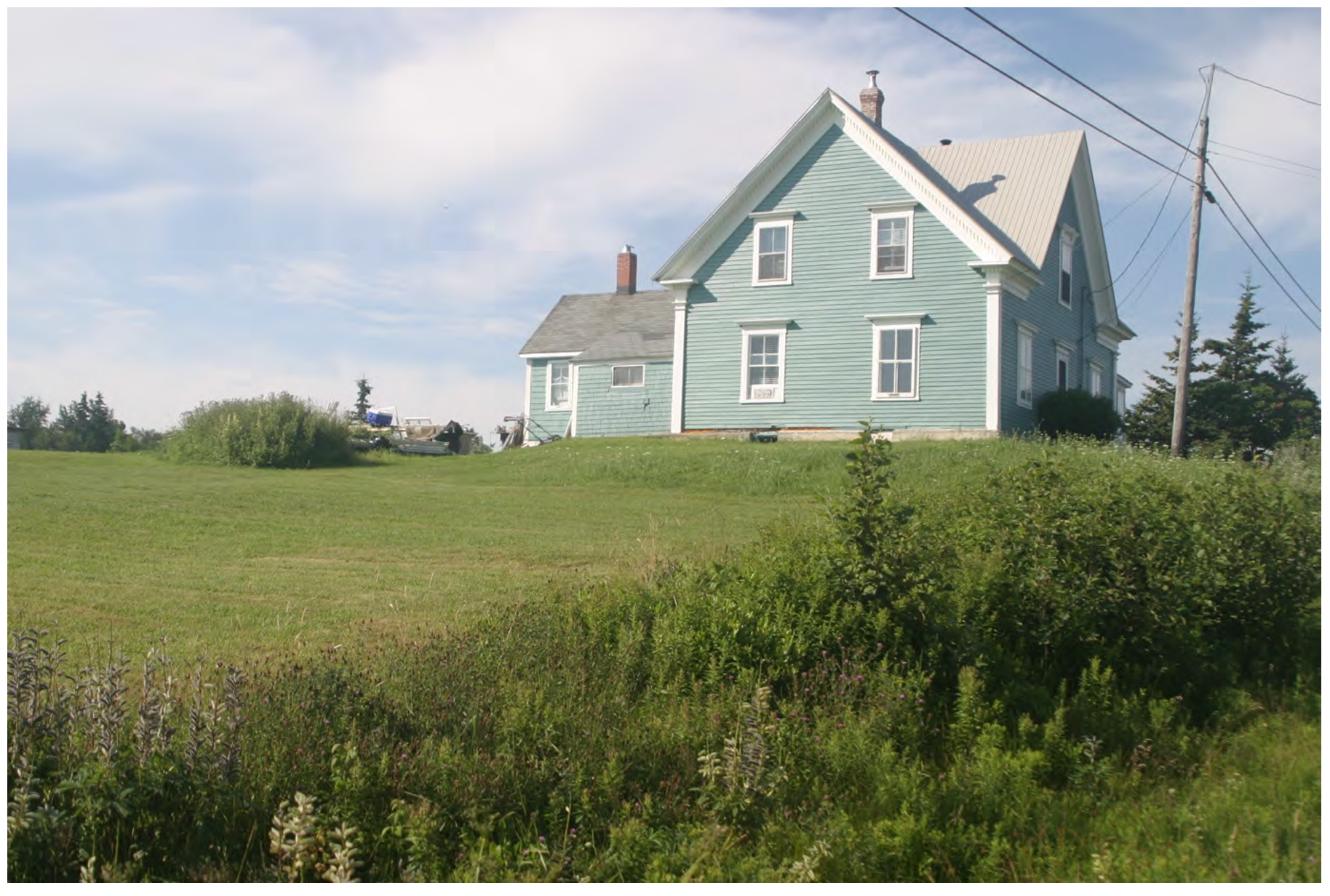
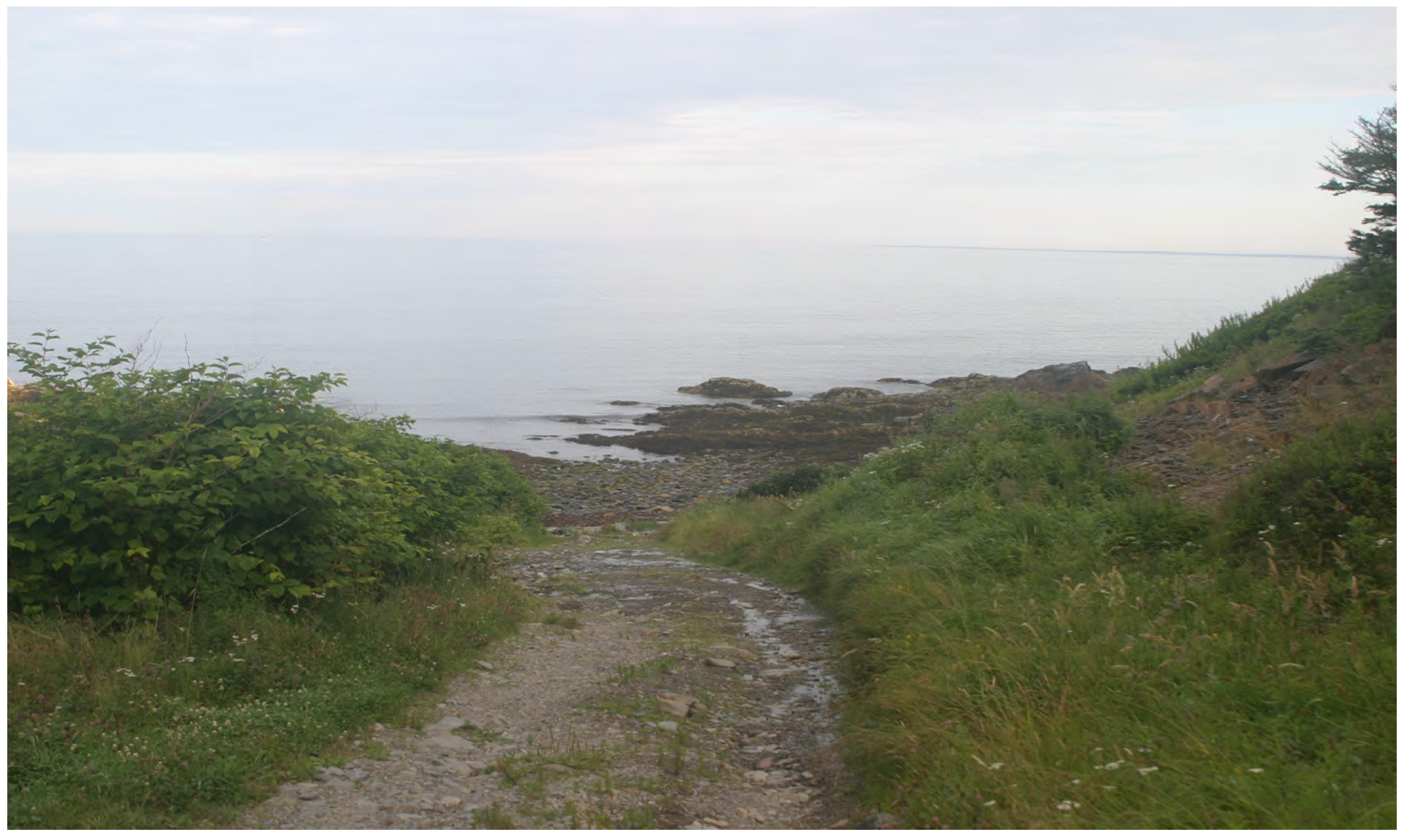
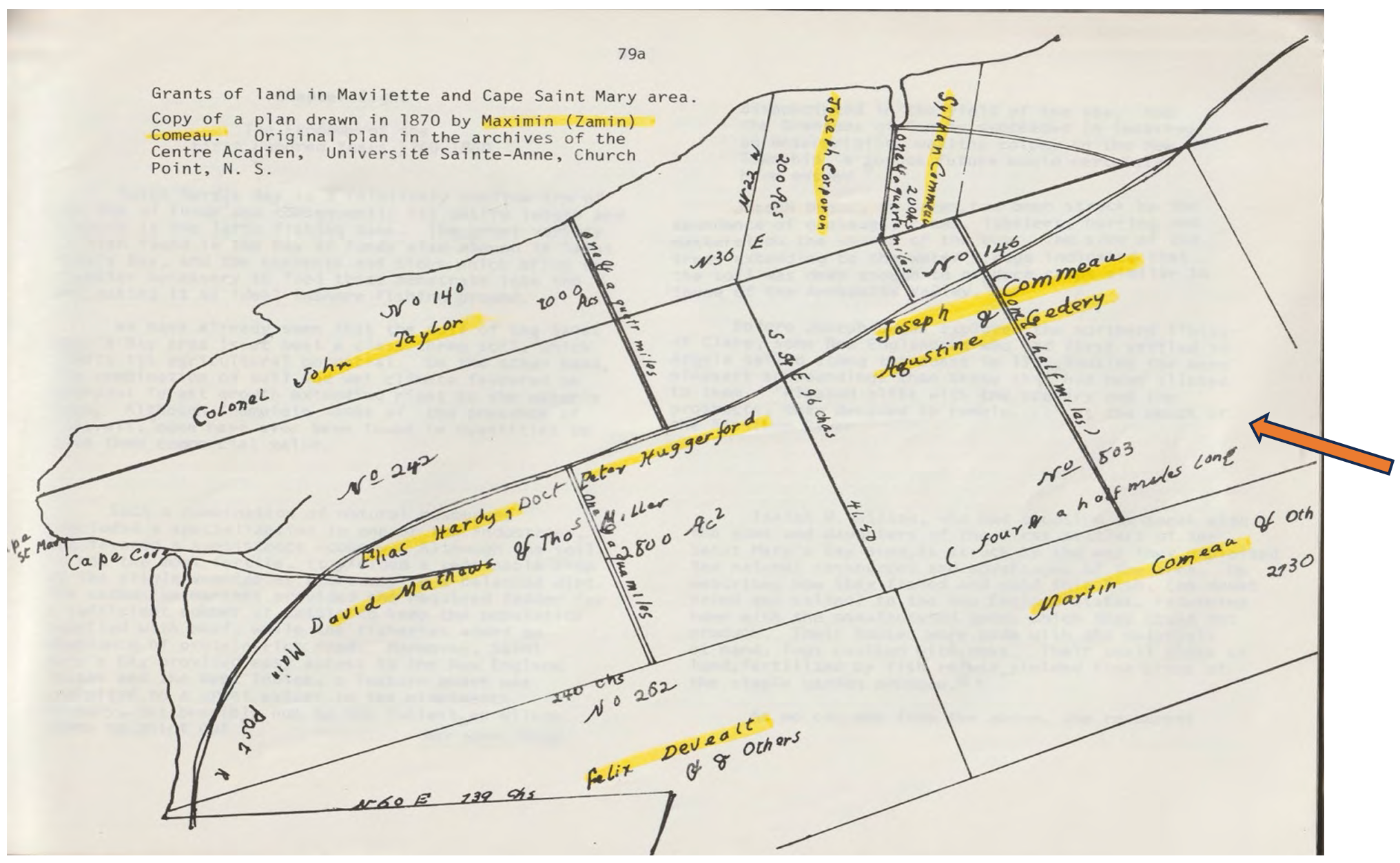
While living at Chéticamp, Augustin and Marie-Françoise had three more children for a total of 13 offspring: Fréderic (b. ca. 1790), Isabelle and Jean (b. ca. 1792; bapt. 25 Aug 1799). 22
Hermat-Pierre Guédry (b. Dec 1767) married Marie-Anne Belliveau, daughter of Joseph Jacques Belliveau and Marguerite Robicheau in a civil ceremony at Baie Sainte-Marie ca. 1795 and had their marriage rehabilitated on 19 January 1800 at Baie Sainte-Marie by Père Jean-Mandé Sigogne. 16 , 22 Hermat-Pierre and Marie-Anne had 10 children from 1796 until 1819 and most, if not all, remained in the Chéticamp (St. Alphonse) area. 19 , 20 They are the progenitors of many of the Geddry, Gedry, Jeddry, Jedry, Guidry and Gidry families of Meteghan and St. Alphonse today. Hermat-Pierre and his brother Philippe along with several other Acadians acquired a 2700-acre grant about 1.5 miles inland from the main highway. This grant comprised part of Bear Cove and Chéticamp. 13 , 21
Joseph-Félix Guédry (b. ca. 1769) married Génévieve Devault (b. 18 Sep 1806), the daughter of Félix Devault and Marie Dousset. 20 They had three children between 1826 and 1832 at Baie Sainte-Marie. 19 , 20
Augustin Guédry fils (b. 20 Jun 1771) married Marie Rebecca Eagle (b. ca. 1776; bapt. 11 Aug 1799 after abjuring Protestantism) 16 , 22 , daughter of Edward Eagle and Catherine Eagle of Georgia. 16 , 22 The marriage occurred shortly before 12 August 1799. 16 , 22 In 1802 Augustin Guédry fils of Clare purchased Lot No. 62 of 200 acres near the border of Plympton and Gilbert's Cove for 50 pounds. He purchased the lot from James Boutineau Franklin, the original grantee. 15 , 23 , 24 This was the same property on which Augustin Guédry, fils' father had settled about 1770. Augustin Guédry, fils (Guiddery) died 9 March 1833 at the age of 64. 15 , 23 That same year William Hobbs of Argyle purchased this property from Marie Rebecca Guédry (Guiddery) for 500 pounds. William Hobbs married Marie Rebecca Guédry of Baie Sainte-Marie in 1833. He was 20 years old (b. 1813) and she was 57 years old (b. ca. 1776). It is not known if Augustin Guédry fils actually moved to Gilbert's Cove to live or not. In 1838 William Hobbs petitioned the Assembly for aid in constructing his oat mill which he built on Hobbs' or Melancon's Brook at the west end of the Plympton section and northern side of the post road. 15 , 23 , 24
Théotiste Guédry married Jean-Baptiste Saulnier, son of Pierre Saulnier and Magdelaine Boudreau, at Baie Sainte-Marie in a civil ceremony on 9 January 1798 and the marriage was rehabilitated on 20 January 1800 by Père Jean-Mandé Sigogne. 16 , 22 They had 12 children between 1798 and 1822. 19 , 20
Marguerite Guédry (Guiddery) married Charles J. LeBlanc before 1806 and had 9 children between 1806 and 1827. 19 , 20
Philippe Guédry (b. ca. 1783) married Angélique Theriau about 1803. Between 1804 and 1827 they had at least 14 children. 19 , 20 Philippe Guédry died on 3 March 1830 in the St. Alphonse/Meteghan area. 28 His widow Angélique Theriau died on 5 March 1864 in the St. Alphonse/Meteghan area. 28 Brothers Hermat-Pierre Gueedry and Philippe Guédry are the progenitors of most of the Guédry (Jeddry, Geddry, Jedry, Gedry, Gidry, Guidry) family in Digby County. Philippe's home still exists along Highway 1 just north of St. Alphonse at 7051 Highway 1. It has been modified some since built, but the "bones" of the house are original.
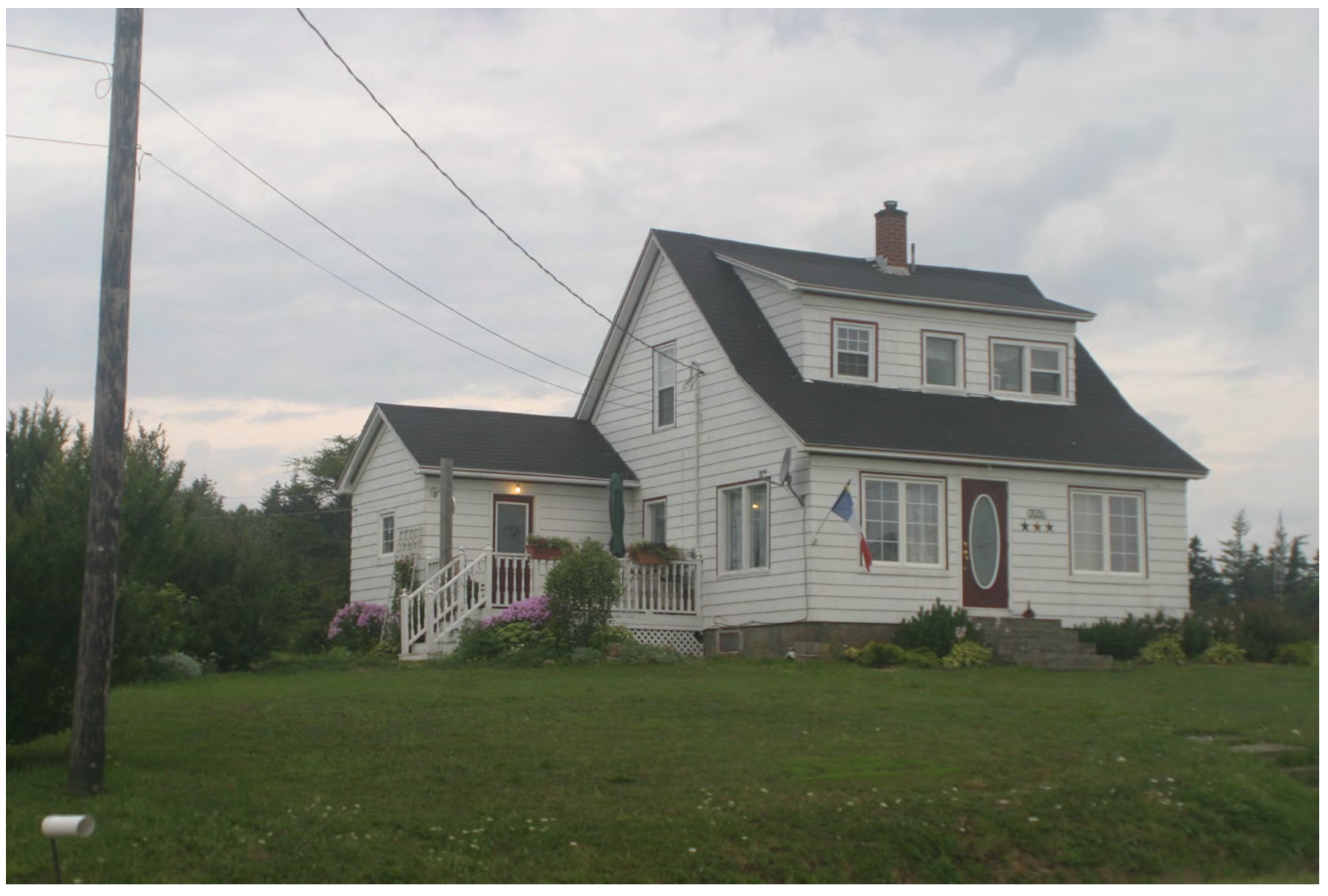
In 1965 Mr. Bernard Geddry, a direct descendent of Philippe Guédry, crawled under the house and observed the old tool marks on some of the beams. 6
Romain Guédry (b. ca. 1784) married Marie Comeau (b. ca. 1778) around 1804 in the Baie Sainte-Marie area. 19 They had seven children between 1805 and 1820. Between 1817 and 1820 Romain and his family moved from Baie Sainte-Marie north to Bonaventure County on the Gaspé peninsula of Québec Province - just north of Campbellton, New Brunswick. 19 , 29 By 1829 Romain and most of his family had relocated to Grand Isle Plantation near Madawaska, New Brunswick. Today the village of Grand Isle is in Aroostook County, Maine on the Saint John River. Romain was called Romain Guédry dit Grivois and over time his name changed to Romain Grivois. Descendants of Roman Guédry and Marie Comeau in the Grand Isle area use the surname Grivois today. Romain Guédry died on 4 March 1846 at or near the Grand Isle, Maine. 30
Marie-Josephe Guédry married Jean-Baptiste Thériau, son of Aléxis Theriau, around 1808. They had ten children between 1809 and 1829. 19 Marie-Josephe died in 1829 - probably in childbirth with Pierre Ignace Thériau (b. 31 Jan 1829) as by late 1829 Jean-Baptiste Thériau had remarried to Angélique Robichau by whom he had eight children between 1830 and 1842. 20
Frederic Guédry (b. ca. 1790) married Marguerite Devault, daughter of François Devault and Cecile Mius, about 1810 at Baie Sainte-Marie. 19 , 20 They had one daughter together in 1811. 19
Isabelle Guédry married Augustin Thériau ca. 1811 at Baie Sainte-Marie. They had 12 children between 1812 and ca. 1830. 19 , 20
Jean Guédry (b. ca. 1793; bapt. 25 Aug 1799 at age about seven) 22 married Rosalie Clothilde Robicheau (b. 14 Mar 1798; bapt. 8 Jun 1800) 22 , daughter of Charles Jean Baptiste Robicheau and Marguerite Saulnier, in 1824. 19 , 20 They had four children between 1825 and 1835. 19 , 20
Augustin Guédry, husband of Marie-Françoise Jeanson and founder of Chéticamp, died in 1825 near Chéticamp. 19 , 28 , 31 Marie Françoise Jeanson died about 1826. 19 , 28 Augustin farmed to support his family. 31
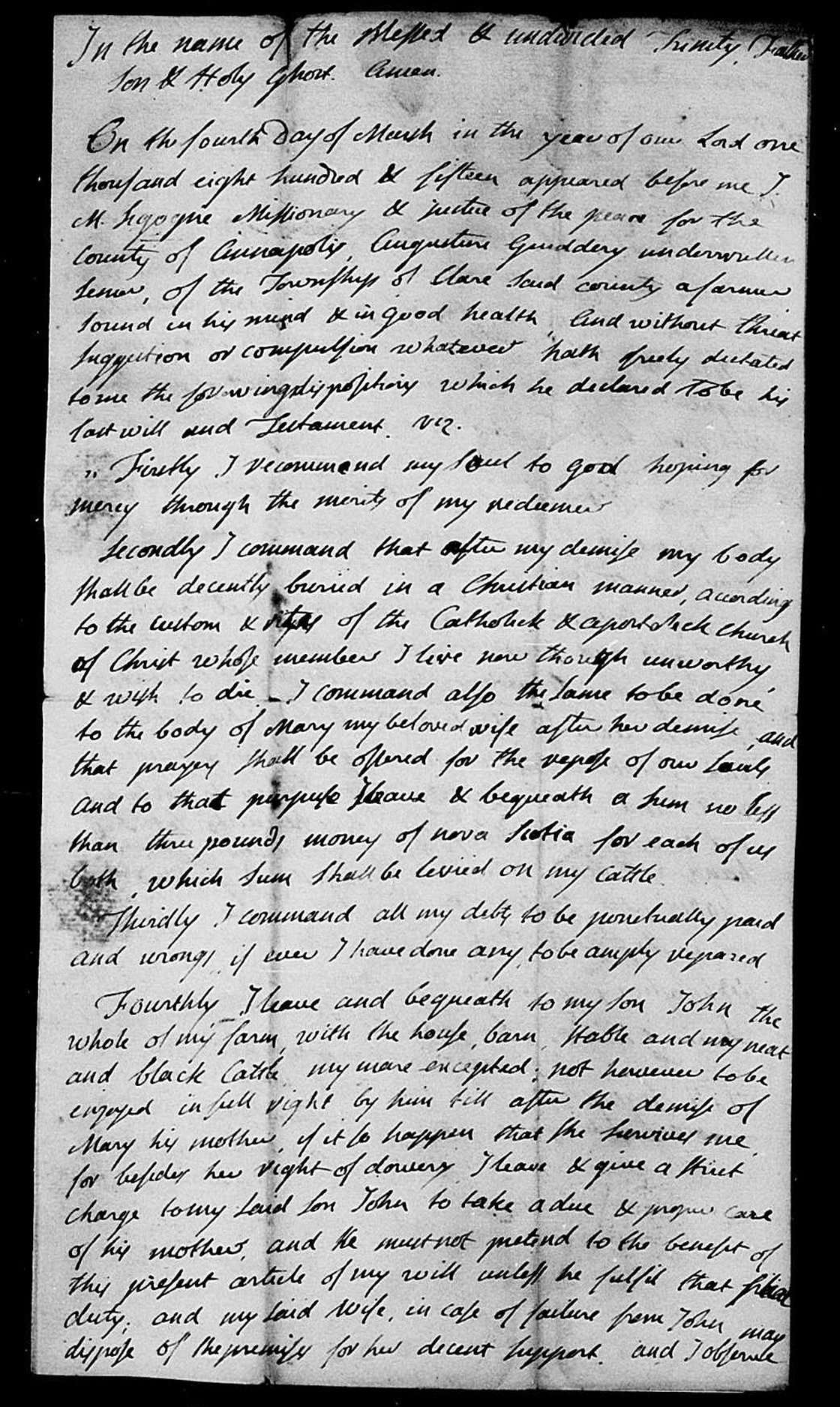
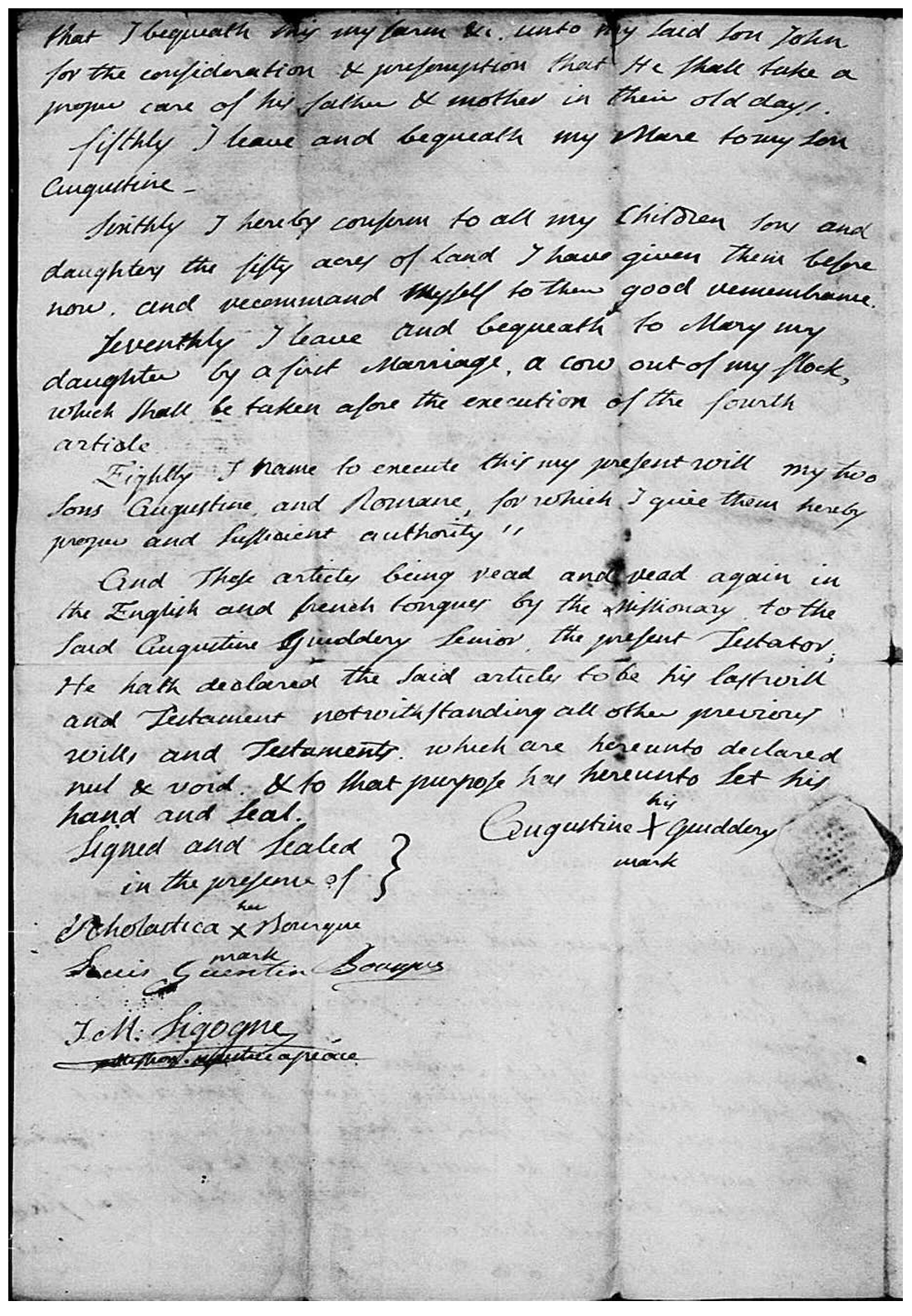
On 4 March 1815 Augustin Guédry had Père Jean-Mandé Sigogne record his Last Will and Testament which was proved in probate court on 21 July 1825 for which an inventory was filed on 13 December 1825. His executors were his sons Augustin Guédry fils and Romain Guédry. The will mentioned his wife Marie Jeanson. As was the Acadian custom at the time, Augustin left his farm, buildings and cattle to his son Jean (John) with the provision that Jean care for Augustin and his wife Mary (Marie Jeanson) for the rest of their natural lives. His son Augustin received his mare and all of his children divided his 50 acres of land equally. Interestingly, he mentioned in the will his daughter Mary by his first wife who received a cow. Besides his farmhouse, barn, stable and cattle, his estate was small. 31
It is rare to find an interesting "picture" of an average person in the early 1800s; however, a wonderful description of Augustin Guédry dit Grivois exists. In 1809 François Lambert Bourneuf, a French sailor, was captured by the English, brought to Halifax and imprisoned. He eventually escaped to Pubnico and later settled in the Baie Sainte-Marie area. In 1813 he journeyed from Pubnico to Church Point to meet Père Jean-Mandé Signogne. He kept a journal and as he reached the Salmon River he wrote:
The first day, I reached Beaver River. I slept there and the next morning, I had breakfast at Archange Deveau's. after breakfast, I started to cross the Salmon River, but Jacques Deveau ran after me and told me that it was impossible to cross the river before the tide was out. He took me to his home to await low tide. I had dinner there, and I left about one-thirty in the afternoon.
In Pubnico, I had been told to watch out for a man named Antoine Grivois(1), as he had instigated the arrest of two French prisoners. But the very first person I met was Grivois.
As I passed his house, he saw me, then saddled his black horse and galloped to catch up to me. He asked me all kinds of questions - his tongue never stopped - and he was ugly as sin. He accompanied me as far as Meteghan, where there was a man who owned a store that sold all sorts of merchandise, including liquor, though he did not have a license. I entered the store and asked the proprietor, Mr. Sullivan, for a glass of rum. He said that he did not have any to sell. When I told Grivois what had happened, he said that if I had let him ask for it, he would have obtained some.
It was one hour before sunset. Grivois went into the store to have a drink, and I continued up the bay. Then Grivois rejoined me. When we arrived at the house of old Justinien Comeau, Grivois said, "There is in this house a smart woman, but the man is an ox." We covered two miles together, then Grivois took a side road, to go to one of his sons-in-law, Jean-Baptiste Thériault (2). Before he departed, I asked him where the nearest inn was. He told me there was one three miles away, at Major Comeau's. 6 , 13 , 27
- Antoine Grivois was Augustin Guédry dit Grivois, the founder of Chéticamp (St. Alphonse de Clare), and husband of Marie-Françoise Jeanson
- Jean-Baptiste Thériault married Marie-Josephe Guédry, the daughter of Augustin Guédry dit Grivois and Marie-Françoise Jeanson
Evidence for Marriage of Augustin Guédry and Anne-Marie Comeau
Although only one definitive primary source has been located confirming the marriage of Augustin Guédry and Anne-Marie Comeau about 1763-1764 31 , significant circumstantial evidence of this marriage does exist.
In the Census of Port-Royal in 1763, François Comeau and his wife had two children with them - could these two children have been their widowed daughter Anne-Marie and their young grandson Jean Saulnier. 9 Also, in this 1763 Census of Port-Royal Augustin Guédry, was a single man. 9 In 1768 Augustin Guédry (written as Augn Grivoir) was one of 57 Acadians willing to take the Oath of Allegiance at Pisiguit. With him at this time were one woman, two boys and one girl. 11 The woman would have been his second wife Marie- Françoise Jeanson 12 whom he married in a civil ceremony about 1767 and one of the boys would have been their son Hermat-Pierre Guédry (born in December 1767) 12 . Possibly the other boy was Augustin's stepson Jean Saulnier (born 8 February 1756 according to Placide Gaudet) 10 and the girl likely was Marie Guédry, Augustin's daughter with Anne-Marie Comeau. 10
When Augustin Guédry received a land grant of 1600 acres in the Clare Municipality of Nova Scotia near present-day Saint-Alphonse, he received the grant with his brother-in-law Joseph Comeau, the brother of Anne-Marie Comeau. 10 , 13
According to Placide Gaudet, Augustin Guédry and Anne-Marie Comeau had a daughter Marie who died an old woman at Baie Sainte-Marie. 10 Marie would have been born shortly after 1763.
On 26 April 1801 Père Jean-Mandé Sigogne baptized Anne Saulnier, daughter of Jean Saulnier and Marie Saulnier at Baie Sainte-Marie. Jean Saulnier was the son of Jean Saulnier and Anne-Marie Comeau, who later married Augustin Guédry. Anne Saulnier had been baptized earlier (ondoyé) by François Comeau, her great-grandfather and the grandfather of Anne's father Jean Saulnier. Her parrain was Dominique Saulnier, the brother of Anne, and her marraine was Marie Giddery (Guédry), aunt of Anne. 22 Jean Saulnier, the father of Anne Saulnier, was the half-brother of Marie Giddery since the mother of both was Anne-Marie Comeau. Marie Giddery was the daughter of Augustin Guédry and Anne-Marie Comeau.
In other early registers of St. Mary's Bay Roman Catholic Church, we find Marie Guédry (called Marie Guiddery) listed several times. In one listing for the period 1818-1823 Marie Guiddery was shown as 49 years old and single. A second listing in the 1818-1823 period she was one of the "vagantes" (vagabonds) who was 54 years old, born in 1764 and single. In the 1823-1829 period Marie Guiddery again was one of the "vagantes". She was 59 years old and single. 19 During the 1840-1844 period Marie Guiddery, a "vagantes", was around 72 years old and a spinster. 20
On 4 March 1815 Augustin Guédry had Père Jean-Mandé Sigogne record his Last Will and Testament which was proved in probate court on 21 July 1825 and for which an inventory filed on 13 December 1825. His executors were his sons Augustin Guédry fils and Romain Guédry. In the will Augustin mentioned "Mary my daughter by a first marriage" to whom he left a cow. 31
References
- Census of Ile Royale and Ile Saint-Jean in 1752 ["Voyage fait par le Sr de la Roque du Roy ... Cinq Fevrier 1752 - Recensement Général des habitants de la ville de Louisbourg, de Barachois et fond de la Baye, de tous les Ports, havres, Rivières et profoundeurs des terres de l'Isle Royale et de l'Isle Saint-Jean"] (Archives Nationales (France); Archives Nationales d'Outre-Mer (ANOM); 29, Chemin du Moulon de Testa; Aix-en-Province, France; Archives des Colonies, G1, 466, Nos. 77 & 81)
- Gaudet, Placide; Report Concerning Canadian Archives for the Year 1905 in Three Volumes - Volume II (Sessional Paper No. 18) (S. E. Dawson, Printer to the King's Most Excellent Majesty; Ottawa, Canada; 1906) Volume II, Appendix A, Part I, p. 40
- Rieder, Milton P., Jr. & Rieder, Norma Gaudet; The Acadians in France, Volume III - Archives of the Port of Saint Servan (Privately Published; Metairie, LA; 1973) pp. 44, 47, 53, 85
- Rieder, Milton P., Jr. & Rieder, Norma Gaudet; The Acadians in France, Volume I - Rolls of the Acadians Living in France Distributed by Towns for the Years 1762 to 1776 (Privately Published; Metairie, LA; 1967) pp. 15, 20, 62, 104
- Robichaux, Albert J., Jr.; The Acadian Exiles in Nantes, 1775-1785 (Privately Published; Harvey, LA; 1978) p. 179
- Geddry, Bernard L.; The Story of An Acadian Family 2 - The Geddrys, Guidrys, Gedrys, Gedrees, Guedrys, Gueldrys, Jeddrys and Labines, etc. (Privately Published; 2019) pp. 68-80, 99-100, 104-112, 205
- LeBlanc, Ronnie-Gilles (author) and DeRoche, John Estano (translator); "The Acadian Refugee Camp on the Miramichi, 1756-1761 with Appendix" (Online article) p. 12 of Appendix (Last accessed on 15 October 2024) https://acadiens-metis-souriquois.ca/uploads/3/4/5/0/34506400/acadian_refugee_camp_on_the_miramichi_1756-1761.pdf (Article) https://acadiens-metis-souriquois.ca/uploads/3/4/5/0/34506400/acadian_households_at_camp_espérance_on_the_miramichi_in_winter_1756-1757.pdf (Appendix)
- Email; Ronnie-Gilles LeBlanc to R. Martin Guidry, 16 January 2018
- Census of Port-Royal in 1763 ["Liste generalle des habitans acadiens contenant Les chefs de Famille, Les Femmes et Les Enfants"] (Archives Nationales (France); Archives Nationales d'Outre-Mer (ANOM); 29, Chemin du Moulon de Testa; Aix-en-Province, France; Archives des Colonies, G1, 466, No. 34)
- "Fonds Placide Gaudet" (Library and Archives Canada; Heritage Canadiana; MG 30 C20; Microfilm C-2238, items 1092-1 & 1092-2, images 1436-1437) (Last accessed on 16 October 2024) https://heritage.canadiana.ca/view/oocihm.lac_mikan_99141
- Brun, Régis Sygefroy; "Prisonniers acadiens du fort Edward, N.-E., 1763, 1764, et Pétitions des Acadiens de cette region, avec les listes des signataires, 1764-1768 (Papiers Deschamps)" ( La Société Historique Acadienne ; Moncton, New Brunswick; 25ième Cahier; Volume III, No. 5; October-December 1969) pp. 191-192
- White, Stephen A.; Registre de L'Abbé Charles-François Bailly 1768 à 1773 (Caraquet) (Centre d'Études Acadiennes, Université de Moncton; Moncton, New Brunswick; 1978) pp. 8, 12-13, 32, 57
- Deveau, J. Alphonse; Along the Shores of Saint Mary's Bay - The Story of a Unique Community, Volume I The First Hundred Years (Université Sainte-Anne; Church Point, Nova Scotia; 1977) pp. 40, 66, 73, 79a, 105, 118, 150-152
- Wilson, Isaiah W.; A Geography and History of the County of Digby Nova Scotia (Mika Studio; Belleville, Ontario; 1972) pp. 28, 43, 98
- Personal Communication (E-Mail); Derek Thurber of Heritage Digby to R. Martin Guidry; 27 June 2001, 28 June 2001, 3 July 2001, 7 July 2001 and 9 July 2001
- Smith, Leonard H., Jr.; St. Mary's Bay 1774-1801 - Early Parish Registers (Owl Books; Clearwater, Florida; 1983) pp. 7, 10, 18, 31, 34, 42
- Department of Lands and Forest; Nova Scotia Book 20, p. 64 or Lib 5, Folio 276
- Deveau, J. Alphonse; Clare ou La Ville Française - Tome 1, Les Premiers Cent Ans (J. A. Deveau; Salmon River, Nova Scotia; c. 1980) pp. 68-69
- Smith, Leonard A., Jr.; St. Mary's Bay, 1818-1829- Catalogue of Families, St. Mary's Bay Roman Catholic Parish, Clare, Digby County, Nova Scotia; Compiled by Father Jean-Mandé Sigogne (Privately Published, Clearwater, Florida; 1974) pp. 3, 13, 19, 20-21, 23-24, 33-35, 41, 83-85, 95-97, 106, 113
- Smith, Leonard A., Jr.; St. Mary's Bay, 1840-1844- Catalogue of Families, St. Mary's Bay Roman Catholic Parish, Clare, Digby County, Nova Scotia; Compiled by Father Jean-Mandé Sigogne (Privately Published, Clearwater, Florida; 1975) pp. 36, 53, 61-62, 66, 69, 83, 96-97, 101, 109, 117, 119-120
- Department of Lands and Forest; Nova Scotia Book F, p. 14 or Lib 8, Folio 107
- Jehn, Janet B.; Baie Ste. Marie Parish Registres 1799-1801 (Privately Published; Covington, Kentucky; 1985) pp. 1, 14, 18, 23, 36, 42-43, 48-49, 54, 60
- Registry of Deeds Office; Weymouth; 1785-1910; Registry of Deeds, Land Registration Office; 4451 #1 Highway; Weymouth, Digby County, Nova Scotia B0W 3T0 - Book 3A Page 76
- Municipality of the District of Digby Historic Property Database; Digby, Digby County, Nova Scotia (Municipal Building at 12548 Highway 217)
- Archives Nationales du Québec - Centre d'archives du Bas St-Laurent et de la Gaspésie- Iles-de-la-Madeleine; 337 rue Moreault; Rimouski; Bonaventure County, Québec, Canada G5L 1P4; Saint-Joseph-de-Carleton Catholic Church (1777 Registre, 39th folio, Carleton, St-Joseph Paroisse, Co. Bonaventure, Québec; 1881 Registre, 15th folio, Carleton, St-Joseph Paroisse, Co. Bonaventure, Québec)
- Saint-Joseph-de-Carleton Catholic Church; 767 Boulevard Perron; Carleton; Bonaventure County, Québec, Canada G0C 1J0 (v. 1 p. 39[B])
- Deveau, J. Alphonse (editor); Diary of a Frenchman - François Lambert Bourneuf's Adventures from France to Acadia, 1787-1871 (Nimbus Publishing Limited; Halifax, Nova Scotia; 1990) pp. 79-80
- Tourist Committee of the Clare Board of Trade; Clare, Nova Scotia; Clare, Nouvelle Ecosse - Chez Les Acadiens (R. H. Davis & Co., Ltd; Yarmouth, Nova Scotia; 2004) pp. 56, 84, 89-90
- Saint-Joseph-de-Carleton Catholic Church (Archives Nationales de Québec - Centre d'archives du Bas St-Laurent et de la Gaspésie-Iles-de-la-Madeleine; 337 Rue Moreault; Rimouski; Bonaventure County, Québec) Baptism 25 (1790-1821; folio 185 of 1820) & Funeral 25 (1790-1821, folio 186 of 1820); Carleton, Saint-Joseph-de-Carleton Catholic Church, Bonaventure County, Québec, Canada; pp. 471-472 of 512
- St. Bruno Catholic Church (Van Buren; Aroostook County, Maine; 1838-1900; Maine State Archives - Cultural Building; 84 State House Station / 230 State Street; Augusta, Maine) Burial 10 (1838-1900; Folio 163 of 1846; Van Buren; St. Bruno Catholic Church; Aroostook County, Maine) p. 111 of 632
- "Last Will and Testament of Augustus Guiddery Senior Dated 4 March 1815, Proved in Probate Court on 21 July 1825 by Executors, His Sons, Augustine And Romane Guiddery. Will Written in English by J. M. Sigogne, Missionary"; Digby County Probate Estate Folios, Estate File A79 (21 July 1825) and File A86 (13 December 1825). Will transcribed in Probate Will Book 1, Page 58 and the original is in File A79. Available online at FamilySearch.org.