Charles Guidry dit Labine - Voyageur
I am the Great Great Great Great Grandson of Jean Charles Guidry dit Labine (hereinafter referred to as Charles Guidry dit Labine). Charles lived in St. Jacques Quebec, which is located just to the northeast of Montreal. He was born in Boston, Massachusetts in the year 1760 to Jean Augustin Baptiste Guidry dit Labine dit Labrador and Marguerite Picotte. His father had been deported from Acadia in the year 1755 and ended up as a refugee in Boston, Mass. Jean’s first wife, Helen Benoit, died sometime after 1753 (probably during the deportation) and Jean and Charles’s mother Marguerite Picotte began living together in Boston in a common law marriage and began having children. They were not married in Boston because there was no Catholic Priest there. They had their common law marriage blessed in L’Assomption, Quebec in 1766 after they arrived there as refugees. It was at that time that the baptism of Jean Charles Guidry dit Labine was also validated.
Charles grew up in a farm located near a small parish called St. Jacques L’Achigan. His father had purchased the land in 1767 after spending the winter at the church in L’Assomption, Quebec. Since his parents were Acadian refugees, it cannot be expected that Jean Charles’s family had much wealth. It was probably important that he find a way to earn his way as soon as possible. Fortunately, for those willing and strong enough, there were good cash paying jobs available at that time working in the fur trade industry as Voyageurs.
Family chart showing lineage of Jean Charles Guidry dit Labine and Mark Labine, the author of this story.
Bernard Bugaret | ||||
| Parents of Claude Guidry Unknown | | Claude Petitpas m. Catherine Bugaret | | |||
| Claude Guidry dit Laverdure b.1648 m. Marguerite Petitpas | | ||||
Pierre Guidry dit Labine b. 1698 | ||||
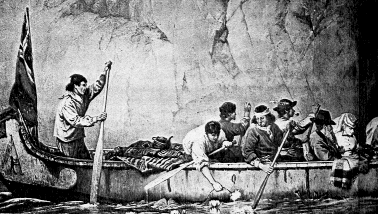
Voyageurs were the crews hired to man the canoes that carried trade goods and supplies to "rendezvous posts" (example: Grand Portage) where goods and supplies were exchanged for furs.
The fur trade was big business in New France and there was much money to be made in it. In early years the fur trade business was wide open and many early settlers risked the perils of traveling through Indian country to seek out Native trappers to trade with. These coureurs des bois were not looked upon favourably by Montreal authorities or royal officials. By 1681, the French authorities realized the traders had to be controlled so that the industry might remain profitable. There were simply too many coureurs des bois and the fur supply was flooding the market. They therefore legitimized and limited the numbers of coureurs des bois by establishing a system that used permits ( congés ). This legitimization created a "second-generation" coureur des bois: the voyageur, which literally means "traveller". This name change came as a result of a need for the legitimate fur traders to distance themselves from the unlicensed ones. Voyageurs therefore, held a permit or were allied with a Montreal merchant who had one.
Over time, Voyageurs came to be known as those men who did the hard labor required to trade furs. The voyageurs were highly valued employees of trading companies, such as the North West Company (NWC) and the Hudson's Bay Company (HBC). In 1779, Charles Guidry dit Labine signed on to work for the North West Company. We also know that at least three of Charles’ brothers signed Voyageur contracts and were hired to work for the Northwest Company.
Today, the voyageurs are legendary, especially in French Canada and also in Minnesota. They are folk heroes celebrated in folklore and music. The reality of their lives was that being a Voyageur was hard work. For example, they had to be able to carry two 90 pound bundles of fur over portages. More suffered from strangulated hernias than any other injury.
Voyageurs who only paddled between Montreal and Grand Portage were known as "mangeurs de lard" (pork eaters) because of their diet, much of which consisted of salt pork. This is considered to be a derogatory term. Those who overwintered and ate "off the land" (mainly fish, pemmican and Rubaboo) were called "hommes du nord" (northern men) or "hivernants" (winterers).
Voyageurs were expected to work 14 hours per day and paddle at a rate of 55 strokes per minute. Few could swim. Many drowned in rapids or in storms while crossing lakes 2 . Portages and routes were often indicated by lob trees, or trees that had their branches cut off just below the top of the tree.
Copies of Charles Guidry and his three brother’s contracts or “engagements” are in the Quebec Archives reports for the years 1943-44 and 1946-47. I have a copy of a Voyageur contract signed by Charles Guidry dit Labine on April 20, 1779, on St. Paul Street in old Montreal, right behind the Notre Dame Cathedral. This contract provided that Charles Guidry would go by canoe to Michilimackinac and Lake Superior to secure furs for the Northwest Company. The literal translation of the “engagement” was as follows:
"Before the Notary of the town and District of Montreal, in the province of tower Canada, there resident, the undersigned, Charles Guidry, of the parish of St., Jacques, who of his own free will has engaged and engages himself by these present to Messrs. McTavish and Frobisher, to this agreeing and accepting, at their first command to leave this town in the position of voyageur mileau in one of their canoes to make the voyage, as much going up to Michilimackinac as for coming down, to go and come and to take good and due care during the voyage, and in the said place of the Merchandise, Edibles, Furs, Utensils and of all the things necessary for the trip; to serve, obey and execute faithfully all that the said McTavish and Frobisher or any of their agents may command that is lawful and honest; to make their profit, avoid damage to them, warn them of it if it comes to his knowledge, and generally all that a good "engage" must and is obliged to perform; without being able to make any private agreement, neither to absent himself from or to quit the said service, under the penalties imposed by the law, and to lose his wages. This Engagement thus made, for and providing the sum of two hundred and forty livre or old shillings of this province, which they promise themselves to give and pay to the said "engage" one month after his return to this town, and on his departure a simple ordinary kit. Charles Guidry recognizes that he has received in advance on account of the said wages four piastres. 3 "
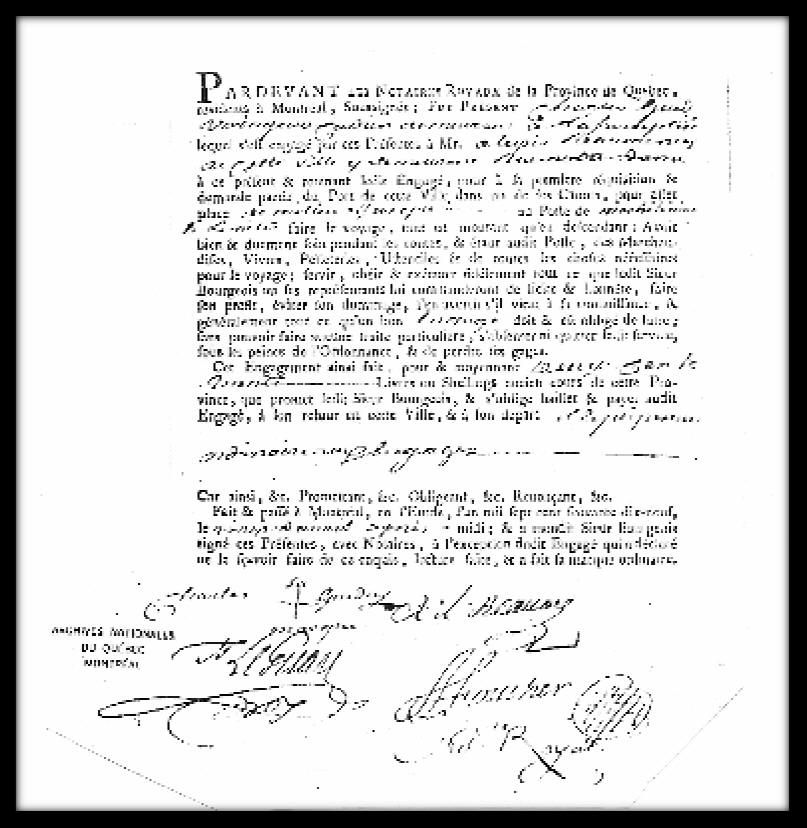
There are several interesting things to note about the Voyageur contract signed by Charles Guidry dit Labine in 1779.
• First - he was only 19 years old.
• Second - the contract is filed under the name “Guidry” and not “Labine”. The family of Jean Baptiste continued to use the name Guidry or Guildry in their formal legal documents until at least 1879. The church records use the name Guildry in the entries I have read rather than Guidry. My Great Grandfather Modeste Labine signed a Mortgage in 1870 using the signature “Modeste Guildry”. Sometime after that the name Guidry disappears and only Labine is used. It appears from these records that the family was called Labine but they used Guidry or Guildry on their legal documents.
• Third - Charles could not sign his name and simply left an X where his signature would have been.
• Fourth - Charles was signed up to be a Voyageur Mileau or a middle canoeman and paid 240 livres. The more experienced Voyageurs were in the front and back of the canoe, with the middle men less experienced. More experienced Voyageurs would be paid 400 livres or even more.
• Fifth - Charles got paid 240 livres or old shillings (shilling ancient) for his work. According to Wikopedia, livres were printed and used by the French Republic until 1794. In 1795 the Franc was introduced and livres were not longer printed or made. This same article says that in 1795 the Livre was worth about 4 dollars American or 2.5 pounds English. Webster’s New World Dictionary says that the Livre at the time it was discontinued in 1795 was worth about the same as an English pound. There is a website called www.measuringworth.com which provides a table to try to measure the worth of money between different time periods. According to this website’s calculator, 240 livres or old shillings in 1779 would be worth $15,078.00 pounds in 2007 using the average earnings index. Other calculators I used show the earnings to be even higher. Trying to equate the actual value of money in 1779 compared to today is difficult but I believe it is a fair statement to say that the amount of money earned by Charles Guidry dit Labine as a Voyageur was a good wage and it must have been a sought after job by young French Canadian men in the province at the time.
• Sixth - The Voyageur contracts are said to number around 35,000. The University of Ottowa is setting up a database that will consolidate the information found in more than 35,000 notarized contracts signed by the voyageurs between 1755 and 1870 in the Montréal-Trois-Rivières corridor. Copies of these contracts are also available in the Quebec Archives.
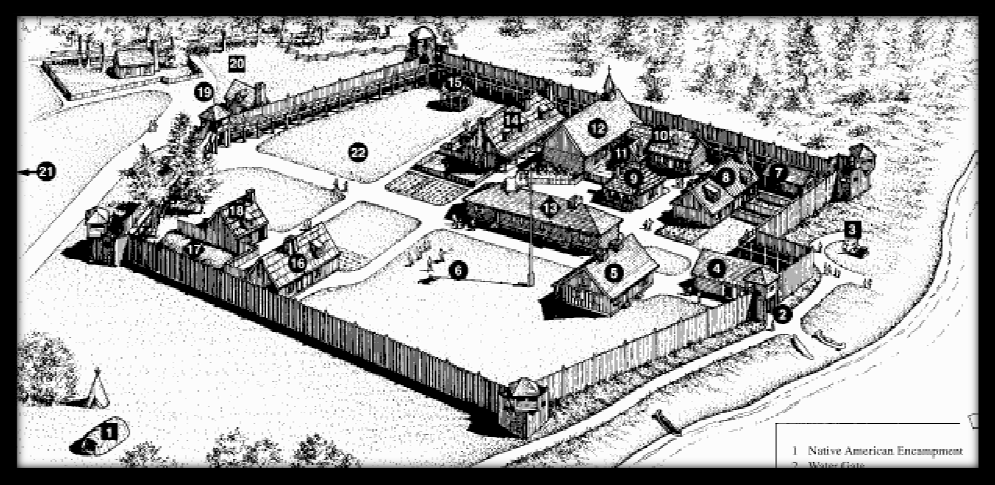
Charles signed a contract to take a canoe from Montreal to Fort Michilimackinac and back. These canoes would depart in April or May from above Lachine Rapids in Montreal and paddle up the St. Lawrence River to the Ottawa River, up the Ottawa River to the Mattawa River, through Lake Nippissing, down the French River to Lake Huron, around Lake Huron to Sault St. Marie and then either on through Lake Superior to Fort William in Thunder Bay or down to Fort Michilimackinac. At Fort William in mid July there would be a rendezvous where the furs from the interior would be exchanged for the goods being brought from Montreal. The "mangeurs de lard" or summer Voyageurs would then head back to Montreal with the furs and the "hivernants" would take the goods and head back into the interior.
We don't know how long Charles was a voyageur, although we know he eventually settled down on his Father's farm in St. Jacques. He married Marie Doucet in 1783 at the age of 22 and began his family shortly thereafter, so it would be a good guess that he was a voyageur for only a few years.
Charles’s older brothers Joseph and Mathurin or Marin also signed voyageur contracts with the Northwest Company. Joseph (b.1759) signed a contract on May 14, 1779. Joseph bought lot number 318 from Germain Landry in 1780 and he raised his family in St. Jacques so I assume he was not a Voyageur long. Marin (his mother was Helen Benoit) was a Voyageur until 1784 when he drowned at the rapids of Lachine near Montreal. These rapids were long and dangerous and at times were deadly.

Olivier (b.1765) and Jean Baptiste Jr. (b.1768) appear to have been voyageurs for a longer period. It is believed Olivier was a voyageur until he was in his late twenties. He married when he was 28 years old in the year 1793 and settled down in Louisiana. On his birth certificate his father is listed as Augustin Guidry from Canada. I believe this refers to Jean Baptiste Guidry dit Labrador dit Labine. When Jean Baptiste’s son Joseph married in Quebec in 1783 Jean Baptiste is shown with the middle name Augustin. It is said that Olivier made the trip from Montreal to New Orleans by canoe to find his distant relatives. After arriving in Louisiana, Olivier farmed along the Mermenou in Louisiana, married Felicite Aucoin and had a son Pierre who had the nickname “Canada”.
Jean Baptiste Jr., (b.1768) we know, spent many years as a voyageur. He was, a "hivernant" (winterer). Jean Baptiste was also called a Northwester, or one of those who crossed the Grand Portage in Northern Minnesota on their way to the Red River settlement near Lake Winnipeg and traveled other routes beyond. In fact, we know that on January 14, 1800, Jean Baptiste, Jr. signed an "engagement" with the Northwest Company to go to the Red River Settlement. Shortly after that he married Josette Vincent (October, 1801), who was the third woman he would have children with. The first one, we know was an Indian woman. Their child was Jean Baptiste III, a Metis.
Charles Guidry dit Labine lived out his life in St. Jacques Quebec. His son Pierre took over his farm and then his grandson Modeste. It appears from maps and historical documents that they continued to sign their names “Guidry” or “Guildry” but called themselves “Labine”. The Guidry or Guildry name disappeared, however, around the time that my ancestors came to the United States. My Great Grandfather, Alfred, simply uses the name Labine on his Homestead certificate when he acquired farmland in Minnesota.
The Voyageur legacy lives strong in Minnesota, where many place names and historical sites celebrate the history of the Voyageurs. A fur trading post museum exists in Pine City, Minnesota celebrating the lives of the Voyageurs. At Fort William, Ontario, which is just north of the Minnesota Border, exists one of the largest living history attractions in North America, devoted to re-creating the days of the North West Company and the Canadian fur trade. Fort William Historical Park is recognized as one of the Top Ten Attractions in Canada and one of the world's most impressive historic sites.
Located on Lake Superior, Fort William became the key midway transshipment point for voyageurs ("winterers") paddling from the west carrying precious furs and voyageurs ("pork eaters") coming from the east bearing valuable trade goods and supplies. This allowed for an exchange of important materials-all within a single season.
Every year, an annual meeting known as The Great Rendezvous was held at Fort William. Every summer in July, Fort William became the centre of frenzied activity as hundreds of Natives, voyageurs, clerks, partners and agents arrived. These Rendezvous meetings required much work but there was also time for fun, with numerous campfires and many stories told.
Today, the Great Rendezvous is re-enacted each year in July, when hundreds of period reenactors from across Canada and the United States gather at Fort William Historical Park to relive the lively fur trade spirit much like their predecessors of centuries past. If you ever decide to attend one of these reenactments, remember your kinfolk Charles, Jean Baptiste, Mautherin (Marin) and Joseph Guidry dit Labine who worked as Voyageurs for the Northwest Company.
Note : Much of the information I obtained in this article I took from my book “La Verdure de Mirligueche” which lists a number of references, including "Five Fur Traders of the Northwest", by Theodore C. Blegen and edited by Charles M. Gates, (Minnesota Historical Society, St. Paul, 1965), and "The Voyageur" by Grace Lee Nute, (Minnesota Historical Society, St. Paul, 1955).
Footnotes
- Written by Mark Labine, Arden Hills, MN
- Charles Guidry dit Labine's brother Marin (Mauthurin) died in the rapids at Lachine, Quebec.
- Piastres was a word used for "dollar" so 4 piastres would equal four dollars.