Dance Halls, Hostelries & The Guédrys
Dance Halls Series
- Dance Halls, Hostelries & The Guédrys Current
- Dance Halls and the Guédrys - An Update
The Acadians have long been known as thrifty, hard-working people - whether in their agricultural, forestry, fishing, business, educational or other pursuits. They also have a reputation for playing with equal enthusiasm - fully enjoying their leisure time. In South Louisiana during the late 1800s and early 1900s Acadians typically worked from sunup to dusk Monday through Friday in farming, fishing, trapping or moss-gathering - often rising long before the sun to warm the house and prepare breakfast and going to sleep shortly after sundown. Saturdays began similar to other days, but work ended a bit earlier so folks could meet friends and enjoy life a bit - the joie de vivre of Acadian culture.
Almost invariably for the young Acadian men this meant saddling the horse or hitching it to the buggy to pick up your girlfriend and then traveling an hour or longer to the nearest home dance or dancehall. The older folks piled all the young‘uns in a buggy or wagon and headed for the same destination. Here young Acadian ladies filled their dance cards while their beaus enjoyed a not-so-soft drink outside. While waiting for the dance to begin, mothers rocked the babies and encouraged the toddlers to lie down and fall asleep (to “faire dormir” or “go to sleep”, later shortened to “fais-do-do”) on blankets in the back corner of the dancehall while young boys and girls played on the fringes of the dance floor and outside. When the music started, couples young and old danced the night away toCajun two-steps or waltzes - often into the early morning hours while children slept to the music.
Knowing a profitable business, Guédry’s owned many of the dancehalls visited on Saturday evenings. Described below are several of the dancehalls and inns owned by our family - principally in South Louisiana.
* Oneziphore Guidry’s Blue Goose Club (Rayne, LA)
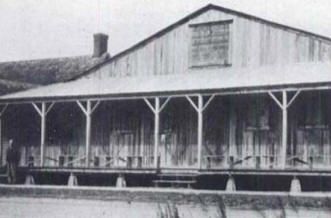
Joseph Falcon, a noted Cajun accordionist and the first person to record a Cajun song (“Allons à Lafayette”), began his career as a professional musician at the Blue Goose. One evening he decided to take his accordion with him to the fais-do-do at the Blue Goose. When the scheduled band didn’t show, Oneziphore Guidry asked Joe to play. At first he resisted, because he only played
for fun and was unsure of himself. With much coaxing from Mr. Guidry, Joe did play and the crowd loved him. At midnight he received four dollars for his night’s work. In April 1928 a local jeweler, George Burr, in Rayne persuaded Columbia Records to record Joe Falcon and Joe’s wife Cléoma Breaux. On April 27, 1928 in New Orleans they recorded “Allons à Lafayette” which caused a sensation when it was released. Thousands of copies were sold and Joe and his wife Cléoma became the first Cajun-recording stars.
* La Salle de Tee-Gar Guidry (Tee-Gar Guidry’s Club) (Mermentau Cove, LA)
Tee-Gar Guidry opened his dance hall in Mermentau Cove, Louisiana before 1920. Nathan Abshire, the legendary Cajun accordionist, played his first performance there in 1921 at the age of eight. After launching his professional career at Tee-Gar Guidry's dance hall, Nathan became the most recorded Cajun accordion player.
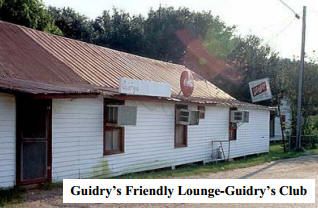
* Guidry’s Friendly Lounge (Guidry’s Club) (Lewisburg, LA)
* Guidry’s Place (Henderson, LA)
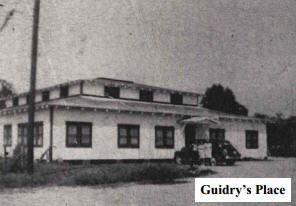
Henry was quite a cook and is best known for making crawfish the premier seafood it is today. Diners drove on dirt roads for miles to eat crawfish at Guidry’s Place in Henderson. Within the same building was Henry Guidry’s dance hall of the same name. Diners could enjoy the Cajun music while dancers from throughout the area glided across the cornmeal-strewn floor to the two-steps and waltzes. The Cajun bands played long into the night. As a young woman, Helen Boudreaux, award-winning Cajun singer and songwriter, remembers sitting on the balcony at Guidry’s Place and watching her two brothers woo the girls with their outstanding dancing. At Henry Guidry’s death in 1954, the family sold the restaurant and dancehall to Pat Huval and it became the world famous Pat’s of Henderson Seafood Restaurant.
* Rendezvous Club (Henderson, LA)
Henry Guidry’s brother Edwin “Mulate” Guidry owned the Rendezvous Club on the Henderson Highway in the early 1950s. Here one could hear Cajun music played by some of the finest bands in the area and watch dancers waltz across the wooden dance floor.
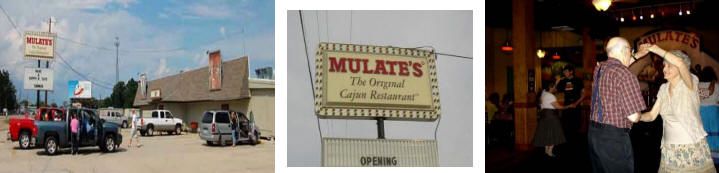
* Mulate’s (Breaux Bridge, LA)
About 1953 Mulate Guidry moved his Rendezvous Club from Henderson to nearby Breaux Bridge and renamed it Mulate’s. Mulate’s was both a restaurant and dance hall located at 325 West Mills Avenue (LA Highway 94) in Breaux Bridge. In 1980 Kerry Boutte purchased Mulate’s and expanded it. In 2011 it was purchased by the long-time manager Jimmy LaGrange and renamed Pont Breaux’s, but it’s still the same fine Cajun restaurant and dance hall with some of the best Cajun bands playing there. I remember hearing Oran “Doc” Guidry, the premier Cajun fiddler, playing there in the 1980s.
* Guidry’s Club (Arnaudville, Louisiana)
Little is known about Guidry’s Club in Arnaudville.
To view an interesting, entertaining video of south Louisiana dancehalls of a bygone era:

* Guidry Hotel (Church Point, Louisiana)
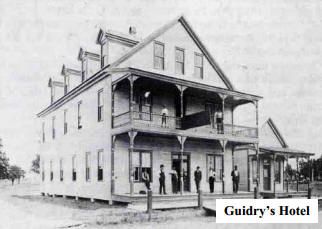
Shortly after Guidry’s Hotel opened, Miss Lula Murrel of Estherwood, Louisiana gave a very pleasant party there one Sunday evening. Among those present enjoying the festivities were Misses Dora Guidry, Elmira Guidry, Rosa Guidry, Odile Guidry, Evelina Murrel, Editha David, Josephine Meche, Louisiana Colligan and Messieurs Theodule Daigle, Joe Wimberley, Jack Guidry, Ben Guidry, Conrad Hockey, Ernest Guidry, Louis Guidry and Ethine Guidry.
The Guidry family ran the hotel for many years with Thélismar’s son Pierre and wife Ernestine Daigle being the proprietors in later years. Eventually the old hotel was sold to Mr. M. A. Hargroder who ran it until it was torn down. This photograph of the Guidry Hotel was taken about 1912.
* Labine Hotel (Fort Coulonge, Pontiac County, Québec, Canada)
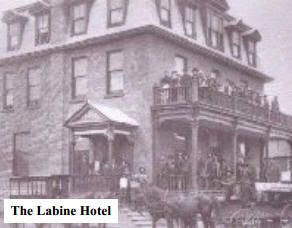
In an effort to provide for every need of the guest, Mrs. Labine operated a horse-drawn bus to carry guests from the train station to the hotel and back. The fare for each of the approximate twenty guests and their luggage was twenty-five cents. Of course, horses needed a place to eat and sleep and the Labine Hotel had their own stable that could support thirty horses - enough for both the Labine’s horses and those of guests. The Labine Hotel provided superb, hearty meals for their guests including boiled pork or sausage, potatoes, beans, soup and freshly-baked bread. Breakfast included all the eggs a man could eat - a special treat since there were no eggs at the lumber camps. The mouth-watering desserts included cakes and apple, prune, raisin and dried peach pies.
Near the end of March the lumber camps broke up and the men headed back south and another stay at the Labine Hotel. They celebrated often providing their own music with juice harp, spoons banging on a pan and similar simple instruments. Often local singers, fiddlers and dancers entertained at the hotel.
The Labine Hotel had twenty-five rooms with a total of forty beds; however, when the need arose, as many as a hundred beds were pressed into service. Mrs. Labine operated the hotel with seven to ten employees including a cook, a kitchen girl, a dining room waitress, two chambermaids, a laundress and a man to stoke the fires. Initially, the Labine Hotel had no electricity so a young lady cleaned and filled approximately 70 oil lamps. Later the hotel acquired a gas generator that eliminated this job.
A shrewd businesswoman, Mrs. Labine respected her guests - minding her own business and keeping their confidentiality. Her motto was “I see nothing, I know nothing, I say nothing.” Her driving principle was “Give a good measure and give quality.” Her guests appreciated Mrs. Labine’s dedication to their comforts and needs. Many visited season after season; some even returned every year for the entire 54 years that she operated the Labine Hotel.
In 1976 the Labine family sold the Labine Hotel to Mr. Leveillé. Sadly, on 1 September 1979 this Fort Coulonge landmark burned down.
* Marco Tourist Court (St. Augustine, Florida)
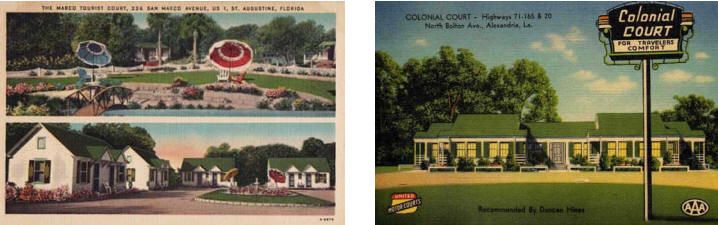
Mr. and Mrs. Jimmie Guidry owned and managed the Marco Tourist Court in the 1940s. Located at 226 San Marco Avenue, the Marco Tourist Court had modern heated cottages, private baths and was convenient to all points of interest in the St. Augustine area.
* Colonial Court (Alexandria, Louisiana)
Managed by A. H. Guidry in the 1940s, the Colonial Court on Bolton Avenue North was central Louisiana’s finest motel. With beauty rest mattresses, air-cooled rooms, private baths and gas heating, the Colonial Court sported the finest in guest comforts. In addition to locked garages, it also had a 24-hour service station and a café.
If you know of other dancehalls and hostelries owned by the Guédry and Petitpas families, please send them to guidryRmartin@gmail.com