Early Analysis of the Guédry and Petitpas Families
In 1970, while I was studying at the University of Illinois at Urbana-Champaign, I was perusing the seventh floor shelves of the Main (Graduate) Library when my eyes fell upon an old dusty set of books containing a number of articles on the Acadians - completely written in French. As I opened Volume 3, an article on the Guidry family appeared. I was hooked and spent the rest of the day perusing this volume. I copied much information from these books over the next year and then spent thirty-five years seeking a set to purchase. Finally, a few years ago, a set became available from a lady living north of AnnapolisRoyal, Nova Scotia and I purchased it. The article that caught my eye was written by Mr. Rameau de Saint-Père and is discussed below along with reference information on these books.
In 1890 Mr. Franéois Edme Rameau de Saint-Père prepared an article about families mentioned in the Registers of Belle-Isle-en-Mer. In the article he provided an historical analysis of twelve old Acadian families in which he cited censuses, narrative reports and other historical records to trace the history of each family in Acadia.
Mr. Rameau de Saint-Père did not have access to the breadth and depth of records available today; therefore, there are some omissions and errors in his work. It is amazing, however, to see how many records - many not well-known even today - that he located on each of the families and how he was able to prepare a brief history of each family. To try to complete the story of each family, he made some suppositions and assumptions which is where most of his errors can be found.
Two of the families that he studied were the Guédry and Petitpas families.
Below we have included a copy of the original French text and a "rough" translation of each article.
The original articles that Mr. Rameau de Saint-Père published are found in:
"Remarques sur les Registres de Belle-Isle-en-Mer" par Mr. E. Rameau de Saint-Père
Collection de Documents Inédits sur le Canada et L'Amérique Publiés Par Le Canada-Français
Tome Troisième
Pages 168-172
Imprimerie de L.-J. Demers et Frères
30, Rue de la Fabrique
Québec, Canada
Janvier 1890
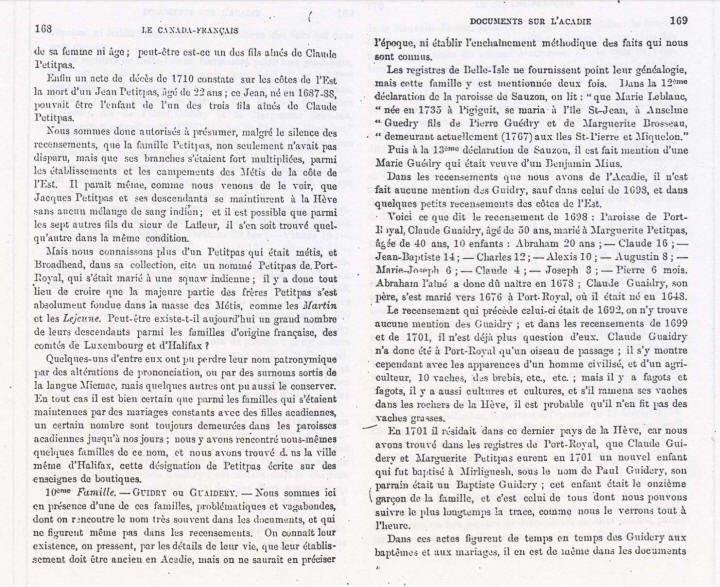
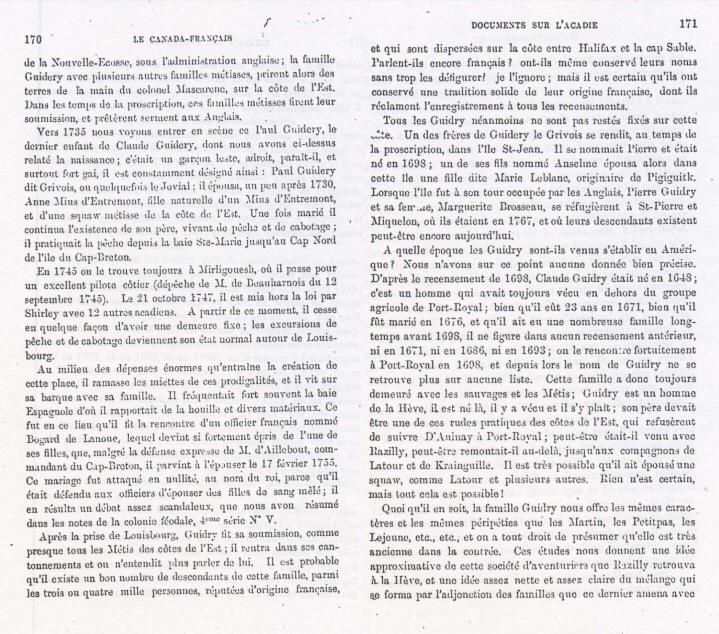
10th Family. GUIDRY or GUAIDERY . - Here we are in the presence of one of those families, problematicals and vagabonds, about whom one encounters the name very often within the documents, and which does not even appear within the censuses. We are aware of their existence; we hasten through the details of their life, but their settlement must be old in Acadia; however, we do not know with accuracy the time nor can we establish systematically the sequence of facts which are known to us.
The registers of Belle-Isle do not provide us with their genealogy, but this family is mentioned twice within it. In the 12th declaration of the parish of Sauzon, one reads: "that Marie Leblanc, born in 1735 at Pigiguit, wed at the Isle St-Jean, to Anselme Guedry, son of Pierre Guedry and of Marguerite Brosseau, now (1767) staying on the islands St-Pierre et Miquelon."
Then in the 13th declaration of Sauzon is mention of one Marie Guedry who was a widow of one Benjamin Mius.
In the censuses that we have of Acadia there is no mention of Guidry except in the one of 1698 and in a few small censuses of the East Coast.
Here is that which the census of 1698 tells: Parish of Port-Royal, Claude Guaidry, age of 50 years, married to Marguerite Petitpas, age of 40 years, 10 children: Abraham 20 years; - Claude 16; - Jean-Baptiste 14; - Charles 12; - Alexis 10; - Augustin 8; - Marie-Joseph 6; - Claude 4; - Joseph 3; - Pierre 6 months. Abraham, the eldest, therefore, ought to have been born in 1678; Claude Guaidry, his father, was married about 1676 at Port-Royal, where he was born in 1648.
The census which precedes this one was of 1692. One finds no mention there of Guaidry and in the censuses of 1699 and 1701 there is already no longer question of them. Claude Guaidry has not, therefore, been at Port-Royal as a bird of passage; he appears, however, as a civilized man and as a farmer; 10 cows, some sheep, etc., etc.; but men are not all alike; there is also cultivated lands, and he brought his cows from the rocks of La Hève. It is likely that it did not suit the fat cows.
In 1701 he resided in this last region of La Hève, because we have found in the registers of Port-Royal that Claude Guidery and Marguerite Petitpas had in 1701 a new child who was baptized at Mirliguesh by the name of Paul Guidery; his godfather was a Baptiste Guidery. This child was the eleventh boy of the family and he is the main one by whom we can follow the trail the longest time as we see him all of the time.
In these records appear from time to time some baptisms and marriages of Guidery. It is, likewise, in the documents of Nova Scotia under the English administration. The Guidery family with several other halfbred families, got some land on the East Coast direct from Colonel Mascarene. During the time of the deportation these half-bred families made their submission and took the oath to the English.
About 1735 we see entering on the scene this Paul Guidery, the last child of Claude Guidery, of whom we have told the beginnings above. He was a sharp young man; he appeared clever and, especially, very cheerful. He is constantly designated, therefore, Paul Guidery dit Grivois or, at times, le Jovial. He married, a little after 1730, Anne Mius d'Entremont, illegitimate daughter of Mius d'Entremont and a halfbreed squaw of the East Coast. Once married, he continued the life of his father - lifetime of fishing and of the coasting-trade. He practiced fishing from the Baie Ste-Marie to as far as Cap Nord of the Isle of Cap-Breton.
In 1745 one finds him at Mirligouesh, where he passes for an excellent coasting pilot (letter of Mr. de Beauharnois of 12 September 1745). The 21st of October 1747 he is made an outlaw by Shirley with 12 other Acadians. From this moment forward, he ceases in any manner to have a fixed residence; the fishing and coasting trips become his normal occupation around Louisbourg.
In the midst of the enormous expenditures which bring about the creation of that occupation, he gathers the bits of these extravagances and he lives on his boat with his family. He visits very frequently the Baie Espagnole where he fetches coal and miscellaneous materials. It was in this place where he made the encounter of a French officer named Bogard de Lanoue, who became so strongly in love with one of his daughters that, despite the prohibition expressed by M. d'Aillebout, commanding officer of Cap-Breton, he succeeded in marriage the 17th of February 1755. That marriage was contested with invalidity in the name of the king because it was forbidden for officers to marry girls of mixed blood. There follows a rather scandalous discussion of it that we have summed up in the notes of the Colonie Féodale, 4th series No V.
After the capture of Louisbourg Guidry made his submission as almost all the Métis of the East Coast; he returns to his home and one no longer hears of him. It is probable that there are a good number of descendants of that family among the three or four thousand persons reputed of French origin and who are scattered about the coast between Halifax and Cap-Sable. Do they speak French also? Have they even preserved their names without marring them too much? I am unaware of it, but it is certain that they have preserved a strong tradition of their French origin by which they claim entry in all censuses.
All the Guidry, nevertheless, do not remain settled on that coast. One of the brothers of Guidery le Grivois surrendered at the time of the deportation on Île St-Jean. He is named Pierre and was born in 1698. One of his sons named Anselme married then on this isle a girl called Marie Leblanc originally of Pigiguitk. When the isle by his place was occupied by the English, Pierre Guidry and his wife Marguerite Brosseau took refuge at St-Pierre et Miquelon where they were in 1767 and where their descendants live possibly yet today.
At which time do the Guidry become established in America? We do not have any good accurate data. According to the Census of 1698, Claude Guidry was born in 1648; he is a man who had always lived beside the agricultural group of Port-Royal. Although he was 23 years old in 1671, although he was married in 1676, and although he has had a large family a long time before 1698, he does not appear in any previous census - neither in 1671, nor in 1686, nor in 1693. We encounter him by chance at Port-Royal in 1698 and since then the name of Guidry is no longer encountered again on any list. This family has, therefore, always lived with the natives and the Métis. Guidry is a man of La Hève. He was born there, he has lived there, and he was happy there. His father may have been one of the rugged characters of the East Coast who refused to follow d'Aulnay to Port-Royal. Perhaps he came with Razilly, perhaps he has origin beyond, even to partners of Latour and Krainguille. It is very possible that he has married a squaw as Latour and several others. Nothing is certain, but all that is possible.
However, it may the Guidry family offers us the same characters and the same sudden turns of fortune as the Martin, the Petitpas, the Lejeune, etc., etc., and we have every right to suppose that it is very old in the region. These studies give us an approximate idea of this company of adventurers that Razilly recovered at La Hève and an idea, rather nice and rather clear of mixture, that forms by the union of families which he brought with him. Mixture, rather badly defined, where prevailed suddenly some rough styles and vagabonds of whom the traces survived a long time within certain families.
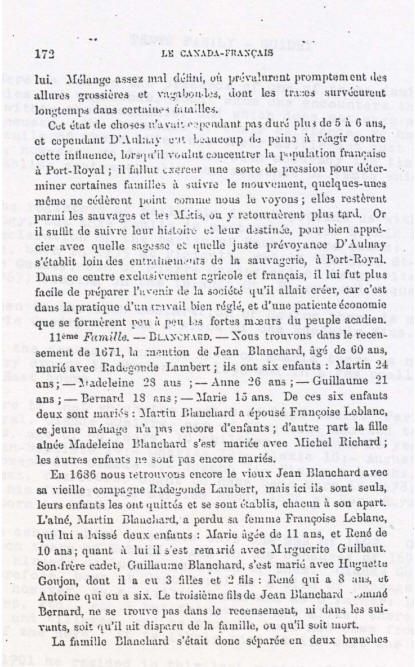
This state of affairs, however, had not lasted more than 5 to 6 years and, yet, d'Aulnay had much difficulty to react against that influence. When he wanted to concentrate the French population in order to cause certain families to follow the move. Some even did not submit as we see it. They stayed among the natives and the Métis or turn up there later. But it suffices to follow their history and their destiny in order to properly appreciate with what wisdom and what accurate foresight d'Aulnay settled at Port-Royal - far from the allurements of the wildness. Within this center, exclusively farming and French, it was easier for him to prepare the future of the society that he proceeds to create because it is in the execution of a job very steady and of an enduring economy that fashion little by little the strong customs of the Acadian people.
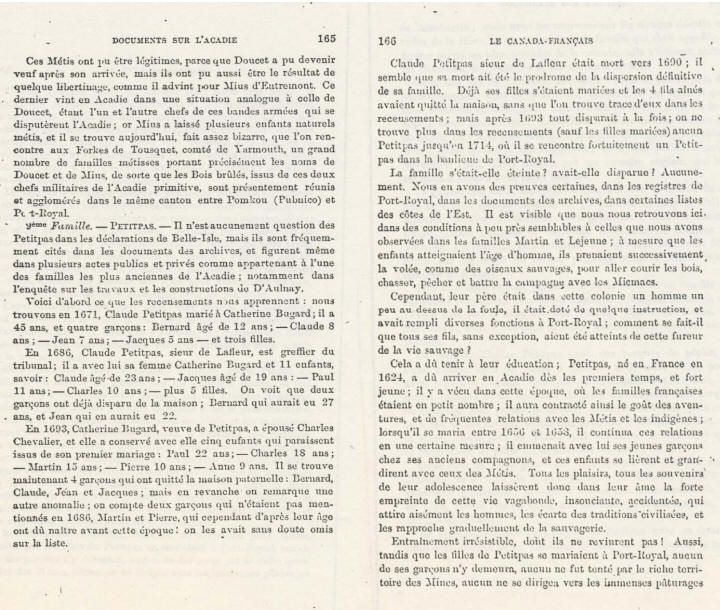
9th Family - PETITPAS . - The Petitpas are not in the declarations of Belle-Isle, but they are mentioned frequently in the documents of the archives, and appear even in several public and private documents as belonging to one of the older families of Acadia; especially in the examination about the works and the buildings of d'Aulnay.
Here is first of all what the censuses teach us: we discover in 1671, Claude Petitpas married to Catherine Bugard; he is 45 years old and has four boys: Bernard age of 12 years; - Claude 8 years; - Jean 7 years; - Jacques 5 years - and three daughters.
In 1686 Claude Petitpas, sieur de Lafleur, is clerk of court; he has with him his wife Catherine Bugard and 11 children, namely: Claude age of 23 years; - Jacques age of 19 years; - Paul 11 years; - Charles 10 years; - plus 5 daughers. One observes that two sons have already disappeared from the house; Bernard who should be 27 years old and Jean who should be 22.
In 1693, Catherine Bugard, widow of Petitpas, has married Charles Chevalier, and she has kept with her five children who appear born of the first marriage: Paul 22 years old; - Charles 18 years old; - Martin 15 years old; - Pierre 10 years old; - Anne 9 years old. It turns out now four sons have left the father's house: Bernard, Claude, Jean and Jacques; but in return one notices another anomaly; one counts two sons, who were not mentioned in 1686, Martin and Pierre, who nevertheless according to their age were born before that time! One had without doubt overlooked them on the list.
Claude Petitpas, sieur de Lafleur, died about 1690; it appears that his death has been the beginning of the definite scattering of his family. Already his daughters were married and the 4 eldest sons had left the house, except we find trace of them in the censuses; but after 1693 all disappear at the same time; one no longer finds in the censuses (except the married daughters) any Petitpas until in 1714, when is found by chance a Petitpas on the outskirts of Port-Royal.
Had the family died out? had it disappeared? By no means. We have some reliable evidence in the registers of Port-Royal, in the documents of the archives, in certain lists of the East Coast. It is evident that we meet again here in almost similar conditions those that we have observed in the families Martin and Lejeune; in proportion as the children attain the age of manhood, they successively took to flight as wild birds, in order to go to pursue the forests, to hunt, to fish and to scour the country with the Micmacs.
Meanwhile, their father was in this settlement a man a little above the multitude, he was endowed with some schooling and had held several offices at Port-Royal; how is it that all his sons, without exception, have been reached by that passion of the untamed life?
That had to occur with their training; Petitpas, born in France in 1624, had to arrive in Acadia since the early time and very young. He has lived there during that time, when the French families were in small number; he will have acquired therefore the liking of adventures and of frequent relations with the Métis and the natives; when he gets married between 1656 and 1658, he continues these relations to a certain extent; he takes with him his young boys to his old companions and these children become acquainted with and grow up with these Métis. All the pleasures , all the memories of their youth leave in their heart the strong imprint of that roving, carefree, rough life, which easily entices the men, they dispel some civilized traditions, and they reconcile gradually with the wildness.
Irresistible attractiveness of which they could not believe! Also, whereas the Petitpas girls married at PortRoyal, none of his boys stayed there, none were enticed by the rich territory of Mines, none made his way about the vast pasture-lands of Beaubassin; but we find them on the wild and rugged beaches of La Hève, and it is thus that a family by who were called to appear among the more distinguished persons of the settlement, got stranded among the hunters, the fishermen, and the fur traders.
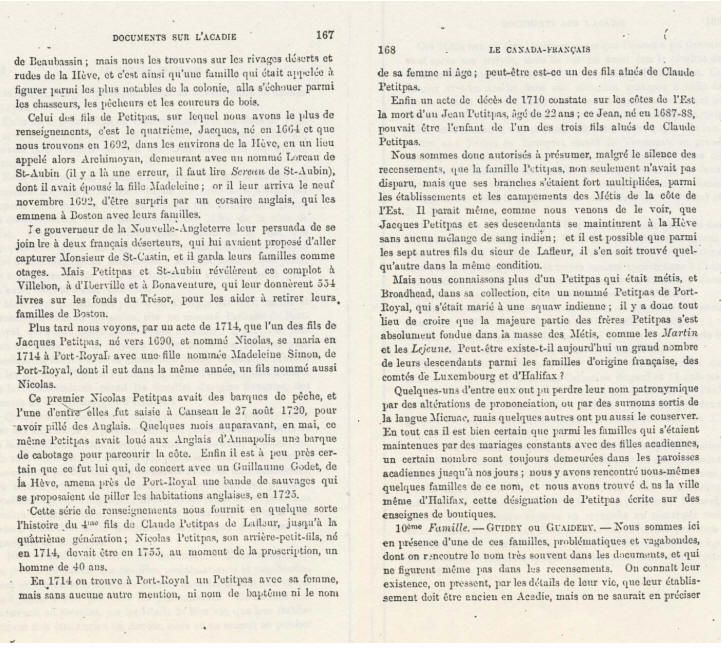
One of the sons of Petitpas, about whom we have the most information, is the fourth, Jacques, born in 1664 and who we find in 1692 in the vicinity of La Hève, in a place called then Archimoyan, living with one named Loreau de St-Aubin (there is an error there, it should read Sereau de St-Aubin), of whom he had married the daughter Madeleine; now he arrived there the ninth of November 1692, being surprised by an English corsair who took them to Boston with their families.
The governor of New England induced them to join with two French deserters, who have proposed to him to go to capture Mr. de St-Castin and he keeps their families as hostages. But Petitpas and St-Aubin reveal this plot to Villebon, to Iberville, and to Bonaventure who give them 554 pounds out of the seat of the Treasury in order to help them take their families out of Boston.
Later we see through a record of 1714 that one of the sons of Jacques Petitpas, born about 1690 and named Nicolas, married in 1714 at Port-Royal to a girl named Madeleine Simon, by whom he had in the same year a son also named Nicolas.
This first Nicolas Petitpas had some boats for fishing and one of them was seized at Canseau the 27th of August 1720, for having pillaged some Englishmen. A few months before, in May, the same Petitpas had rented from the English at Annapolis a coasting vessel in order to survey the coast. Finally it is almost certain that it was he who with a plan with a William Godet of La Hève, led close to Port-Royal a band of natives who intended to ransack the English dwellings, in 1725.
That series of accounts furnishes us with some sort of history of the 4th son of Claude Petitpas de Lafleur, up to the fourth generation; Nicolas Petitpas, his great-grandson, born in 1714, should be in 1755, at the moment of the deportation, a man of 40 years.
In 1714 one finds at Port-Royal a Petitpas with his wife, but without any other mention, neither Christian name nor the name of his wife nor age; perhaps it is one of the elder sons of Claude Petitpas.
Finally a death certificate of 1710 establishes on the East Coast the death of a Jean Petitpas, age of 22 years; this Jean born in 1687-1688, is possibly the child of one of the three elder sons of Claude Petitpas.
We are therefore permitted to presume despite the silence of censuses, that the family Petitpas, not only had not disappeared, but that its branches had multiplied themselves strongly, among the settlements and the camps of the Métis of the East Coast. It even appears, as we have just seen, that Jacques Petitipas and his descendants remained at La Hève without any mixture of Indian blood; and it is possible that among the seven other sons of Sieur de Lafleur, one may find, some others in the same condition.
But we know more of one Petitpas, who was a half-breed and Broadhead, in his collection, mentions a name Petitpas of Port-Royal, who was married to an Indian squaw; there is therefore all reason to believe that the major part of Petitpas brothers is completely merged in the mass of the Métis, as the Martin and the Lejeune.
Some among them have lost their ancestral name by the changes of pronounciation or by the type surnames of the Micmac language, but a few others have also preserved it. In any case it is certainly good that among the families who have continued by the steadfast marriages with Acadian girls, a certain number have always stayed in the Acadian parishes even to our day; we have encountered here ourselves several families with that name and we have found in the same town of Halifax, this designation of Petitpas written on the signs of shops.