In the Footsteps of the Ancestor Claude Petitpas in France
On September 21, 1639 was celebrated in the chapel of Port-Royal the baptism of Marie, daughter of Charles de Menou d'Aulnay and Jeanne Motin de Reux. This baptism is of particular interest to the history of our family in that the record that has been preserved provides us with the first and only mention of the presence of our ancestor Claude Petitpas, father in the land of Acadia. So we read there, keeping the original spelling:
Extract from Baptism of September 21, 1639 [Port-Royal] concerning that of Marie, daughter of Sieur Charles de Menou, escuier s. donay lieutenant general pour le Roy en Coste dacadie païs de la Nouvelle France was baptized at 4 o'clock in the evening on the said day that she was born one hour after midday on Wednesday, September 21 and that she was consecrated to the Blessed Virgin by Claude Petitpas and M. Boudrot first sindics of Port-Royal, her godfather was Pierre son of Pierre Cachet, her godmother Jeanne Traihan, daughter of Guillaume Traihant mareschal and Françoise Corbineau. 1
This document confirms that a certain Claude Petitpas was not only present in Port-Royal just a few years after the founding of the colony, but also that he already occupied a privileged position there, that of trustee of the parish of Saint-Jean-Baptiste of Port-Royal. 2
The censuses of Acadia of 1671 and 1686, the main sources of information on the first Acadian families, report a Claude Petitpas, qualified as "sieur de La Fleur and clerk" in 1686, born around 1624 3 or 1626 (45 years in 1671 and 60 years in 1686). Considering that he would only have been about 15 or 13 years old in 1639, he could obviously not be the Claude Petitpas mentioned as parish trustee in the Port-Royal registers. This is also the opinion of genealogist Stephen A. White:
Claude Petitpas, one of the first trustees of Port-Royal, is mentioned in the baptismal certificate of Marie de Menou d'Aulnay, September 21, 1639, in Port-Royal. As the future clerk would have been only thirteen on that date, we do not believe that it is the same individual. 4
There was therefore no evidence of a relationship between the two namesakes although there was a strong presumption in favor of a father-son link. It would indeed have been a very curious coincidence that he found himself in the small colony of Port-Royal, and in the space of a few years only, two men bearing exactly the same names and surnames but without any kinship connection.
Many questions therefore remained unanswered. Where did Claude Petitpas come from? When had he immigrated to Acadia? What about his family? etc. To one of these questions at least, could we provide an embryonic answer? When did our ancestor leave the old continent to attempt the Acadian adventure?
Before 1639, when, as we have seen, his presence is attested in Port-Royal, there were only two contingents of settlers to settle in Acadia, those of 1632 and 1636. Since he did not appear on the embarkment roll of 1636, which has been preserved, we can logically assume that Claude Petitpas was part of the Saint-Jehan recruit in 1632. This is also the hypothesis put forward by the genealogist Léopold Lanctôt who tried to reconstitute the contingent of settlers in 1632. Among these, he mentions:
Claude Petitpas, his wife (whose name is unknown) and their son Claude (6 years old); several singles: Michel Boudrot, Pierre Comeau, François Gautherot, Louis Robichaud et Simon Pelletret. 5
As for its place of origin, again and like most of the first Acadian families, we had very few clues to guide our research. In the early 1960s, the French linguist and ethnologist Geneviève Massignon, dealing with the probable origins of Acadian families, hypothesized that Claude Petitpas was originally from the town or region of Loudun in the current department of Vienne, partly the former region of Poitou, in France. 6
On the strength of this hypothesis, I therefore undertook to examine the registers of the parishes of the department of Vienne, now available in digital version, and especially those of the three parishes of the city of Loudun at that time, namely Saint-Pierre du Marché, SainteCroix and Saint-Pierre de Martray. The results were as slim as they were inconclusive. For the period in question, the first quarter of the 17th century, there is only one family bearing the surname Petitpas in Loudun. They are the couple of Jean Petitpas and Louise Jaquet who have two children baptized in the Saint-Pierre du Marché church: Charles, on March 13, 1618 [he would marry Marguerite Coindreau on May 26, 1647; then to Denise Blin on August 1, 1666], and Marthe, May 1, 1622. Nothing therefore that can lead us to the ancestor Claude.
For the other parishes of Vienne, only the registers of Notre-Dame de Montmorillon and SaintHilaire de Concise seem to mention a few Petitpas, although the writing is so illegible that it could as well be Petitpied or that of Pitipis ... Thus, no convincing track on that side either.
It is ultimately thanks to the Geneanet website that I think I have solved, at least that is my conviction, this thorny problem. By making an inventory of the Petitpas families listed in each French department for this period, I made, on September 18, 2019, a very interesting discovery. In the registers of the parish of Saint-Georges de Salbris in the department of Loiret-Cher, formerly the French province of Orléanais, we find, dated February 25, 1623, the baptism of Claude Petitpas:
![[Le 23 de feb[vrier] 1623 baptisé Claude Pettipas fils d'honneste homme Claude Pettipas et Anne Ferand (ou Forand) ses père et mère, son parrain honneste homme Toussaint Richer sa maraine Louyse Forand qui n'a su signer.]](images/footsteps-of-claude-petitpas-in-france-1.png)
Several indications lead us to believe that this could well be the future Sieur de La Fleur and clerk of Port-Royal. First of all, the date: 1623. The censuses of 1671 and 1686 gave it birth around 1626, Rameau de Saint-Père and Bona Arsenault put forward the date of 1624. February 23, 1623 therefore becomes a perfectly acceptable date. In addition, here we have a father and son tandem named Claude like the Port-Royal tandem.
The mention "honest man", and on a few occasions that of "merchant in Salbris", appended to the name of Claude Petitpas father and which we find in the baptismal certificate of two other children of the couple Claude Petitpas - Anne Forand / Ferand, as well as on several occasions in the first registers of Salbris (1610-1644), testifies to a social rank equivalent to the bourgeoisie. 7 In addition, between 1611 and 1625, Claude Petitpas appends his signature to this same register thirteen times as father, godfather or witness. This ability to sign at the very least denotes an instruction which would fully qualify him for the office of trustee of the parish of Port-Royal.
Geneviève Massignon put forward the hypothesis of an origin in the department of Vienne, Salbris is in Loir-et-Cher, a neighboring department separated from Vienne by that of Indre-etLoire. Historical research has not yet made it possible to determine with precision the places of origin or of recruitment of Acadian pioneers. Nothing therefore prevents us from imagining that the recruitment of Isaac de Razilly could have exceeded the strict limits of Poitou to extend to neighboring provinces including that of Orléanais.
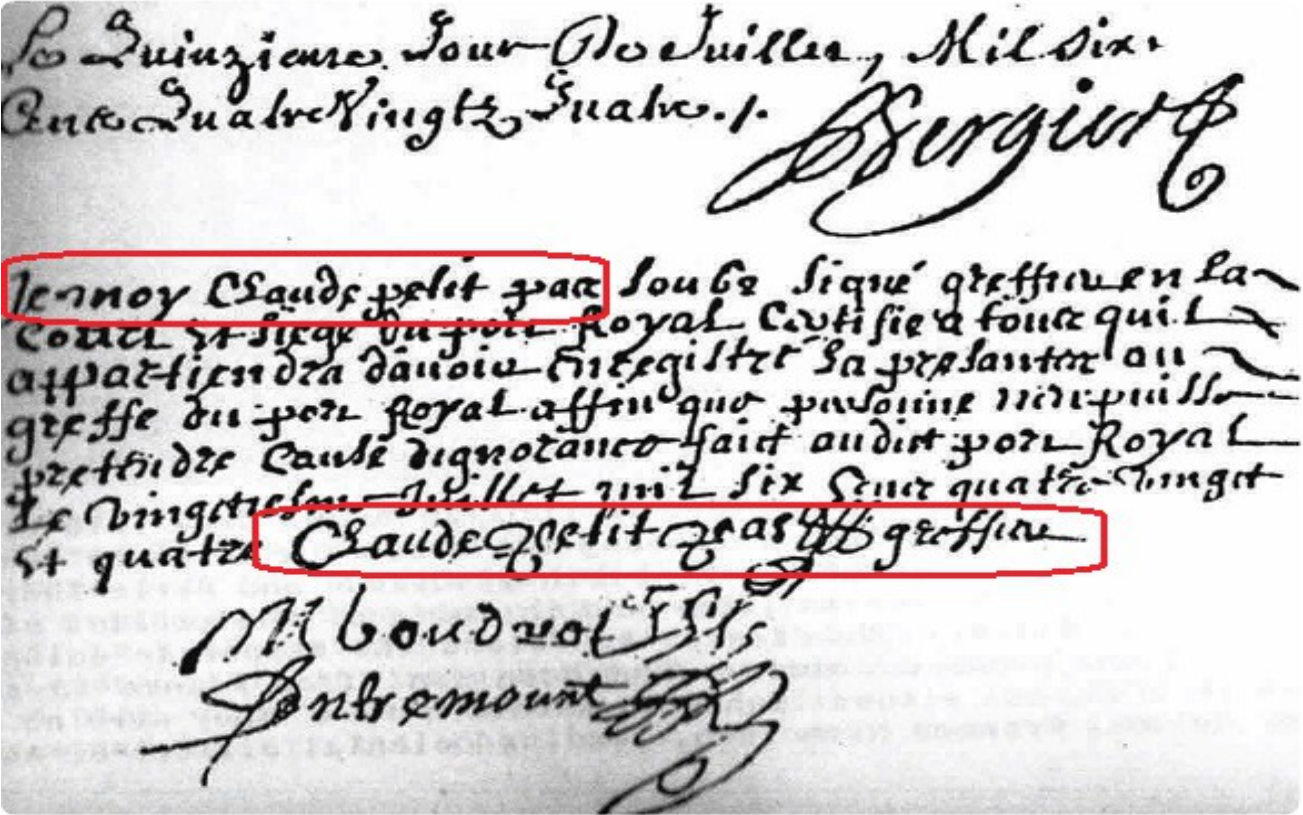
Another fact also seems to support this hypothesis. Claude Petitpas fils, born in 1623, will become clerk at the Port-Royal court. He designates himself under this title in an act of July 15, 1684 when he signs the following act:
The French historian Émile Lauvrière confirms for his part:
On the faith of Raynal and other panegyrists who affirm that these religious pastors [of Port-Royal] drew up deeds, received wills and settled all disputes, we may have exaggerated the judicial role of priests and mitigated the inevitable conflicts of interest. In fact, there were in Port-Royal a lieutenant general of the jurisdiction, Michel Boudrot, a public prosecutor, Philippe d'Entremont, a clerk, Claude Petitpas; but in 1686 Governor Perrot and the intendant of Meulles, the lieutenant general, aged 85, is deaf; the 77-year-old prosecutor is decrepit; the clerk, aged 60, is ignorant; and, moreover, as they are poor and "without wages", Justice is very badly rendered. 8
Claude Petitpas son therefore benefited from a certain education which at least enabled him to hold the Port-Royal registry. Taking into account the low literacy rate both in the French countryside and in 17th century Acadia, the fact that the father and son Claude Petitpas were able to hold their pen also supports the Salbris trail.
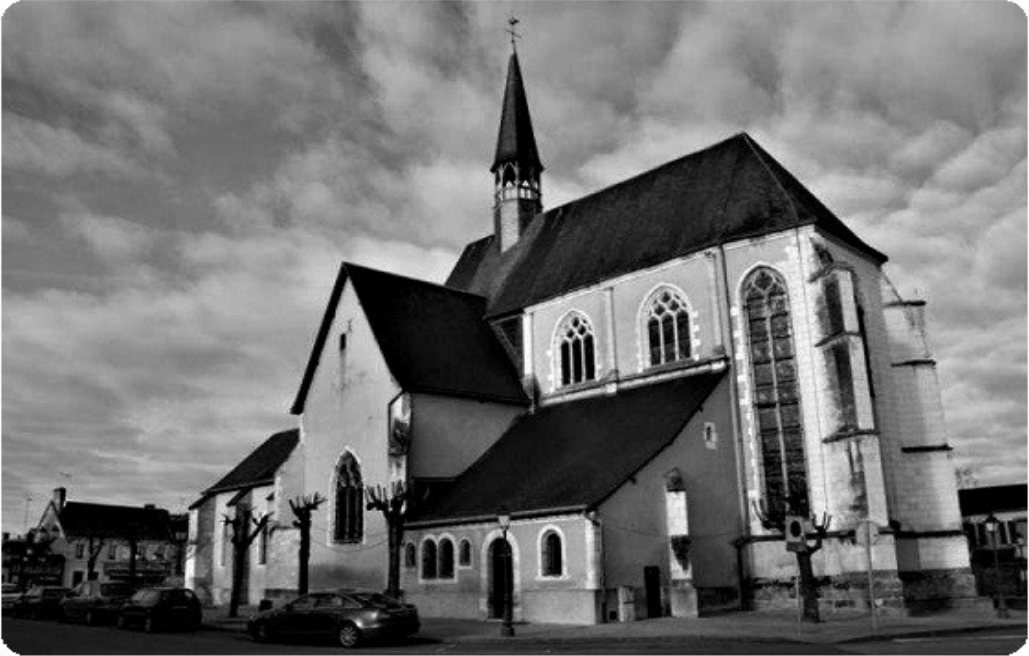
So what about Salbris? Chief place of the canton of Sologne was located to the east of the department of Loir-et-Cher, in an agricultural region called Grande Sologne. In the 17th century, as we have seen, the region belonged to the former province of Orléanais. In 2018, Salbris had 5,060 inhabitants. SaintGeorges church, where Claude Petitpas was baptized in 1623, dates in its oldest part from the 12th Century and for the rest from the 16th Century. The current church is therefore that one that was known to the ancestor Claude and his family.
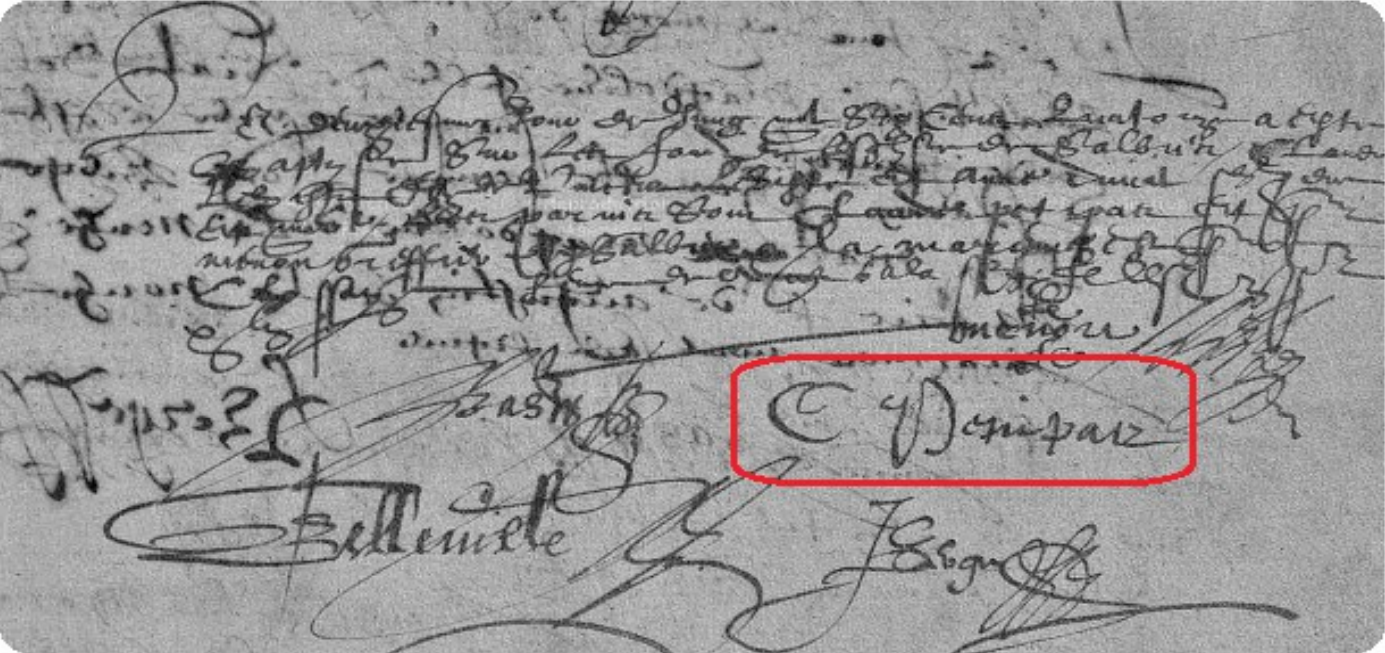
The oldest register kept in the parish of Saint-Georges de Salbris opened on May 14, 1610 (the same day that King Henry IV was assassinated in Paris) and ends on July 25, 1644. This first register unfortunately only contains the baptisms; the register of marriages and burials not opening until January 1669. From August 9, 1610, we find the mention of a certain Jehan Petitpas (the first name is difficult to decipher), but the name and signature of Claude Petitpas become perfectly clear from March 21, 1611, and this thirteen times until December 12, 1625. The name of his wife, Anne Forand (Ferand or Ferrand), appears for the first time on March 19, 1617.
Between 1617 and 1625, Claude and Anne will therefore have five children baptized at a regular frequency of one child every two years:
- Antoinette ; baptized in Salbris on March 19, 1617; Godfather: ...; godmother: Antoinette Forand.
- James ; baptized in Salbris on January 17, 1619; godfather: James Bechereau "Lieutenant à Salbris"; godmother: ... [Married in Salbris around 1641 to Louise Pain from whom six children known to be born between 1642 and 1650].
- Madeleine ; baptized in Salbris on April 26, 1621; godfather: Louis ...; godmother: Madeleine Forand.
- Claude ; baptized in Salbris on February 25, 1623; godfather: "honest man" Toussaint Richer; godmother: Louise Forand. [I strongly believe that this is our Acadian ancestor].
- Marguerite ; baptized in Salbris on March 6, 1625; godfather: Silvain ...; godmother: Jeanne Marchand; buried in Salbris on May 28, 1684. Married first in Salbris to Laurent Simon; and secondly at Salbris to Silvain Pain, son of Silvain Pain and Simonne...
The first thing that strikes us about these baptisms is that three of the five godmothers belong to the mother's family. One can imagine that Antoinette, Madeleine and Louise Forand were the sisters of Anne, the wife of Claude, but no member of the Petitpas family is mentioned as godfather or godmother. If we add to this that no other Petitpas family is mentioned in the registers of this parish, and this for the whole of the 17th Century, we can legitimately think that Claude Petitpas, the father, was from a commune other than Salbris and that he settled there around 1610 either for his work or following his marriage. So where did he come from? The existing registers for the surrounding parishes are completely silent in this regard.
In Loiret, border department of Loir-et-Cher, in the parish of the Holy Trinity of Mignerette, we find at the same time, several Petitpas families, a Jehan Petitpas is even parish priest of Mignerette in 1580, but no trace of a Claude Petitpas.
As we have seen, the last mention of Claude the father in the registers of Salbris is from December 12, 1625. Of his son Claude, no mention other than that of his baptism. The family seems to have disappeared from Salbris with the exception of James, born in 1619, married to Louise Pain and who will be described as an "honest man and merchant" at the baptism of his six children [his line died with his son Claude in 1731] and Marguerite, born in 1625, who married twice and was buried in Salbris on May 28, 1684.
Since the register of burials at Salbris did not open until 1669, one could imagine that Claude Petitpas father, his wife Anne Forand and their three other children died there before that date. But other hypotheses are also possible:
- Claude Petitpas would have signed up for Acadia, would have taken his wife and children there, but would have returned to France after a few years leaving his son Claude in Acadia (Claude father was mentioned only once in Acadia, in 1639). Let us not forget that of the many families registered on the embarkation roll of the SaintJehan which left La Rochelle for Acadia in 1636, very few remained in Acadia; most of them having returned to France after a few years.
- Claude Petitpas would have signed up for Acadia, would have gone there taking only his only son Claude and leaving his wife and his other children in France (the case arose with regard to numerous settlers in New France in particular).
- Having become a widower, Claude the father left for Acadia with his only son Claude (or with his wife and a few children) and that he died there (like his wife) between 1639 and the 1671 census. The registers of the parish of Port-Royal for this period are particularly regrettable in this regard.
In conclusion, I would therefore personally opt for the first scenario, namely that Claude Petitpas, his wife Anne Forand and their children were part of the colonists recruited in 1632 by Isaac de Razilly for the colony of La Hève, in Acadia. Embarked on the Saint-Jehan, they left La Rochelle on April 1, 1632 to arrive at La Hève on the following September 8. In the summer of 1636, the colony was transported to Port-Royal where the presence of Claude the father will be attested on September 21, 1639. Like several Acadian settler families mentioned in the 1636 embarkation roll (those of Jehan Chalumeau, Thibault Destouches, Jehan Mangonneau or Pierre Choiseau among others), he returned to France with his family, leaving his son Claude, aged at least seventeen, in Acadia where he would begin his family.
This is of course only a guess, but so far this is the most serious lead we have. Future discoveries will undoubtedly confirm or disprove this hypothesis, but for now, I consider it historically and geographically plausible.
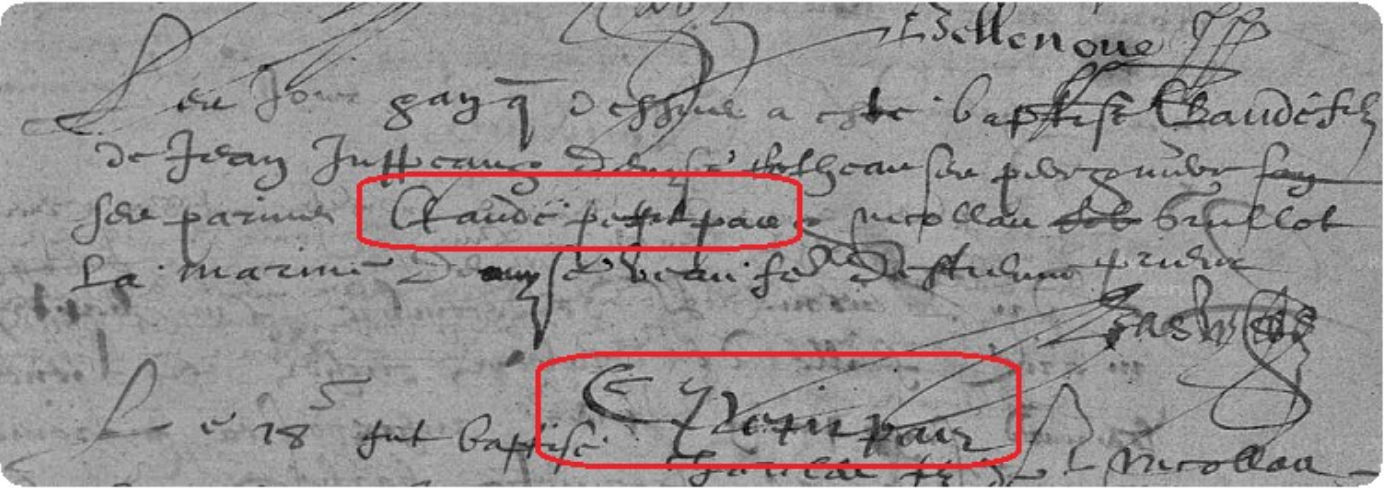
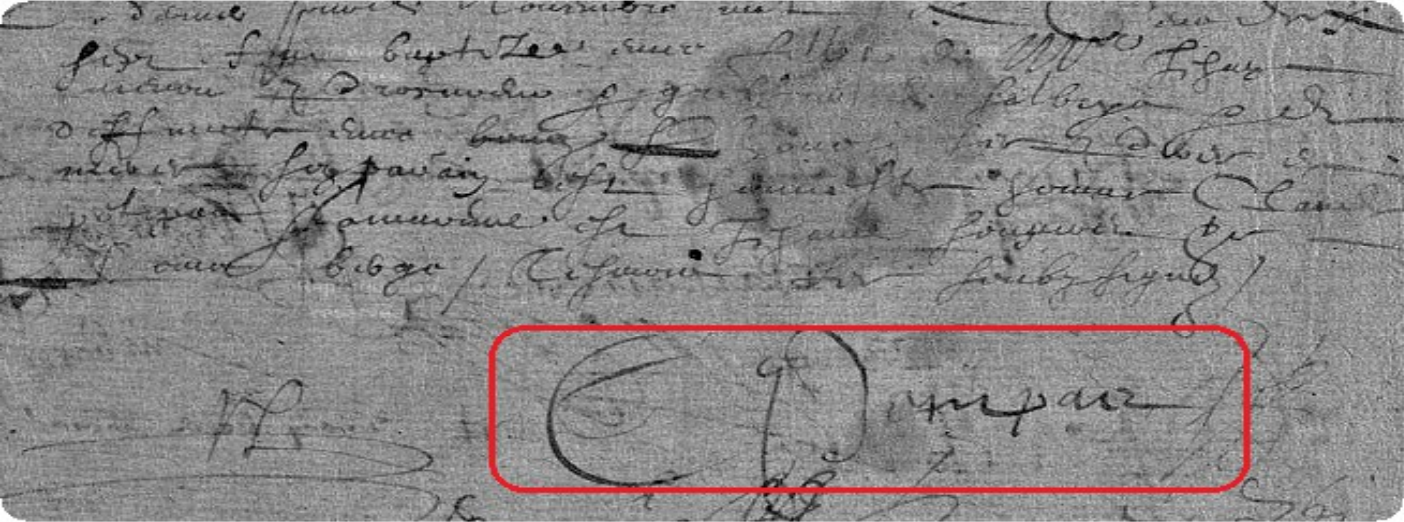
Here follow some examples of the signature of Claude Petitpas in the registers of Salbris:
Biography of Rev. Jean-François Petitpas
Jean-François Petitpas, son of the late Robert and Thelma (LeBlanc) Petitpas was born at the Magdalen Islands, Québec in 1965. He was ordained a Roman Catholic priest for the Diocese of Gaspé at St-André Church, Cap-aux-Meules (Magdalen Islands) 11 July 1999. Stationed on the Gaspé peninsula, he later joined the Royal Canadian Navy, and now lives in Québec City.
In addition to his priestly ministry, he is also a reliable intermediate genealogical researcher, especially with regards his own family tree, and that of other neighboring Madelinot families. He is also a generous collaborator to Dennis M. Boudreau's Dictionnaire généalogique des familles des Iles-de-la-Madeleine, Québec, 1760-1948 (published 2001, updated to 5,000+ pages since that year).
Please remember, this study is but a possible path of discovery, and a seemingly good one, although he himself states that the named relationships recorded herein this article, may possibly be (or not be) those of Claude Petitpas Jr, ancestor of the Acadian Petitpas family.
References
- Lanctôt, Léopold o.m.i. Les familles acadiennes , Ottawa, Éditions du Libre-Échange, 1994, tome I, p. 68.
- In France, under the Ancient Régime, a syndic is someone notably charged to represent, administer and to defend the interests of a parish or rural community. In the case of a parish, he is generally elected by an assembly of communicants, constituted by the heads of families of the parish.
- Rameau de Saint-Père, Edme. Remarques sur les registres de Belle-Isle-en-Mer, dans Collection de documents inédits sur le Canada et l'Amérique , Imprimerie L.J. Demers et frères, Québec, vol. III, janvier 1890, pp. 166, et Arsenault, Bona, Histoire et généalogie des Acadiens , Montmagny, Éditions Marquis, 1988, tome 2, p. 721.
- Stephen White, Dictionnaire généalogique des familles acadiennes, 1604-1714 ; Moncton, Centre d'Études Acadiennes, 1999, p. 1295.
- Lanctôt, already cited, volume I, p. 68.
- Massignon, Geneviève, Les parlers français d'Acadie , Paris, Librairie C. Klincksieck, 1962, volume I, page 33, note 6.
- "An honest man must have the qualities of nobility and enough personal merit to aspire to be of this class.'' (Wikipedia).
- Lauvrière, Émile, La tragédie d'un peuple , Paris, Librairie Henry Goulet, 1924, volume I, p. 190.