Gravestones of Original Acadian Deportees
As the Acadians were being deported during the period 1755 through 1765, they were determined to protect their families, to survive this difficult journey, to continue their Catholic faith and to keep their Acadian identity. They lost everything during the deportations except for the scant few things they could bring onto the overcrowded ships. As they disembarked at ports along the eastern seaboard of the United States, among Atlantic ports in France and in England coastal towns, they had to start their lives anew - having lost essentially all their possessions. Some drowned as their ships sank; and others died of illness on board the ships - both forever sharing the sea as their final resting place. Most that survived the wretched deportation voyages died poor and were buried in pauper graves - with at most a small wooden marker atop their grave.
A few Acadian deportees prospered later in life and could afford a stone marker as their memorial; however, most of these stones suffered from the weather over the years and became so worn that their inscriptions are no longer legible. Vandals destroyed others. The gravestones of a few Acadian deportees have survived the almost 200 years since they died and are still legible today.
For many years I have sought these in cemeteries across North America. These tombstones mark the graves of Acadians who were born in Acadia before being deported or who were born in Acadia prior to 1764 and remained in Acadia successfully avoiding deportation. Here are the few I have found.
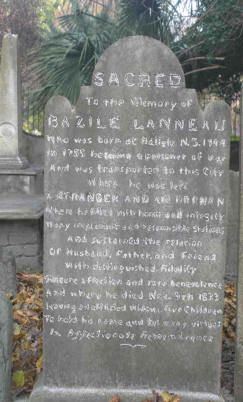 BAZILE LANNEAU
Circular Congregational Church Cemetery
Charleston, South Carolina
Born in Belleisle, Acadia in 1746 to René Lanoue and Marguerite Richard, Bazile was the sixth of seven children - all boys - in the family. René Lanoue died at Belleisle in 1751. On 8 December 1755 the English crowded Bazile, his mother, four of his brothers and 336 other Acadians onto the 177-ton snow Hopson anchored off Goat Island near Annapolis Royal. After a grueling, 38-day voyage through stormy seas with the Acadians herded in crowded, filthy quarters below deck, the Hopson entered the harbor at Charleston, South Carolina on 15 January 1756 and anchored just off Sullivan's Island. French, Catholic and unwanted, the Acadians had to remain onboard the Hopson until 11 February 1756 when they were herded ashore onto Sullivan's Island and quarantined. At the end of March South Carolinian authorities finally permitted the Acadians to enter the town of Charleston.
Soon after arriving at Charleston, Bazile's mother Marguerite Richard and his younger brother François died of fever - leaving Bazile and his three surviving brothers as orphans. The four brothers became separated with JeanBaptiste being “adopted” by the owners of Vanderhorst Plantation, Pierre was apprenticed to a physician and Bazile was “adopted” by Colonel Henry Laurens who apprenticed him to a tanner. Shortly after arriving, Pierre and Gregoire, the eldest brother, escaped Charleston in an attempt to return to Acadia. Jean-Baptiste, who had become an Episcopalian, died in Charleston in 1781 at the age of 42.
Bazile Lanoue prospered in the tannery business - progressing from apprentice to owning his business and purchasing numerous local properties. He amassed a considerable fortune through his business dealings and overt time his name changed to Bazile Lanneau. He built several homes in Charleston and at least three survive today. About 1766 Bazile Lanneau first married Suzanne Frizelle, French Hugenot, by whom he had five children. All five children died before 1790 and his wife passed away shortly thereafter. All are buried at the French Hugenot Church Cemetery although their graves can no longer be located.
In 1796 at the age of 50 Bazile married Anne (Hannah) Vinyard, a young woman of 28 years. Hannah and Bazile had nine children - five sons and four daughters . Five of their children died young. After their marriage Hannah and Bazile joined the Circular Congregation Church in Charleston. Bazile Lanneau died in 1833 just four days shy of his 87th birthday. Hannah survived her husband and died in 1847. They are buried next to each other behind the Circular Congregational Church. Their slate markers read:
Sacred
to the Memory ofBAZILE LANNEAU
Who was born at Balisle N.S., 1744
In 1755 he became a prisoner of war
And was transported to this city
Where he was left
A Stranger and an Orphan.
Where he filled with honor and integrity
Many important and responsible stations
And sustained the relation
Of Husband, Father and Friend
With distinguished fidelity
Sincere affection and rare benevolence
And where he died, Nov. 9, 1833
Leaving an afflicted Widow and four children
To hold his name and many virtues
In Affectionate Remembrance.
Sacred
to the Memory ofHANNAH LANNEAU
Consort of Bazile Lanneau
Who departed this life 29th April 1847
In the Seventy Ninth Year of her Age
In health and sickness, in life
And in death, she was sustained
By the consolations of the religion
Of Jesus which she long professed;
And which she fully exemplified
In her daily walk and conversation
For her "to live was Christ" - to die gain
This stone is erected to her Memory
By her Four Children
Who hope they have obtained
"Like precious faith"
And who still live to cherish her
Meek Christian example
And maternal virtues
In sacred and affectionate
Remembrance.
MARGUERITE COMEAU
Oak Grove Cemetery
St. Mary's, Georgia
A small plaque affixed to the brick wall tells of their history: “Tomb of Acadians - Acadians deported from Grand Pre, Nova Scotia, first found refuge in St. Domingo. Later, insurrection of natives drove them to St. Mary's. Evangeline's friend buried here.”
Although a bit inaccurate, the plaque sheds a brief glimpse into their lives. One alone of the dozen or so graves is that of an Acadian born in Acadia. The others were born in St-Domingue or in the United States. That one is Marguerite Comeau.
Little is known of Marguerite Comeau's life before or after the deportations. Probably born near Port-Royal, Acadia about 1749, Marguerite Comeau very likely was deported about 1756 to one of the English colonies along the eastern seaboard of the Atlantic. With the 1763 Treaty of Paris ending the French and Indian War in North America, the deported Acadians had an opportunity to return to French soil and begin life anew. The French needed workers in St-Domingue to build a naval base at Môle Saint-Nicolas - located on the northwestern tip of today's Haiti. They recruited Acadians from the English colonies and many Acadian accepted their offer. Marguerite Comeau was one of these Acadians. It is not known if she came alone or with her family.
Arriving initially at Cap-François in late January, 1764, Marguerite and her 400 fellow Acadians were quickly moved to Môle Saint-Nicolas in early February, 1764. Soon they discovered their new paradise was a nightmare. The French worked the Acadians as slaves with very low wages. Supplies were sparse and unpredictable. The French gave the Acadians small parcels of land - land that was arid and poor quality. The nearby river had little water. The heat was almost unbearable for the Acadians - accustomed to the colder climate of Acadia and the English colonies. Devastating diseases were common.
Marguerite Comeau married at St-Domingue Joseph Carbon, a master ship's carpenter from Genoa living at Môle. On 22 October 1776 their daughter Anne was born. They apparently also had a daughter Marguerite born earlier. By February 1778 Joseph Carbon had died. Marguerite Carbon, their daughter, married Joseph Desclaux, a Frenchman, at St-Domingue and the couple eventually had three daughters and a son. The StDomingue Slave Revolt began in 1791 causing many residents to flee the island in the ensuing years. Many came to the United States.
Joseph Desclaux took his wife, daughter and his mother-in-law Marguerite Comeau (widow Carbon) and escaped to Charleston, South Carolina in 1799. After a brief stay in Charleston, they headed south and settled at St. Mary's, Georgia. Here Marguerite Comeau died on 1 February 1829 at the age of 80 years. She is buried in Oak Grove Cemetery.
Marguerite Comeau's weathered tombstone, inscribed in French, reads as translated:
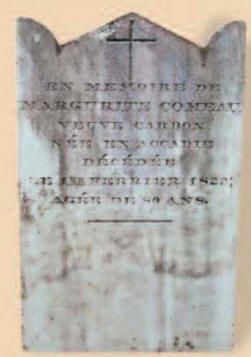
IN MEMORY OF
MARGUERITE COMEAU
WIDOW CARBON
BORN IN ACADIA
DIED
THE 1ST OF FEBRUARY 1829
AGE OF 80 YEARS
JEAN MOUTON
St. John the Evangelist Catholic Cemetery
Lafayette, Louisiana
Born about 1754 in the Chignecto region of Acadia, Jean Mouton was the son of Salvator Mouton and Anne Bastarche. As relations with the English became ever more tense, in the fall of 1755 Salvator moved his family north to Restigouche just north of New Brunswick. With him were his wife Anne Bastarche and his son Jean. In 1760 they were captured by the English and brought south to Acadia. During 1761 and 1762 they were imprisoned in Fort Edward at Pisiguit, Acadia. At Fort Edward were Salvator, his wife Anne Bastarche and their children Jean, Marin and Anne Prexede. In 1763 Salvator Mouton, his wife Anne and their sons Jean and Marin appeared on the Census of Port Royal, Acadia.
In 1765 Salvator Mouton with his wife Anne and sons Jean and Marin departed from Halifax, Acadia, stopped briefly at St-Domingue and disembarked in New Orleans, Louisiana in late 1765. The small family baptized their newest member, daughter Marie-Geneviève on 2 December 1765 at St. Louis Catholic Church in New Orleans. She had been born the previous September. In April 1766 the Spanish settled Salvator Mouton and his family along the banks of the Mississippi River at Cabannocé in today's St. James Parish. In 1777 Jean and his brother Marin crossed the Atchafalaya Swamp with their older cousin Jean Mouton dit Neveu and resettled in the Attakapas District of Louisiana.
Jean Mouton married Marie-Marthe Bordat, daughter of influential New Orleans surgeon Antoine Bordat and his wife Marguerite Martin dit Barnabé, in June 1783. Over the years Jean acquired considerable land and money while raising cattle and sugar cane. He founded the town of Vermilionville (now Lafayette) - donating land for the church and courthouse. Jean Mouton served in the Attakapas Militia appearing on the Roster of 10 May 1777. He is, therefore, a Patriot of the American Revolution.
Because of the number of Mouton's in the Attakapas District, each branch acquired a distinct 'dit' name. Jean Mouton and his descendants are called the Mouton dit Chapeau because Jean wore a “chapeau” or large hat.
Still today you can hear that moniker used by proud Chapeau Mouton's. On 22 November 1834 Jean Mouton died in Lafayette Parish, Louisiana and is buried behind his beloved St. John the Evangelist Catholic Church. His tombstone, written in French, reads as translated:
HERE RESTS
JEAN MOUTON
Died 22 November 1834
Age of 80 Years
HIS CHILDREN
In Respect for his memory have to him
erected this stone
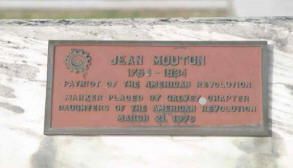
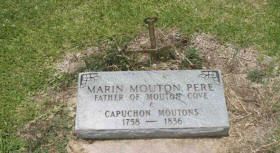
MARIN MOUTON
Private Residence (Lacour Estate)
Mouton Cove, Louisiana
Born about 1758 near Restigouche just north of New Brunswick, Marin Mouton was the son of Salvator Mouton and Anne Bastarche. As relations with the English became ever more tense, in the Fall of 1755 Salvator Mouton moved his family north to Restigouche. With him were his wife Anne Bastarche and his son Jean. While evading the English at Restigouche, Salvator and Anne had a son Marin born about 1758. In 1760 they were captured by the English and brought south to Acadia. During 1761 and 1762 they were imprisoned in Fort Edward at Pisiguit, Acadia. At Fort Edward were Salvator, his wife Anne Bastarche and their children Jean, Marin and Anne Prexede. In 1763 Salvator Mouton, his wife Anne and their sons Jean and Marin appeared on the Census of Port Royal, Acadia.
In 1765 Salvator Mouton with his wife Anne and sons Jean and Marin departed from Halifax, Acadia, stopped briefly at St-Domingue and disembarked in New Orleans, Louisiana in late 1765. The small family baptized their newest member, daughter Marie-Geneviève, on 2 December 1765 at St. Louis Catholic Church in New Orleans. She had been born the previous September. In April 1766 the Spanish settled Salvator Mouton and his family along the banks of the Mississippi River at Cabannocé in today's St. James Parish. Marin Mouton married Marie Josephe Lambert, daughter of Jean Baptiste Lambert and Catherine Eustache, at Cabannocé on 20 January 1777. Later that year Marin, his new wife and his brother Jean crossed the Atchafalaya Swamp with their older cousin Jean Mouton dit Neveu and resettled in the Attakapas District of Louisiana. After the death of Marie-Josephe Lambert in 1811, Marin married Marguerite Bernard, daughter of André Bernard and Marguerite Edlemer, on 27 February 1815.
Marin Mouton and his family settled eight miles below Abbeville, Louisiana where he founded the small village of Mouton Cove. Marin served in the Attakapas Militia appearing on the Roster of 10 May 1777. He is, therefore, a Patriot of the American Revolution.
Because of the number of Mouton's in the Attakapas District, each branch acquired a distinct 'dit' name. Marin Mouton and his descendants are called the Mouton dit Capuchon because Marin wore a “capuchon” or homespun cap. Still today you can hear that moniker used by proud Capuchon Mouton's. In September 1836 Marin Mouton died in Vermilion Parish, Louisiana and is buried on a hill on the privately-owned Lacour Estate at Mouton Cove. His grave is marked by an old iron cross and a recently-dedicated marker that reads:
MARIN MOUTON PERE
FATHER OF MOUTON COVE
&
CAPUCHON MOUTONS
1758 - 1836
JEAN-BAPTISTE BROUSSARD
St. John the Evangelist Catholic Cemetery
Lafayette, Louisiana
The son of Alexandre Broussard dit Beausoleil and Marguerite Thibodeau, Jean-Baptiste Broussard was born about 1731 probably in the Chignecto area of Acadia. After his father was exiled to South Carolina in late 1755, Jean-Baptiste with his mother and siblings hid from the English in New Brunswick. His father escaped from South Carolina in 1756 and rejoined his family in southern New Brunswick. Here he renewed his efforts with his brother Joseph Broussard dit Beausoleil to fight and defeat the English. In 1760 Joseph Broussard dit Beausoleil and his band of resistance fighters with their families were captured by the English and imprisoned at Georges Island in Halifax harbor and at Fort Edward in Pisiguit. About 1763 Jean-Baptiste Broussard married Anne Brun while imprisoned at Georges Island.
In late November 1764 Joseph and Alexandre Broussard and their families left Acadia in a chartered schooner with over 200 fellow Acadians for St-Domingue. After briefly stopping at Cap-François, St-Domingue, they realized the climate, land and work conditions were intolerable for the Acadians. They changed ships and headed to New Orleans planning to resettle in the Illinois country. Reaching New Orleans in February 1765, the Broussard party decided to remain in Louisiana and settled in the Attakapas District in April 1765. JeanBaptiste Broussard was one of the seven Acadians to sign the Dauterive Compact on 4 April 1765 that began the Acadian cattle industry in Louisiana. Jean-Baptiste remained in the Attakapas area throughout his life raising cattle and farming. In November 1798 Anne Brun died. Shortly afterwards, on 9 September 1799 he married Elizabeth Landry, daughter of Baptiste Landry and Elizabeth Dugas and the widow of Joseph Dugas.
Jean-Baptiste Broussard served in the Attakapas Militia appearing on the Roster of 10 May 1777. He is, therefore, a Patriot of the American Revolution. On 15 October 1825 Jean-Baptiste Broussard died in Lafayette Parish, Louisiana at the home of his eldest son Jean at 7:00 pm.
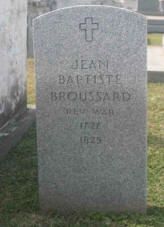
He was buried the next day in St. John the Evangelist Catholic Cemetery. His gravestone, which incorrectly lists his birth year as 1727, reads:
JEAN
BAPTISTE
BROUSSARDREV WAR
1727
1825
PIERRE BROUSSARD
St. Martin de Tours Catholic Cemetery (behind church)
St. Martinville, Louisiana
Pierre Broussard, the youngest son of Alexandre Broussard dit Beausoleil and Marguerite Thibodeau, was born about 1750 probably in the Petitcodiac area of southern New Brunswick. After his father was exiled to South Carolina in late 1755, young Pierre with his mother and siblings hid from the English in New Brunswick. His father escaped from South Carolina in 1756 and rejoined his family in southern New Brunswick.
Here he renewed his efforts with his brother Joseph Broussard dit Beausoleil to fight and defeat the English. In 1760 Joseph Broussard dit Beausoleil and his band of resistance fighters with their families were captured by the English and imprisoned at Georges Island in Halifax harbor and at Fort Edward in Pisiguit.
In late November 1764 Joseph and Alexandre Broussard and their families left Acadia in a chartered schooner with over 200 fellow Acadians for St-Domingue. After briefly stopping at Cap-François, St-Domingue, they realized the climate, land and work conditions were intolerable for the Acadians. They changed ships and headed to New Orleans planning to resettle in the Illinois country. Reaching New Orleans in February 1765, the Broussard party decided to remain in Louisiana and settled in the Attakapas District in April 1765. On 1 July 1776 in St. James Parish, Pierre Broussard married Marie Melancon, daughter of Honoré Melancon and Marie Breau. Pierre and Marie lived in the Attakapas District where their son Joseph Pierre Broussard was born on 15 June 1777. Marie Melancon, Pierre's wife, died of dropsy in St. Martin Parish in January 1797. Shortly afterwards, on 16 April 1798 Pierre married Marguerite Guédry, daughter of Pierre Guédry and Marguerite Miller. Pierre and Marguerite lived near his father-in-law's home at Grand-Pointe (today's Cecilia) in St. Martin Parish.
On 12 December 1828 Pierre Broussard died at his home at Grand-Pointe and was buried the next day in the St. Martin de Tours Catholic Cemetery. His broken grave marker presently lies in a small memorial cemetery behind the St. Martin de Tours Catholic Church. Pierre Broussard's marker, written in French, reads as translated:
HERE LIES
…E BROUSSARD
… en acadie
… 11 Dec 1828
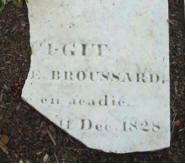
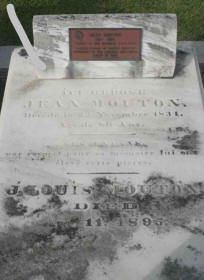
Above: Pierre Broussard's Gravestone R-Jean Mouton Gravestone
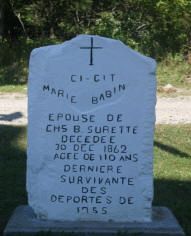
MARIE BABIN
St. Joseph's Catholic Church Cemetery
(Her grave is in front of the church)
Surrette's Island, Nova Scotia
Although her gravestone indicates that she was the last survivor of the Acadian deportation and that she was 110 years old at death, Marie Babin never was deported and was actually a young 101 years at death.
Marie was baptized at Restigouche, just north of Campbellton, New Brunswick, on 6 March 1761 and was likely born there a short time earlier. Her father Pierre Babin had fled to the Miramichi region or the Baie des Chaleurs near Restigouche to escape the English turmoil near his Pisiguit, Acadia home. There he met and married Cécile Bois about 1759. Marie was born shortly after their marriage. In 1768 the family was living on the St. John River in New Brunswick and later moved to the Halifax area.
About 1786 Marie Babin married Charles Henri Barromée Surette (called Gee-Gee), son of Joseph Surette and Marguerite Blanche Pellerin. Charles and Marie lived for several years at Ste-Anne-du-Ruisseau (today Eel Brook) in Yarmouth County, Acadia. In 1801 they moved to Surette's Island where Marie Babin died on 20 December 1862. Her grave marker, written in French, reads as translated:
HERE LIES
MARIE BABIN
WIFE OF
CHS B. SURETTE
DIED
30 DEC 1862
AGE OF 110 YEARS
LAST
SURVIVING
OF THE
DEPORTED OF
1755
For many of the original Acadian deportees the civil or ecclesiastical records indicate the cemetery of burial; however, no discernable marker remains.
If you know the location of other grave markers of original Acadian deportees or of Acadians born before 1764 that were not deported, please email Martin Guidry at guidryRmartin@gmail.com