The Grivois Family of Northeast Maine
Another Branch of the Guédry Family
To give the reader a flavor of the difficulty in researching Acadians during the eighteenth and nineteenth centuries, we have used the spellings of names as found in the original documents. If it is unclear who the person was, the actual first name of the person follows in parentheses. Most Acadians could not read and write until the mid to late 1800s; therefore, they would verbally tell a census enumerator, surveyor or priest their names and this individual would attempt to spell the names correctly - often spelling them phonetically. The problem in Maine was compounded because the census enumerators and surveyors were English with little knowledge of French names.
About 1784 Augustin Guédry dit Grivois, son of Pierre Guédry dit Labine and Marguerite Brasseau, and his wife Marie-Françoise Jeanson had a son Romain in Digby County, Nova Scotia - probably while they were living at Gilbert's Cove. 1 Shortly afterwards, Augustin would move his family a short distance south near Bear Cove along Baie Sainte-Marie (St. Mary's Bay). Here he founded the village of Chéticamp (later to be called St. Alphonse). Near Baie Sainte-Marie Romain Guedry would grow from a young boy to an adult as he romped in the forests and fished the waters of Baie Sainte-Marie. On the 25th of August 1799 Romain became the parrain (godfather) of his nephew Joseph Giddery, son of Pierre Giddery and Anne Belliveau. 2 , 3 , 4
Romain Guedry married Marie Comeau about 1804 in Digby County. 5 , 6 , 7 , 8 During the next dozen years Romain and Marie had six children in the Baie Sainte-Marie area: Hilaire Augustin Guedry on 18 February 1805, Jean Anselme Guedry on 22 December 1806, Marie Elizabeth Guedry on 2 July 1809, Marie Guedry on 15 July 1811, Calais Guedry on 27 July 1813 and Joseph Gatien Guedry on 18 December 1816. 5 , 6
While Joseph Gatien was still an infant, Romain and Marie moved the family from the Baie Sainte-Marie area far north to Nouvelle, Québec on the Gaspé peninsula just above New Brunswick. Why would they uproot their young family and begin life anew in a distant place? The answer is not known. Lumbering and fishing were the two most viable occupations for the Acadians of the early 1800s in Baie Sainte-Marie; the soil of the area was too rocky for farming. Perhaps Romain wished to enter a different occupation and saw his future in the north. They moved between 1818 when Father Sigogne began his census of Baie Sainte-Marie families and early 1820 when their daughter Marguerite was born at Nouvelle, Québec. 2 , 3 , 9
Romain Guedry and his family with one exception did not remain long in the Nouvelle/Carleton, Québec area. Little is known about their lives in Québec. Shortly after arriving on the Gaspé Penninsula, Marie Comeau gave birth to a new daughter Marguerite Gilliry on 26 March 1820 at Nouvelle, Québec. 9 The family's happiness was short-lived as Marguerite died the next day and was buried at St-Joseph-de-Carleton Catholic Cemetery on 29 March. 10
While in Carleton, the family's eldest son Hilaire Guidry met a local Acadian belle, Cécile Bourg, daughter of Edward Bourg and Henriette Landry, and married her in Carleton on 23 November 1829. 11 , 12 Romain Guédry and Marie Comeau already had left the Carleton area at this time as the marriage record states that they were at Madawaska. Hilaire and Cécile remained behind at Carleton and raised three boys and three girls. Although Hilaire and Cécile made Carleton their home, several of their children ventured south to Campbellton and Petit -Rocher in New Brunswick where they established their families.
Today their Guidry descendants are found from Campbellton to Bathurst. Hilaire Gidry died at Carleton, Québec on 23 September 1846 and was buried on 29 September at the St-Joseph-de-Carleton Catholic Cemetery. 13 , 14
In the June 1830 Census of Madawaska Settlement on the St. John River in Maine is Roma Godney (Romain) with his wife, two boys, two girls and two other men. 15 These two men must have been boarders or helpers. In addition, nearby Jerome Gorney (Jean Anselme) was living alone. 15
Romain and his son Jean Anselme acquired plots of ungranted land on the south (Maine) side of the St. John River where they began farming. The availability of free land with rich soil may have been the stimulus for Romain and Marie moving from Baie Sainte-Marie north to the Madawaska area. The 1833 New Brunswick Special Census of the Madawaska Settlement included families on both sides of the St. John River. Romain Goodrie with his wife (Marie Comeau), two boys and two girls had 4 oxen, 1 cow, 17 sheep and 9 pigs. He had no horses or young cattle. The previous spring he sowed 20 bushels of wheat, 8 bushels of oats, ½ bushel of buckwheat, 2 bushels of peas and 42 bushels of potatoes. He harvested 30 bushels of wheat, 20 bushels of oats and 150 bushels of potatoes. Romain cut 12 tons of hay. Samuel Goodrie (Jean Anselme) was living with his wife adjacent to his father. He had 1 horse, 2 cows, 7 sheep and 2 pigs. He did not have any oxen or young cattle. The previous spring Anselme planted 8 bushels of wheat, 3 bushels of oats, 1 bushel of buckwheat, 1 bushel of peas and 12 bushels of potatoes. He harvested 12 bushels of wheat, 20 bushels of oats, 8 bushels of buckwheat, 1 bushel of peas and 30 bushels of potatoes. Anselme cut 1 ton of hay. 16
In the 1840 U. S. Census Roman Jiddry was still in the Madawaska area of Maine. With him were his wife Marie Comeau, two sons between 20 and 30 years of age (Calais and Joseph Gatien) and one daughter between 20 and 30 years old (Marie Elizabeth). Living adjacent to Roman was his son Samuel Jiddry (Jean Anselme) with his wife Suzanne Violette, five young boys less than 5 years old (Joseph, Alexis, HIlaire and Urbain are the only four known), one girl under 5 years of age, three girls between 5 and 10 years of age and one woman between 40 and 50 years old. It is not known who these females with the family were. Not far distant were Désire Vilet with his wife Marie Guedry and one girl less than five years old (Elizabeth). 35
The Webster-Ashburton Treaty of 1842 between Great Britain and the United States formally settled the long disputed boundary between northeastern Maine and northwestern New Brunswick. It basically set the boundary as the center of the St. John River and the St. Francis River. During the period from 1783 until 1842 many people had settled on disputed land in Maine under British grants or with no grants at all. The United States needed to determine who were the legal owners of land in the formerly disputed territory. As a first step the United States agreed to honor both U. S. and British grants in Maine. They then appointed commissioners who surveyed the land in August 1844 while requesting documentation from settlers. The commission established five categories of claims: 1) grants by the British government, 2) ungranted land settled before August 1836, 3) ungranted land settled between August 1836 and August 1842, 4) grants by State of Maine for which a payment was attached and 5) settlers on land granted to others. The first four categories were recognized as valid claims and Maine then granted the land to these established settlers. The fifth category was not recognized and the requests were not honored.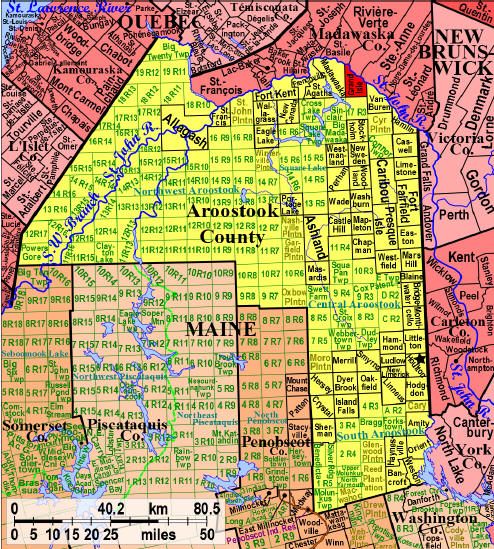
The commissioners in August 1844 found that Romain Gederi had two valid claims in the Grand Isle area - one of 194.12 acres on River Lots in Township No. 18, Range 3 and a second of 4.59 acres of the Inland Lots in Township No. 18, Range 3. Both of these were for ungranted land based on possession and improvement before August 1836. Anselme Gederi had one valid claim for the same reason. It was 92.86 acres on River Lots in Township No. 18, Range 3. Desire Violette was granted 93 acres on Rear Lots in Township M, Range 2 for ungranted land based on possession and improvement after August 1836. He settled his property in 1842. Township 18 is the area of Grand Isle, Maine while Township M is the area of Van Buren, Maine. 50
Suzanne Violette died 19 Mar 1848, probably from complications of childbirth, leaving Jean Anselme Guedry with a large family to raise. This must have been a difficult time for Jean Anselme - having to till his land while raising a large family alone. As Acadians often did when in this situation, Jean Anselme quickly remarried. On 29 January 1849 he married Martine Fournier, daughter of Jacques Fournier and Josette Hébert, at Saint-Basile, New Brunswick. 27 During the next eighteen years Jean Anselme and Martine had seven children: François Xavier (born 16 February 1850), 28 Sophia (born 29 February 1852), 29 Remi (born 11 July 1854), 30 Florent (b. 2 Nov 1856), 30a Hyppolite Paul (born 8 November 1858), 31 Romain (born 21 April 1861), 32 Thomas (born 13 March 1864) 33 and Malvina Dinah (born 10 June 1867). 34
Marie Elizabeth Guedry, daughter of Romain Guedry and Marie Comeau, never married. She lived with her parents when young and as she aged lived with her brothers Jean Anselme and Joseph Gatien and her nephew Marcel Grivois. 35 , 36 , 37 , 38
Romain and Marie's daughter Marie married Désiré Violette, son of Alexandre Violette and Josephte Pelletier and brother of Jean Anselme's wife Suzanne, on 6 November 1838 at Van Buren Plantation, Maine. 39 , 40 Désire and Marie had five children: an unnamed infant (born 1 May 1839 and died 2 May 1839), 41 Elizabeth (born ca. 1840), 42 Maxime (born 8 October 1841), 43 Félix (born 25 February 1843) 44 and Athalie (born 10 March 1846). 45
Calais Guedry was with his family from his birth through the 1840 U. S. Census and then vanished. He may have died during the next decade although no death record has been located.
Joseph Gatien Guedry married Thècle Martin, daughter of Charlemagne Martin and Marguerite Chassé, at St. Basile, New Brunswick on 5 February 1845 46 . They had three children: Marcel (born 30 May 1846) 47 , Margaret (born 14 Nov 1847) 48 and Denis (born 27 Dec 1856) 49 .
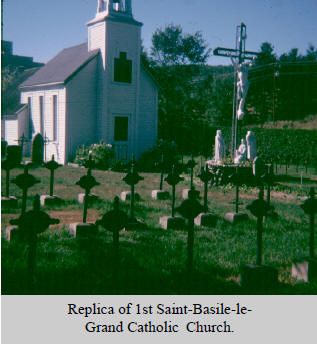
Certainly Romain Guedry and his sons Anselme Guedry and Joseph Guedry had lived near today's Grand Isle since the early 1830s - perhaps as early as 1830. They were part of the Saint-Basile-le-Grand Catholic Church parish in St. Basile, New Brunswick where their families often received the sacraments. Marie Guedry and her husband Désiré Violette settled near present-day Van Buren when they married in 1838 and remained there throughout their lives attending St. Bruno Catholic Church at Van Buren. In 1843 the settlement near Désiré Violette and his family would become Van Buren Plantation while in 1859 the settlement where Romain and Anselme lived with their families would become Grand Isle Plantation.
Plantations as a form of local government are unique to Maine. They are the first step in the development of an incorporated entity. Plantations are unincorporated, rural areas (generally with a small population) that are organized by a vote of the county commissioners. Plantations have an annual meeting that is the governing body of the town. Here assessors are elected to carry out the daily operations of government, taxes are raised and voters are registered. Towns are incorporated by a special act of the Maine State Legislature at which time the town is given certain privileges and required to perform certain duties. Town residents can select to vote at annual meetings or by secret ballot. Cities have a charter form of government - that is, a basic body of laws by which the community governs itself. Cities also have a representative form of government with elected officials.
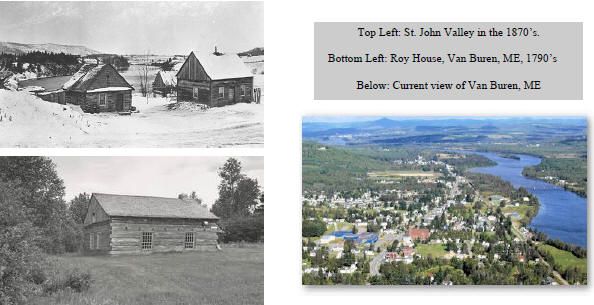
Grand Isle Plantation was initially organized in 1843 as part of Van Buren Plantation to its south; however, in 1859 it separated from Van Buren Plantation and became Grand Isle Plantation. In 1869 Grand Isle Plantation became a town and changed its name to Grand Isle. Van Buren Plantation was organized in 1843. It became the town of Van Buren in 1881. Cyr Plantation, like Grand Isle Plantation, was initially part of Van Buren Plantation and split off as Cyr Plantation in 1859. It continues today as Cyr Plantation.
On 4 March 1846 the Guedry family of Madawaska lost its patriarch when Romain Guedry died at Van Buren Plantation near present-day Grand Isle. The pastor of Saint-Basile-le-Grand Catholic Church provided a note to the pastor of St. Bruno Catholic Church at Van Buren Plantation permitting him to inter the body of Romain at the St. Bruno Catholic Cemetery on 6 March.
By 1850 the Grivois (Guedry) family had set firm roots in Aroostook County along the St. John River. The family was expanding rapidly with the third generation appearing prominently in the United States Census of 1850. Marie Comeau, widow of Romain Guedry, was proud to see her grandchildren grow into fine young men and women. It had been a difficult life for she and Romain, but seeing the fruits of their labor scampering along the banks of the St. John made everything worth their sacrifices. In the Van Buren area four of Désiré Violette and Marie Guedry's children married and had children providing a strong Violette connection to the Grivois (Guedry) family. At Grand Isle Jean Anselme Guedry married first Susanna Violette and second Martine Fournier. He had sixteen children with these two wives and most of these children had children themselves. Also at Grand Isle Joseph Gatien Guedry married Thècle Martin and they had three children who left descendants.
In the 1850 U. S. Census Aussim Gedree (Jean Anselme), 40 years of age and a laborer, was living with his wife Marcina (Martine Fournier), 26 years old with their five sons and one daughter: Joseph (16 years old and a laborer like his father), Alexis (14 years old), Martine (9 years old), Dennis (6 years old), William (2 years old) and Savia (Xavier, 4½ months old). Living with the family was Elenor Forney (Eleonore Fournier), the 16-year-old half-sister of Anselme's wife Martine Fournier. Jean Anselme and his family were living at Grand Isle Plantation although in 1850 it was part of the currently undivided Van Buren Plantation. 51 Residing nearby was Anselme's brother Joseph Gedree, a 32-year-old farmer with $600 of real estate. With Joseph was his wife Latic (Thècle Martin, 30 years old), their son Marcel (4 years old) and daughter Margaret (3 years old). Also in the household was Joseph's mother Mary Gedree (Marie Comeau) who was 72 years of age and Anselme's son Eli Gedree (Hilaire, 11 years old). 51
Living at Van Buren Plantation was Desire Violett (Désiré Violette), a 34-year-old laborer with his wife Mary (Marie Guedry), 40 years old, and their four children: Eliza (Elizabeth, 10 years old), Maxim (Maxime, 9 years old), Felix (8 years old) and Tallere (Athalie, 4 years old). 51
By 1850 the descendants of Jean Anselme and Joseph Gatien in Aroostook County were using the Grivois surname almost without exception. Over the next century the Grivois family increased numerically while spreading out from their historic Aroostook County home. Studying the civil and ecclesiastical vital records as well as the diennial U. S. censuses provides detailed information on the expanding family. For example, Alexis Grivois, a grandson of Romain and Marie, moved with his family to Ramsey, Minnesota about 1883. With the move came a name change to Greveous. Some Grivois families chose the New England states as their new home while others remained in Maine, but moved to other counties. Several Grivois families remained in Aroostook County where they live today.
The transition of the surname Guedry to Grivois for this family in Aroostook County is interesting. In the United States Censuses, although the spelling of the family surname takes many forms, it phonetically appears as Guedry through the 1860 U. S. Census. By 1870 the surname Grivois begins to creep into the nomenclature and by 1880 the family, almost without exception, has adopted the surname Grivois.
In the civil and ecclesiastical vital records the Grivois surname appears widely by the early 1840s and by 1850 appears entrenched in the family. Why this time shift occurs between the two sets of records is not known; however, we do know that most of the first two generations could not read and write. Could it be that church and local civil authorities knew the family as Grivois (much as we today call someone by a nickname if we know them well) and thus the local authorities noted that in the records. An “outsider”, however, enumerated the censuses, asking the family their names and was told Guedry. The enumerator then phonetically spelled the confusing French names as best he could.
The reason for adopting Grivois as a surname is easier to explain. The father of Romain Guedry was Augustin Guédry dit Grivois. The “dit” name is similar to a nickname given to people to distinguish them. It could denote the place of origin, land owned, an ancestral name or even a personal trait. “Grivois” has several meanings such as bawdy and naughty and may represent a trait of Augustin Guédry dit Grivois. During the mid-1800s family members in Aroostook County chose to use the “dit” name Grivois in place of the original surname Guedry. This is the second time within the Guédry family that a “dit” name has replaced Guédry. During the late 1700s in the Montréal area some of the Guédry family chose to use their “dit” name Labine. Today the Labine surname is a major branch of the Guédry family.
An excellent website on the Upper St. John Valley that contains both historical discussions and transcriptions of records is “The Upper St. John River Valley” by Chip Gagnon. It is at: https://www.upperstjohn.com/ .
Thanks to Jessica Cyr of St. Leonard, New Brunswick for her assistance in researching the Grivois family of Maine and New Brunswick.
A Brief Line of Descent of the Early Guédry Family
- Romain Guedry dit Grivois m. Marie Comeau
- Augustin Guédry dit Grivois m. Marie-Françoise Jeanso
- Pierre Guédry dit Labine m. Marguerite Brasseau
- Claude Guédry dit LaVerdure m. Marguerite Petitpas
References
- Geddry, Bernard L.; The Story of An Acadian Family - The Geddrys, Guedrys, Guiddrys, Guidreys, Jeddrys, and Jedreys of Clare, Nova Scotia and New England (Privately Published; Peoria, AZ, 2004), pp. 55, 84, 91
- Registre de Baptemes, Mariages, et Sepultures de la Paroisse Ste. Marie, a la Baie Ste. Marie, Diocese de Quebec, Nouvelle Ecosse 1799-1801 (Centre d'Études Acadiennes; Université de Moncton; Moncton, New Brunswick E1A 3E9)
- Jehn, Janet B.; Baie Ste. Marie Parish Registers 1799-1801 (Janet B. Jehn; Covington, KY; 1985) p. 24
- Ibid., p. 57
- Sigogne, Father Jean-Mandé; Catalogue of the Families of the Parishes of St. Mary's Bay and St. Mandé, etc. 1818-1823 (Compiled by Father Jean-Mandé Sigogne in 1818-1823 at Baie Saint-Marie, Nova Scotia; One copy of register deposited at Centre Acadien, Université Sainte-Anne, Church Point, Nova Scotia BOW 1MO), p. 10 (Family #155)
- Smith, Leonard H. Jr.; St. Mary's Bay 1818 - 1829 (Catalogue of Families St. Mary's Bay Roman Catholic Parish, Clare, Digby County, Nova Scotia) (Leonard H. Smith Jr.; Clearwater, FL; 1975), p. 21
- St-Joseph-de-Carleton Catholic Church Registers (Carleton, Bonaventure County, Québec, Canada) (Deposited at Archives Nationales du Québec; Centre d'Archives du Bas St-Laurence et de la Gaspésie-Iles-de-la-Madeliene; 337 rue Moreault; Rimouski; Bonaventure County, Québec, Canada] 1790-1821 Registre, pp. 185-186; 1829 Registre, pp. 27-28 (v. 7 p. 141 of Marriages)
- Arsenault, Bona; Les Registres de Carleton 1773-1900 (Télévision de la Baie des Chaleurs, Inc. [CHAU-TV]; Carleton, Québec, Canada; 1983), p.134
- St-Joseph-de-Carleton Catholic Church Registers , op. cit., 1790-1821 Registre, p. 185
- Ibid., 1790-1821 Registre, p. 186
- Ibid., 1829 Registre, pp. 27-28
- Arsenault, Bona; Les Registres de Carleton 1773-1900 (Télévision de la Baie des Chaleurs, Inc. (CHAU-TV); Carleton, Québec, 1983), p. 134
- St-Joseph-de-Carleton Catholic Church Registers , op. cit., 1846 Registre, p. 24
- Arsenault, Bona; op. cit., p. 524
- 1830 United States Census (Madawaska Settlement, St. John River, Penobscot County, Maine) [NARA Series: M19, Roll Number: 51], p. 385
- 1833 New Brunswick Special Census of the Madawaska Settlement (Madawaska Settlement, St. John River, New Brunswick and Maine) [Provincial Archives of New Brunswick, Fredericton, New Brunswick; RS24/1834zz2], p. 7
- St-Basile-le-Grand Catholic Church Registers (St-Basile, Madawaska County, New Brunswick, Canada), 1792-1837 Registre, 6th folio of 1833
- Maine Death Records, 1617-1922 (Deposited at Maine State Archives - Cultural Building; 84 State House Station; 230 State Street; Augusta, Maine 04333), 1892-1907 Vital Records - Roll No. 12
- 1850 United States Census (Van Buren Plantation, Aroostook County, Maine) [NARA Series: M432, Roll Number: 248], p. 142A
- St-Basile-le-Grand Catholic Church Registers , op. cit., folio 13 of 1836
- Ibid., folio 13 of 1838
- Ibid., folio 71 of 1840 & folio 96 of 1841
- Ibid., folio 793 of 1844
- St. Bruno Catholic Church Registers (Van Buren, Aroostook County, Maine) (Deposited at Maine State Archives - Cultural Building; 84 State House Station; 230 State Street; Augusta, Maine 04333; Repository ID - REPO1), 1838-1900 Register, folio 168 of 1846
- St-Basile-le-Grand Catholic Church Registers , op. cit., folio 163 of 1850
- St. Bruno Catholic Church Registers , op. cit., folio 19 of 1848
- St-Basile-le-Grand Catholic Church Registers , op. cit., folio 128 of 1849
- Ibid., folio 162 of 1850
- St. Bruno Catholic Church Registers , op. cit., folio 91 of 1852
- St-Basile-le-Grand Catholic Church Registers , op. cit., folio 334 of 1854; (a) folio 431 of 1856
- Ibid., folio 64 of 1858
- Ibid., folio 158 of 1861
- Ibid., folio 336 of 1864
- Ibid., folio 572 of 1867
- 1840 United States Census (Madawaska, Aroostook County, Maine) [NARA Series: M704, Roll Number 136], p. 104
- 1860 United States Census (Madawaska, Aroostook County, Maine) [NARA Series: M653, Roll Number 136], p. 402
- 1870 United States Census (Madawaska, Aroostook County, Maine) [NARA Series: M593, Roll Number 538], p. 125B
- 1880 United States Census (Madawaska, Aroostook County, Maine) [NARA Series T9, Roll Number 476], p. 70B
- Bureau de Santé de Woodstock (Woodstock, Carleton County, New Brunswick) (Deposited at Provincial Archives of New Brunswick; Richard Bennett Hatfield Archives Complex; Bonar Law - Bennett Building; 23 Dineen Drive; University of New Brunswick Campus; P. O. Box 6000; Fredericton, New Brunswick, Canada E3B 5H1); Register of Marriages; 1832-1862, p. 79
- St. Bruno Catholic Church Registers , op. cit., folio 3 of 1838
- Ibid., folio 13 of 1839
- 1850 United States Census , op. cit., p. 140B
- St. Bruno Catholic Church Registers , op. cit., folio 59 of 1841
- Ibid.; folio 90 of 1843
- Ibid.; folio 163 of 1846
- St-Basile-le-Grand Catholic Church Registers , op. cit., folio 210 of 1845
- St. Bruno Catholic Church Registers , op. cit., folio 167 of 1846
- St-Basile-le-Grand Catholic Church Registers , op. cit., folio 83 of 1847
- Ibid.; folio 434 of 1856
- Eastman, Philip; Dana, John; Cunningham, Henry; Allen, Samuel, Webber, John and Jones, Samuel; Joint Report of the Commissioners to Locate Grants And Determine the Extent of Possessory Claims Under the Late Treaty with Great Britain (Upper St. John River Valley and Aroostook River Valley Surveyed August 1844; Report Submitted to Maine and Massachusetts on 25 December 1844) [Maine State Archives - Cultural Building; 84 State House Station; 230 State Street; Augusta, Maine 04333]
- 1850 United States Census , op. cit., pp. 140B, 142A