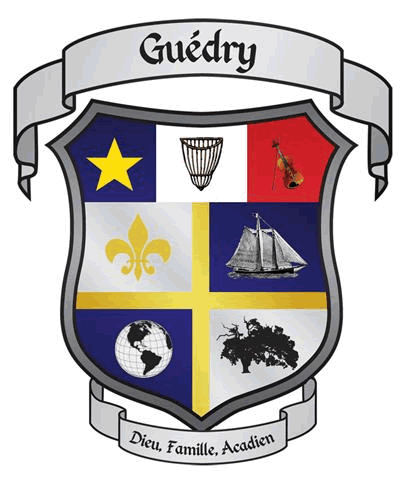
Ancestry of the Guédry Family of Clare, Nova Scotia (Jedrey, Geddry)
The Jedreys and Geddrys currently living in the Municipality of Clare (Meteghan and its evnirons)have a proud heritage - descending from one of the few Acadians never captured by the English during the deportation of 1755 - 1763.
Bernard Geddry, a resident of Peoria, AZ and formerly of Norwood, MA, has extensively researchedhis early Acadian ancestry over many years. Through his diligent, well-documented work we nowknow the exciting story of Augustin Guédry dit Grivois and the founding of the Guédry community in the Meteghan region of Nova Scotia. Bernie is a very active member of Les Guidry d'Asteur - servingon the Genealogy Committee and assisting researchers seeking their Guédry ancestry.
Born in 1697 in Acadia, Pierre Guédry dit Labine, the 9th of eleven children of Claude Guédry andMarguerite Petitpas, was six months old when the Census of Port Royal was taken in 1698. In 1708we find young Pierre at La Hève with his family. About 1722 he married Marguerite Brasseau at Port Royal, Acadia. Marguerite, born ca. 1702, was the daughter of Pierre Brasseau and Gabrielle Forestdite Michel. Where Pierre and Marguerite lived during the early years of their marriage is uncertain - perhaps at Merliguèche or maybe Pisiguit or Cobequid. Prior to the English arriving at Merliguèche in 1752, Pierre and his family seem to have fled to Ile St. Jean. It is here that Pierre and Margueritewere captured by the English in 1755 and exiled. In 1767 we find them living at St. Pierre and Miquelon.
Typical of Acadian families, Pierre Guédry and Marguerite Brasseau had a largefamily of seven sons and four daughters. Augustin Guédry, the 10th child of thefamily, was born in 1740. In 1752 twelve-yearold Augustin was at Pointe a la Jeunesse, Ile St. Jean with the family ofhis brother and sister-in-law - CharlesGuédry and Madeleine Hébert. This youngcouple - both 25 years of age - had livingwith them their two daughters - Marie-Madeleine(6 years old) and an unnamed daughter only eight days old - as well asthree brothers of Charles - Joseph Guédry(20 years old), Jean Femilien Guédry (17years old) and Augustin Guédry (12 years old) - and Charles' sister Agnès (10 years old). This surely was a burden on the young couple - especially in an area with rocky soils and a harsh climate.
Although most of the children of Pierre Guédry and Marguerite Brasseau were captured by theEnglish and deported during 1755 - 1763, Augustin Guédry evaded capture and remained free throughout the period. It was a very tough and difficult life - having to fight the elements and surviveon what nature provided. Although his whereabouts between 1755 and 1764 are not known with certainty, it appears that he lived among the Indians during this time - perhaps in the Merliguèche region. His family had developed strong ties with the Micmacs of the region over the past half-century and it seems probable that he returned to live among them in this time of need. They knew how toharvest the bounty of the land and sea and how to survive the freezing winters of Acadia. They also offered Augustin the opportunity to fade into the woodlands and thus avoid capture.
With the end of the French and Indian War and the Treaty of Paris in 1763 the English allowed theAcadians to begin returning to Nova Scotia under certain conditions. In 1764 Governor MichaelFranklin had permitted Acadians returning to Nova Scotia to obtain land by Order-in-Council. Because English settlers had occupied the fertile Acadian lands of old, the returning Acadians had toresettle in coastal areas. The seven principle areas that the Acadians resettled after 1763 and whichtheir descendants still occupy today are: Argyle (Yarmouth County), Clare (Digby County), Minudie, Nappan & Maccan (Cumberland County), Chéticamp (Inverness County, Cape Breton), Isle Madame(Richmond County, Cape Breton), Pomquet, Tracadie & Havre-Boucher (Antigonish County) and Chezzetcook (Halifax County). [To avoid confusion later, remember that in the late 1700's the areaaround Meteghan, Digby County was known as Chéticamp. Today the coastal town in northeastern Inverness County, Cape Breton bears this name and the town near Meteghan is called Saint-Alphonse-de-Clare.] In 1768 the government authorized Deputy Surveyor John Morrison to survey and divide the Clare District into lots.
With the French and Indian War ended and Acadians returning to their homeland, about 1764Augustin Guédry dit Grivois emerged from hiding in the La Hève area and settled at Gilbert's Cove near Hobb's Hill and west of St. Croix Chapel in present-day Digby County - the first Acadian to settlealong St. Mary's Bay. Untouched by the conflict of 1755 - 1763, this area had not been settled by Acadians before 1755 and no English had moved into the region during the period of deportation. Atthis time Augustin used the appellation Augustin Guiddery. Shortly thereafter Olivier Robichaud, Augustin's future brother-in-law, settled nearby.
In 1900 Augustin Guiddery's farm at Gilbert's Cove was occupied by Charles Mande Melancon;however, an interesting story has emerged about this farm. It seems that in 1802 Augustin Guiddery,Jr. (the son of Augustin Guiddery, Sr. and Marie-Françoise Jeanson) purchased this farm from a Mr. James Bontineau Franklin for 50 pounds. How Mr. Franklin acquired the land is not known at thistime. Augustin Jr. died on 9 March 1833 at 62 years of age. That same year a William Hobbs of Argyle purchased the land from Mrs. A. Guiddery (Augustin Guiddery, Jr.'s widow) and also marriedMrs. A. Guiddery. The purchase price was 200 pounds - a substantial increase in value from 1802 to 1833; perhaps indicating significant improvements to the property. Interestingly William Hobbs wasonly 20 years old in 1833 while Mrs. A. Guiddery was 57 years old - quite a catch for the lady and a hefty purchase price for a young 20-year old groom. William Hobbs was a miller and in 1838 hepetitioned the Assembly to construct an oat mill that he erected on Hobbs' brook in the west end of the Plympton section. Augustin Guiddery and the other Acadians of Gilbert's Cove planted appletrees on their land. Many of these trees were still standing in the early 1900's. Mrs. Augustin Guiddery, Jr. was Marie Rebecca Eagle Guiddery, daughter of Edward Eage and his wife Catherine. She is called by various surnames in the records including Giddery, Geddry, Gedrie, Jeddrie and Jeddry.
About 1767, Augustin Guédry, Sr. married Marie-Françoise Jeanson, daughter of Guillaume Jeansondit Billy and Marie Aucoin, in a civil ceremony. Later on 8 May 1769 their marriage was rehabilitated by a missionary of Windsor (formerly Pisiguit). Augustin and Marie-Françoise began their family at Gilbert's Cove with the birth of their son Hermat Pierre Guédry in 1767. Other children soon followedincluding: Joseph Felix Guédry (born 1770), Augustin Guédry (born 1771), Ann Guédry (born 1773), Théotiste Guédry, Jean-Dominique Guédry (born 1776), Marguerite Guédry, Josette Guédry, PhilippeGuédry (born 1783) and Roman Guédry (born 1784).
Having initially settled toward the northern sector of St. Mary's Bay, Augustin soon noticedEnglishmen moving south and settling near him. Not wishing to live near these former enemies, Augustin Guédry decided to move further south and away from the English. About 1786 AugustinGuédry and Joseph Comeau received at grant of 1600 acres south of Guillot Lake just below present-day Meteghan in an area known as Chéticamp. In 1790 two new sons Frederic and Jean Guédryjoined the Augustin Guédry family. A short time later Pierre and Philippe Guédry (son of Augustin Guédry, Sr.) shared a grant of 2730 acres just inland from the St. Mary's Bay at Bear Cove andChéticamp (present-day Saint-Alphonse-de-Clare) with the LeBlanc's, Comeau's and Saulnier's. Pioneer settlers near present-day Meteghan, the Guédry family remains a strong thread in theAcadian fabric of Meteghan and the adjacent region.
Beginning in the early 1800's one notices the Guédry name being spelled as Guiddery, Geddry,Gedre, Jeddrie and Jedre in various documents. This trend continued in the decades to follow with additional variations as Jedery and Gidry.
The poll tax record of 1792 lists Augustin Guédry, Sr. and three of his sons Pierre, Augustin andPhilippe as taxpayers. In this record the Guédry name is spelled Gedree. About this time Pierre andhis descendants began spelling their name Jedrey while Philippe and his descendants generally used the surname Geddry or Guidry although occasionally they used Jeddry.
The Guédry family appears prominently in the series of censuses taken by Father Ligogne from 1818to 1823. The Census indicates that Augustin Guédry, the progenitor of the Guédry's of St. Mary'sBay, died before 1824 as he is listed as deceased in the Census. This Census, however, confirms that the Guédry family is well-rooted along St. Mary's Bay with Augustin's widow Marie-FrançoiseJeanson as well as several of her sons including Philippe and her grandchildren all living near Meteghan and Plympton.
Showing the same tendency for large families as their cousins in Louisiana, the Guédry families of St.Mary's Bay in the early 1800's tended to have families with many children. In 1795 Hermat PierreGuédry, born in 1767, married Anne Belliveau, daughter of Jean-Jacques Belliveau and Marguerite Robichaud, with whom he had a family of ten children. Pierre died in 1857. Pierre's brother Philippe,born in 1783, married Angélique Theriau in 1803. Philippe and Angélique had 14 children. AugustinGuédry, Jr., born in 1771, married Marie Rebecca Eagle before 1800. Augustin died in 1833. Romain Guédry, born in 1784, married Marie Comeau with whom he had 6 children. Frederic Guédry, born in1790, married Marguerite Deveau. Frederic and Marguerite had only a single child. Jean Guédry, born in 1790, married Rosalie Clothilde Robichau. Jean and Rosalie had four children.
From this early, but strong, beginning the Guédry family of St. Mary's Bay in Nova Scotia descends. Today they are known by many different names - Guédry, Geddry, Gedrey, Gedery, Gedere, Gidrie,Geadry, Jeddery, Jeddry, Jedery, Jedry and Jedrie. Most of Hermat Pierre Guédry's descendants spell their name with a "J" while descendants of Philippe Guédry and the other sons of Augustin Guédry use a "G" in spelling their name. Occasionally, however, a crossover occurs. Small pockets ofthe Guédry family also live on Prince Edward Island (Ile St. Jean) and Cape Breton (Ile Royale).
References
- Arsenault, Bona; Histoire et Généalogique des Acadiens (Editions Leméac, Inc.; Ottawa, Québec;1978) pp. 589-590.
- Arsenault, Bona; Les Registres de Carleton 1793-1900 (Télévision de la Baie des Chaleurs, Inc.;Carleton, Québec; 1983) p. 294.
- Canadian Archives; Report Concerning Canadian Archives for the Year 1905 (Sessional Paper No.18) , "Tour of Inspection Made by Sieur de la Roque. Census. 1752" (S. E. Dawson, Printer; Ottawa,Québec; 1906) Volume II, Appendix A, p. 40.
- Deveau, J. Alphonse; Along the Shores of Saint Mary's Bay - The Story of a Unique Community:Volume 1 The First Hundred Years (Université Sainte-Anne; Church Point, Nova Scotia; 1977) pp. 40, 66, 73, 79a, 105, 118, 151-152.
- Geddry, Bernard L.; Guidry, Guedry, Geddry, Jedrey - The Story of an Acadian Family (Unpublishedmanuscript; Norwood, MA; 1975).
- Jehn, Janet; Baie Ste. Marie Parish Registers 1799-1801 (Janet B. Jehn; Covington, KY; 1985).
- Labine, Mark; La Verdure de Mirligueche - The Story of the Guidry dit Labine Family in North America (Privately published; Arden Hills, MN; 2002) pp. D-22, D-78.
- Smith, Leonard H., Jr.; St. Mary's Bay 1818-1829 (Leonard H. Smith, Jr.; Clearwater, FL; 1975).
- Smith, Leonard H., Jr.; St. Mary's Bay 1840-1844 (Leonard H. Smith, Jr.; Clearwater, FL; 1975).
- Smith, Leonard H., Jr.; Salmon River Vital Records 1849-1907 (Leonard H. Smith, Jr.; Clearwater,FL; 1977).
- Thurber, Derek ("Heritage Digby"); Personal correspondence; 3-9 Jul 2001.
- White, Stephen A.; Registre de L'Abbé Charles-François Bailly 1768 à 1773 (Caraquet) (Universitéde Moncton; Moncton, NB; 1978).
- Wilson, Isaiah W.; A Geography and History of the County of Digby, Nova Scotia (Holloway Bros.,Printers; Halifax, NS; 1900) pp. 28, 43, 98.