A Labine "Lost" in British Columbia - Léon Labine and the Hudson's Bay Company
Little is known of the early life of Léon Labine. There are references that he was a Québecois 1a,b and was French-Canadian 2a,b , but when and where he was born, who his parents were and other information elude us at this time.
In 1849 Léon Labine became a middleman (i.e., unskilled laborer) for the Hudson's Bay Company in their Columbia Department 3 - a fur-trading district in the Pacific Northwest region of British North America. In 1850 he was stationed at Fort Rupert 3 (present-day Port Hardy on the northeastern tip of Vancouver Island). Fort Rupert was built in 1849 to excavate coal from a local seam. The effort failed due to labor problems, native hostilities and poor quality coal. By 1851 the Hudson's Bay Company began moving its coal operations to Nanaimo - further south on Vancouver Island near present-day Victoria. Fort Rupert continued until 1873 as a trading post.
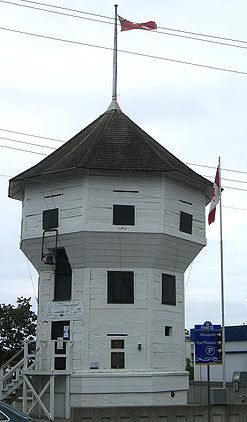
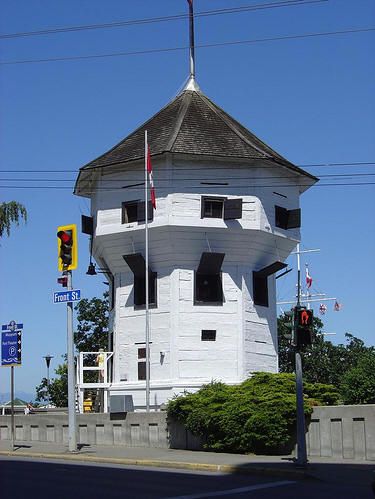
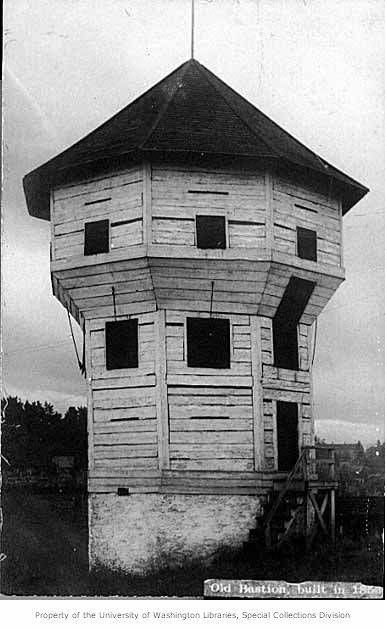
Léon Labine remained at Fort Rupert until early 1853 when he transferred south to the Nanaimo Post north of Fort Victoria 3 in the Western Department of the Hudson's Bay Company. Evidently, while at Fort Rupert he had developed excellent axe and construction skills as he is called a “skilled axeman” 1b and an “expert fort-builder” 4 . In early February 1853 Labine and Jean Baptiste Fortier were the supervisors and principal builders of the Nanaimo Bastion that was completed in June 1853 2a .
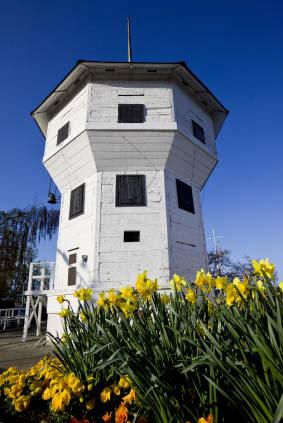
The Hudson's Bay Company built the Nanaimo Bastion to protect the small Nanaimo community from the local natives. It is a three-story, octagonal building from which two small cannons project. The Hudson's Bay Company store lay within the picket fence surrounding the Bastion and clustered nearby were ten large log cabins for the Company coal miners.
The bottom floor of the Bastion contained the Company office, the second floor and was used for defensive purposes and the third floor, twice the size of the two lower floors, was a refuge for employees and their families during periods of danger. The Bastion is 37 feet high 1a , 1b , 2b , 4 , 5 .
The Nanaimo Bastion is the oldest freestanding Hudson's Bay Company fort in North America. In December 1985 it was designated a Municipal Heritage Building and it is listed on the Canadian Register of Heritage Properties. The Bastion is the only known Hudson's Bay Company fort that focused primarily on coal mining rather than fur trading 2a .
Labine worked for the Hudson's Bay Company until at least 18563. He remained in the Victoria area until at least 1864. About 1855 he married Anne Gagner and on 20 July 1856 Léon Labine and Anne Gagner had their son Joseph Labine baptized near Victoria, British Columbia - probably at St. Peter's Catholic Chapel at Nanaimo 6 . St. Andrew's Catholic Cathedral maintains the Victoria area ecclesiastical records for this early period.
The Labine family quickly grew as Léon and Anne baptized additional children - likely also at St. Peter's Chapel in Nanaimo: Guillaume Labine on 28 August 1858, Isabelle Labine on 4 November 1859, Mary Angele Labine on 7 July 1861, Sara Labine on 28 September 1862 and Mathilde Labine on 13 March 1864 6 .
After 1864 we find no other records of Léon Labine. While in British Columbia, he was known variously as Leon Labine, Leo Labine, Levi Labine and Leon Lebine. His wife Anne Gagner was known during this period as Anne Gagner, Sarah Gagner, Anna Geimer, Anne Gana and Anna Gaynor.
If you have additional information on Léon Labine, his wife Anne Gagner and their family, please e-mail Martin Guidry at guidryRmartin@gmail.com. Specific information of interest is Léon Labine's Québec origins - his birthplace and date of birth as well as who his parents and family were. Also, what happened to Léon Labine and his family after 1864 - did they remain in British Columbia or did he return to Québec?
References
- (a) “Attractions Through the Centuries - An Imaginary Tourist Brochure - 1850” at: http://www.royalbcmuseum.bc.ca/exhibits/journeys/uploads/1092872986/student.htm (b) “The Bastion” [See 'Site Facts' & 'Architectural Description'] (Nanaimo Bastion Museum Society; 100 Cameron Road; Nanaimo, British Columbia, Canada V9R 2X1; & British Columbia Heritage Trust and Heritage Branch; British Columbia, Canada; 1998) at: http://www.bcheritage.ca/drawings/sites/site2/site2.html
- (a) “Over 150 Years of History in the Nanaimo Bastion” (Nanaimo District Museum; 100 Cameron Road; Nanaimo, British Columbia, Canada V9R 2X1) at: http://www.nanaimomuseum.ca/bastionpage.htm (b) “The Landing at Nanaimo” from “An Account of the Life and Times of Vancouver Island Pioneer George Robinson” by Randolph S. Vickers (Victoria, British Columbia, Canada; 1983) at: http://www.crunchers.bc.ca/robinson/landing.html
- Hudson's Bay Company Archives (130-200 Vaughan Street; Winnipeg, Manitoba, Canada) [See Post Record B, Post Number 239, Northern Department, Abstracts of Servants' Accounts, Volumes 89-92 & Post Record B, Post Number 226, Fort Victoria, Abstracts of Servants' Accounts, Volumes 1-3 & Account Books, Volume 3a, folio 326]. Index available at: http://www.gov.mb.ca/chc/archives/hbca/biographical/l.html
- Jordon, Mabel E.; “The Century Old Bastion at Nanaimo”, Canadian Geographical Journal (The Royal Canadian Geographical Society; Suite 200, 1155 Lola Street; Ottawa, Ontario, Canada K1K 4C1; Vol. XLIX, No. 1, July 1954), pp. 18-19.
- The Beaver, June 1851, p. 11
- Baptismal Records, St. Andrew's Catholic Cathedral (740 View Street; Victoria, British Columbia, Canada V8W 1J8). [See Volume 109, Item 1, Records 159, 161, 163, 165, 167, 173 and Volume 109, Item 2, Record 1 of the Baptisms (1836-1888)]