The Odyssey of the Old St. Gabriel Church
David, a recognized expert on old Louisiana buildings and furniture, has studied the Old St. Gabriel Church and has worked diligently over the years to preserve it. Paul Boutin and his wife Ursule Guédry were among the original settlers of St. Gabriel in 1767 and helped construct the old church in the 1770s.
Within days of our nation's Founding Fathers signing the Declaration of Independence, the building of the Old St.Gabriel Church was nearing completion. On July 7, 1776, the commandant of the Iberville District wrote the governor of Spanish colonial Louisiana to notify him that "the church should be completed by the end of the month. It is very beautiful." 1 It is the oldest church structure in the Mississippi River Valley. It's the only surviving Colonial church structure in Louisiana.
In 1763, the Mississippi River and Bayou Manchac became the international boundary between Spain and Great Britain. France had ceded its long possession of the Louisiana territory. It took Spain about three years to take actual possession and ruled by proxy in the interim with French administrators. When the Spanish government did arrive, its most pressing issue was to protect its borders and that meant increasing Louisiana's population and placing settlers near its boundaries. 2
When a ship of Acadian families arrived from Maryland to New Orleans in July 1767, Governor Antonio de Ulloa sent the 210 settlers to Fort San Gabriel at the juncture of Bayou Manchac and the Mississippi. 3 These exiles had spent 12 years in Maryland and had hoped to join relatives who had been settled earlier in St. James. Holdover French administrators had directed those Acadians in 1765 before Spain took physical possession in 1766. These same French authorities sent a second ship of Acadians to the Attakapas area.
Ulloa wanted to put into action his settlement policy to bolster the protection of the fort and the newly acquired territory. Spain issued land grants and gave each habitant a gun, a saw, and farm implements. The colonial government also provided a year's rationing. The Maryland Acadians arrived in the heat and rain of August and struggled through the land distribution with very muddy conditions as well as a spreading sickness. 4
An undated map of the settlement (which likely dates to 1769), shows a site set aside for a church. 5 On February 14, 1770, a royal decree had set forth the church "Parish of St. Gabriel at the Establishment of the Acadians of the Iberville Coast." The order was signed by Governor Alejandro O'Reilly and Vicar-General of the Diocese Fr. Dagobert. 6 The Spanish government and the Catholic Church were very closely connected.
Letters from the Iberville District commandant Louis Dutisné describe events leading up to the construction of the church. On October 9, 1770, the settlers petitioned the governor to change the church site, "because the community has decided that Pierre Babin's lot would make a better site for construction of a church and presbytere." 7 The Babin site was about two miles downriver from the map site and matches the present-day location of the church.
On January 17, 1772, Commandant Dutisné writes, "The church is rising on the site of Pierre Babin." However, he describes the building of the presbytere, and a couple of months later writes that the presbytere is finished and will serve as a temporary church. 8 One of the first church functions recorded is a baptism in April 1773 by Father Angelus. Perhaps this is when the Acadians handed over the church registry they carried with them from St. Charles Parish at Mines, Acadia. That registry now resides in the Archives of the Baton Rouge Diocese.
Governor Luis Unzaga responded to their progress with some praise for having completed the presbytere but also some admonishing for not having built the church yet. 9 On March 23, 1774, the commandant tells Unzaga that they will build it soon and it's not done yet because he hasn't found a builder capable of the task. 10
On December 18, 1774, Dutisné writes, "The habitants have begun the construction of a church. The habitants began November 20. The building is 60 feet long by 33 ½ feet wide (French measurement). Louis Le Conte, a habitant of La Fourche, has taken on the job for a sum of 1450 piastries. The habitants have agreed to pay 1 ½ piastries per arpent across the front." 11 It's understood that the Acadians can provide labor in lieu of paying the tax.
It wasn't until September 27, 1776, that the commandant confirms its completion and writes, "the church of this parish is finished and recognized as perfect until the approval of M. Andry who has been called to do the inspection." 12
Louis Andry was a royal engineer and implied by the letter is that he's the designer. Andry was put in charge of overseeing the Acadians sent to the Attakapas District, and the St. Martinville church was being built about the same time as the St. Gabriel church. A drawing done of the St. Martin de Tours church about 50 years after completion shows a similar design but with the side galleries enclosed. 13 The two churches, along with the Galveztown church, show evidence of following the same building plan. 14
The archival letters of the commandant and the governor show just how much that the church is the product of Spain, the French administrators, and the Acadian diaspora. The chronological progression towards getting the church built should dispel an assumption made by the late Catholic Church historian Roger Baudier that the building was once on a different tract of land and was dismantled and moved to the present tract of land. 15 Baudier started that myth when he wrote a history of St. Gabriel Church to coincide with the dedication of the new St. Gabriel Church in 1953. The one item from the Old Church that was transferred to the new one was the Spanish bell that was cast in 1768. 16
These archival letters were uncovered and brought to light and translated in 1995. Historic American Building Survey drawings were done of the church in 1993 by William Brockway of LSU School of Architecture. 17 An addendum to those drawings followed with more building research to create interpretive restoration drawings in 1994. 18 These were done under the guidance of Jay Edwards of the LSU Department of Geography and Anthropology. Additionally, a 3-D model was made to exact scale by one of Edwards' students. The Old Church Commission even had an award winning video made to better inform the parishioners of the discoveries as well as the outside community.
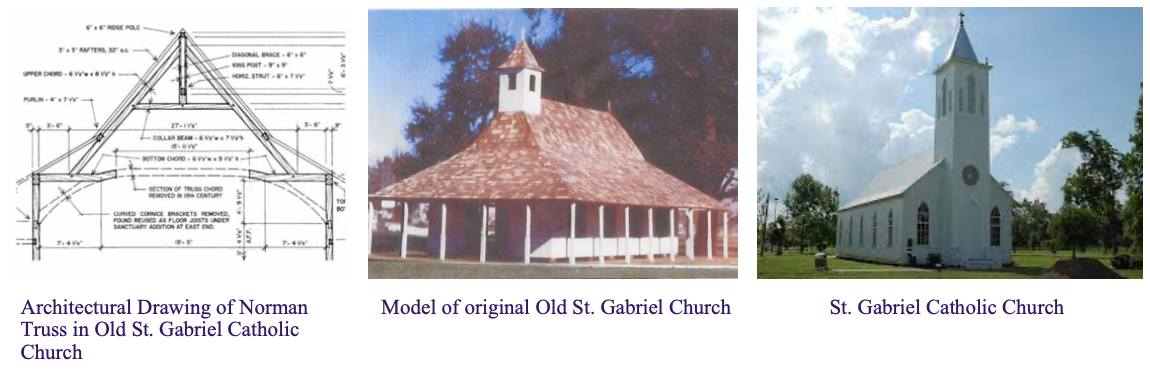
All of the research on the construction details of the original building began to give a picture and a pattern of a type of building form that has come to be called Creole Architecture. The term "Creole" in this case means something derived from the Old World but born of the New World. Specifically, the architecture resembles that of France, but is modified to adapt to the subtropical and tropical environment in the Gulf Coast and the Caribbean. The most defining feature of this Louisiana vernacular building form is the gallery. The roof extensions that form the galleries start with the presence of a Norman truss structure that makes up the roof and attaches the roof to the body of the building. 19
These trusses evolved over centuries in Europe and the French brought their building practices to Louisiana. The 18th century Louisiana versions of the truss were modified because of the need for galleries because of the heat and rainfall and the need to have the windows open during those periods. The trusses were also modified for the roof to have a double pitch with a steeper upper portion and a lesser slope on the lower section. The roof shape is also referred to as a broken pitch roof. The overall roof shape was a four-sided hipped roof and the gallery extensions occurred on all four sides, but the rear extension was enclosed to make the sacristy. The original steeple exited the roof at the front roof ridge.
About the time the building was 100 years old or about 1870-80, the church was in need of repair judging from original 1 by 12 siding boards found in the attic. 20 The building was moved back from the Mississippi River in 1932 because of the construction of the modern-day levee. In 1887, it is recorded to have been moved back. In the margins of the church registry was written "Roulage de l'Eglise". 21 And then, Baudier claims that the building had to be rolled back from the encroaching river in 1818. 22 There is evidence in the walls of a possible modification to and elimination of the galleries along the sides of the building. 23 Perhaps that first move was difficult because the front and side galleries were floorless galleries, with posts going to the ground. These type porches can also be called dirt floor galleries. That move could have contributed to the removal of the side ones.
By 1870-80, the building was in need of repairs or design alterations in the style of the day. The 19th century renovation removed the galleries and changed the shape of the front and rear roof to gable-end additions. A 12 ½ by 12 ½ foot bell tower was introduced that straddled the front wall and included a parapet front. The tower is 74 feet tall. Only about four feet was added to the rear of the building, although on the inside, a larger sanctuary was made deeper and elevated and sacristies flanked the sanctuary. Along the side of the building, the windows were given Gothic features and made taller with lancet arched tops. Two large windows with the same shape were added to the front and flanked the tower. The tower was also embellished with Gothic features and spire. The tower rises about 40 feet above the ridge of the roof.
The Gothic Revival style's emphasis on lancet arched forms and height has the allure of reaching to the heavens. It can have an uplifting effect and appeal to the sentimental. The original Creole Colonial design has a more protective, down-to-earth feel. It's more of a mothering symbol. It evokes pragmatism and authenticity and is a clear example where form follows function.
On the inside, the walls are stilled lined with the original 1 by 12 inch, tongue and groove horizontal cypress boards throughout the building. The building has no bousillage. The ceiling framing and form was changed in the 1870-80 renovation. The original ceiling configuration was uncovered in 1993.
The original ceiling was comprised of 36 foot joists made from 15 by 6 ½ inch hand-hewn timbers. These joists were carved with a slight arch in the middle section that was given extra support and shape with angled braces at each end that connected to the wall posts. The braces were also curved and together with the arch in the joist created a shallow-arched ceiling. Other Colonial Louisiana churches had a similar ceiling but they no longer exist. 24
In the 19th century ceiling renovation, the middle (16 feet) section of the ceiling joists were cut and removed to create a cathedral ceiling that is present today. Five turned wooden columns were added on each side to support the remaining joist sections and the vaulted ceiling. The curved braces connected to the wall and ceiling joists were removed and a flat ceiling using the original 1 by 12 cypress boards flanked the vaulted ceiling.
Throughout the 19th century renovations, all of the original materials that were removed for the alterations were reused for different purposes and thus still exist in the building. If any new material was used in the renovation, it tended to be southern yellow pine except for the replacement of the exterior siding which was narrower cypress than the original. Approximately, 73 percent of the original material still exists in the building. 25 Also worth mentioning, in about 1910, the interior wall and ceiling surfaces were covered and pasted with a burlap material. It was painted and decoratively stenciled. It's become a bit tattered over the past 100 years.
Sometime after the building of the new church, perhaps about 1960, the pastor had concerns that the 19th century tower on the Old Church was at risk of toppling over, and had the tower cut down to roof height. Hurricane Betsy in 1965 actually did do damage to the roofing of the altered steeple. In 1972, the building was placed on the National Register. About two or three years later, the altered steeple was rebuilt. In 1991, an interlocking tin shingle roof was installed.
In 1995, with all the then recently acquired building and archival research, the Old Church committee voted to set the goal of restoring the building back to its original 18th century form. The Pastoral Council along with the pastor voted against the committee's decision because of "the emotional sentiments of parishioners." The restoration issue had become too divisive as some had grown attached to the 19th century form. Others could see the value and uniqueness of the historical discoveries and the committee could see that people outside of the church parish also could appreciate restoring the building to its original form, so much so, that there were two pledges totaling $150,000. Since that failed attempt to restore the building, the efforts toward preservation have been keeping up with routine maintenance and exterior painting. a low profile and keep the building painted.
Hurricane Gustav in 2008 blew the rebuilt tower to the ground and it broke loose at about the level it had once been severed in 1960. A group of parishioners rallied to have the tower rebuilt once again and it was said to be better connected and anchored to building this time, which would mean anchored to the 18th century structure.
There are a few issues regarding this rare, one-of-a-kind building, that should give pause or be a cause for concern. The National Register regards the integrity of historic building as very important because the more intact the parts are, the better able for the building to convey the history that it represents. The period of historical significance that the Old Church serves is the confluence of the Spanish rulers and their need for settlers, the French administrator and professionals who had already begun to adapt to the Louisiana environment, and the Acadian diaspora that led to a new home in Louisiana and the Acadians help in building the church.
In addition to the history surrounding the building, the 18th century structure is the earliest example of Creole architecture which is highly regarded for National Register recognition. There are no other examples of a church in Louisiana or the Lower Mississippi Valley from the Colonial period. For the sake of the building's integrity and protection, the galleries should be restored.
The larger cause for concern is that the rebuilt tower is being anchored to the 18th century building and the tower is a 12 foot by 12 foot wind mast that rises 40 feet above the roof ridge. This would seem to be cause for alarm with hurricanes appearing to be getting more powerful. The building's Norman truss roof structure might have been designed to hold together against normal hurricane winds. But, asking it to hold upright such a tall wind mast could be assuming too much of a risk.
Along with that concern, the building's ceiling joists were cut with the 19th century vaulted ceiling renovation. Buildings with cathedral ceilings normally have buttresses to keep its wall from spreading apart. There are no buttresses. Again, the Norman truss is being subjected to extra stress that it wasn't designed to deal with. Iron tie-rods were added some time after 1920 to address the compromised structural integrity and to keep the building from spreading apart. The rods work in tension, and if extreme winds broadside the building, the rods won't be as helpful as the original joists would have been.
The story of the Old St. Gabriel Church is not done yet. There's still work to do to protect and preserve. It's understandable that the St. Gabriel Catholic Church, the real Church, has to minister to its people and their spiritual and religious needs. The Church Parish also has everyday costs and maintenance of its buildings and grounds on its campus.
Finding a purpose of use could be helpful. Perhaps the Old Church could serve as a place for funeral wake services, or a tourist attraction, or a reception hall. Other ideas have been suggested and sometimes there would be a hitch because of church rules or doctrine. The question that still exist is what form would the building take? Would the Gothic Revival veil be lifted? Would the rare original building become further buried? Would Louisiana's colonial history be served?
The odyssey continues with the Old Church, but it's still with us. It has come from the Old World, but was born of New World inspiration. It grew old and got a Gothic Revival makeover and then a Queen Anne dressing up and later was replaced and became "the Old Church."
The building is approaching 250 years old. The Ursuline Convent in the French Quarter is considered be the oldest building in the Mississippi Valley. There are definitive documents that tell when the construction of it was begun and finished, who the builder was and who designed it. It was designed in 1745, construction was begun in 1749 and it was completed in 1753.The second oldest building with comparable definitive documentation is the Old St. Gabriel Church, which was begun in 1774, and completed in 1776. The Ursuline Convent is an example of French Colonial architecture. Its design followed the form of buildings in France. The Old St. Gabriel Church is one of the earliest examples of Creole architecture.
References
- Archivo General de Indias, Papeles Procedentes de Cuba (hereafter cited as PPC), Legajo 189-B, (#256).
- Din, Gilbert, Populating the Barrera , University of Louisiana Press 2014, p.6.
- Chandler, R. E., "End of an Odyssey: Acadians arrive in St. Gabriel, Louisiana." Louisiana History , XXIV (1973).
- Chandler, R. E., "The St. Gabriel Acadians: The First Five Months." Louisiana History XXI (1980).
- Biblieteca Nacional, Belles Arts 19-1A, Plan des Etablissimens de S A Maje Catholique a la Rivere D'hiberville.
- PPC, Legajo 2357 (#276)
- PPC, Legajo 188-B (#173).
- PPC, Legajo 189-A (#349, #350).
- PPC, Legajo 189-A (#350).
- PPC, Legajo 189-A (#393).
- PPC, Legajo 189-B (#229).
- PPC, Legajo 189-B (#261).
- Wilson, Samuel, The Architecture of Colonial Louisiana , p 143.
- Iberville Parish Courthouse, Conveyance Book A-2 (#9)
- Baudier, Roger " St. Gabriel of Iberville 1773-1953 , (1953), p.8-9.
- Ibid, p.12.
- Brockway, William, "Old St. Gabriel Church, Iberville Parish Louisiana", HABS, 1993
- Edwards, Jay D., "Addendum to Old St. Gabriel Church, Iberville Parish, Louisiana", HABS 1994.
- Duncan, Patricia, "Louisiana Architecture: A Handbook on Styles French Creole", Office of Cultural Development, Division of Historic Preservation; Edwards, Jay, D., Louisiana's Remarkable Vernacular Architecture , Department of Geography and Anthropology, LSU, 1988, p.4.
- Iberville South, Article about Rev. Jean Honoré Dubernard, May 16, 1985.
- Baudier, Roger, " St. Gabriel of Iberville 1773-1953 ", (1953), p.42, 50.
- Ibid, p.33.
- Ledford, Paul, Broussard, David, "Exploring the Old Stt. Gabriel Church", Video Documentary, 1995.
- Boyer, Marcel Plantations by the River , Dept. of Geography and Anthropology, LSU, 2001, p.62-63.
- Edwards, Jay D., "Addendum to Old St. Gabriel Church, Iberville Parish, Louisiana, HABS 1994.