The Petitpas of Acadia (L'Acadye)
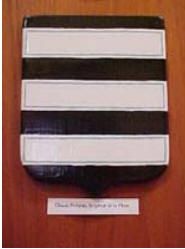
On the 1671 census of old Acadia, believed to be the earliest known record of the first families of the region, Claude Petit Pas (meaning 'little step') is listed as age 45 with 26 cattle and 11 sheep. In addition to his wife, Catherine Bagard, his household at the time consisted of seven children: Bernard, age 12; Claude (from whom I descend) age 8; Jean, age 7; Jacques, age 5 and 3 daughters. Names of female children were not recorded in the census, but, since Marguerite was born in 1661, it is being assumed that she was one of the daughters. She would later marry first Martin Dugas and second Claude Guédry becoming ancestor to the many families with variations of the Guédry name in North America.
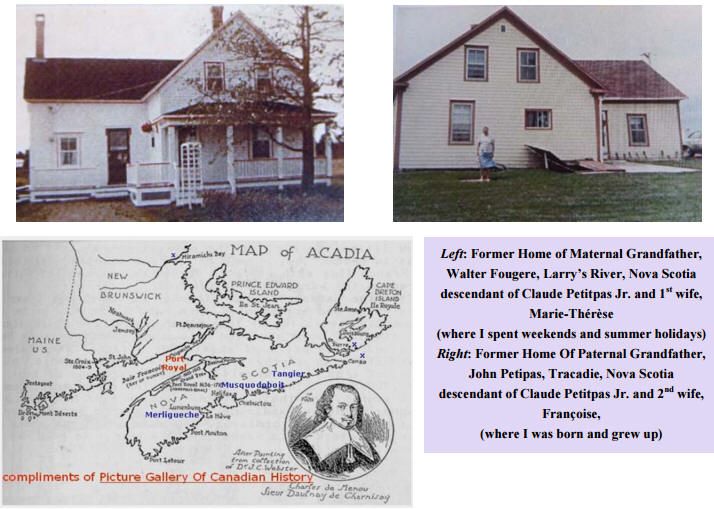
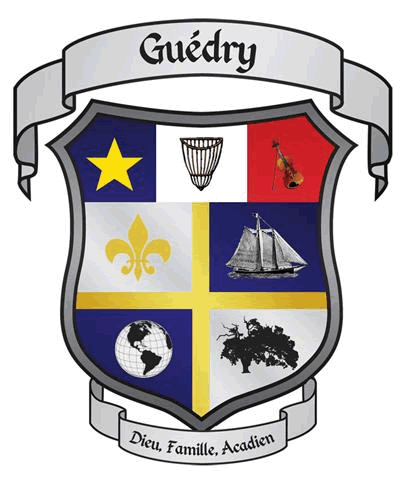
Claude Sr. died at Port Royal in 1690. Among his and Catherine's thirteen children that I was able to identify, the two about whom I was able to gather the most information were daughter, Marguerite, and son, Claude Jr. One reason for the lack of information on Claude Sr.'s remaining children is that several became integrated into the Mi'kmaq community, thereby disappearing from census and church records. Some of the descendants of Marguerite eventually ended up in the Louisiana area following the Great Deportation or Le Grand Dérangement, i.e., the forced removal by the British of the Acadians between 1755 and 1764 from the present- day Canadian Maritime provinces of Nova Scotia, New Brunswick and Prince Edward Island - an area then known as l'Acadye. As articles for this newsletter have previously been written by recent descendants of Marguerite, I would like to focus my article on her brother, Claude Jr. from whom I descend.
Claude Petitpas Jr. was born ca 1663 in Port Royal. Growing up there, he had always been close to the Mi'kmaq who lived in the Port Royal region. Here ca 1685 he met and married his first wife, Marie-Thérèse, a Mi'kmaq, by whom he had at least 7 children from whom some of my maternal Nova Scotia ancestors descend. Although no date was found, based on signage in the Merliguèche (Lunenburg) area of southwestern Nova Scotia, both Claude Jr., his sister, Marguerite, and their families later resided there with other settlers and their families. There “. . . they felled trees to clear the rocky soil for a little farming, plus fished and traded furs with the Mi'kmaq of the area.” Merliguèche, a Mi'kmaq summer camp in this region, was just a short distance from LaHave where between 1636 and 1638 Claude Jr. and Marguerite's maternal grandfather, Bernard Bugaret, a Basque carpenter, worked intermittently as a ship builder and organizer of fur hunting expeditions for Nicolas Denys. Denys would later become governor of the Gulf of St. Lawrence from Canso, Nova Scotia to Gaspé, Québec.
Claude Jr. and family next settled at Mouscoudabouet (Musquodoboit Harbour), southeast of Halifax, Nova Scotia, where ca 1698 he appears to have become closely associated with Boston fishermen who were quite active there, resulting in complaints about his relationship with them. In 1718 a frigate commanded by Captain Thomas Smart and sent from Boston by the governor of Massachusetts seized a number of French fishermen in nearby Canso (Canseau) harbour including Bernard La Sonde, son-in-law of Claude and his wife, Marie-Thérèse, and the seigneur of the region. Claude Jr. even placed his own schooner at the disposal of the English so that they might better carry out their plan! This is the only known military conflict between the Acadians and the British. Two years later, in 1720, the legislative council of Boston granted Claude Jr. £100 for obtaining the liberty of English captives during the Indian War by paying their ransom out of his own pocket. The council further agreed that the government would pay the tuition fees of one of his sons for four years at Harvard College.
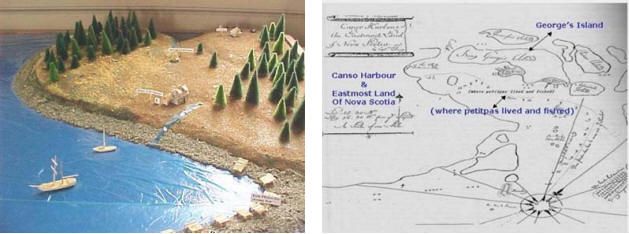
Among Claude Jr. and Marie-Thérèse's more notable children was son Barthélemy Petitpas , born 1687 possibly at Musquodoboit Harbour. Similar to his father, Barthélemy grew up among the Mi'kmaq, speaking their language and his family's French. Following in his father's footsteps, he also developed a close association with New Englanders trading and fishing in Acadia, becoming fluent in English also. His knowledge of all three languages made him a valuable asset in negotiations between the English and French rivals in Acadia, both among the Mi'kmaq and the Acadians.
Barthélemy appears to have also been involved in the 1718 Canso incident mentioned above. Afterwards he spent several years in Boston perfecting his English before returning in 1721 to become the official British Mi'kmaq agent in Nova Scotia. This caused concern to French officials, knowing he was becoming as much of a risk as his father, who had also helped the English. In November of 1721 his 18-ton schooner was confiscated at Louisburg, located on the southeastern end of Cape Breton, Nova Scotia. The partial restoration of the old fortress at Louisbourg in the 1960s and 1970s was the largest reconstruction project in North American history.
Because of his nonconforming ways, the following year Barthélemy was sent to the seminary in Québec in hopes of having him develop an interest in French missionary work. From Québec, where he displayed a greater interest in navigation, he was sent to Rochefort, France in 1722 to study under a hydrographer at the crown's expense and in 1723 sent to Martinique as a soldier. His bad influence on his comrades, however, led authorities to return him to France where he was imprisoned at Le Havre. Upon his release in 1730, and though prohibited from returning to Acadia, he arrived in ÎÎe Royale (Cape Breton) in the summer of 1731 where he was recommended for the post of Indian interpreter - a position earlier held by his father Claude Jr. until his death the previous summer. In 1745, while piloting a ship during New England's capture of Louisburg, Barthélemy was seized and imprisoned in Boston, Massachusetts, where he died in January 1747. His widow Madeleine Coste is reported in the 1752 census as living with six of their children at L'Ardoise on Île Royale.
Following the death of his first wife, Marie-Thérèse, Claude Petitpas Jr. appears to have moved to Port Toulouse (St. Peter's) on Île Royale where several of his children had settled, including Barthélemy mentioned above. There Claude Jr. married his second wife Françoise Lavergne in 1721 by whom he had four more children. Like Claude Jr., Françoise also had moved from Port Royal because of the unrest there, i.e., l'Acadye was now under British rule whereas Île Royale was still under French control. At Port Toulouse Claude Jr. continued his close association with the English. For example, in 1728 an inquiry was conducted by Joseph de Brouillan dit Saint-Ovide (Monbeton), then governor of Île Royale into the loyalty of the Indians towards the French. It appeared that Claude Jr. was attempting to influence the Indians, particularly the young ones, in favour of the English. If, however, the governor's attempt to get rid of him and two of his troubling sons from his first marriage by sending them to France was carried out, Claude Jr. does not appear to have been absent for more than two years before returning to Île Royale where he died in 1730. Following his death, the king presented Claude Jr.'s widow with a sum of money for services rendered in his capacity as interpreter. Then in 1747, Massachusetts Governor Shirley bestowed accolades upon him as a faithful subject of the British Crown for his services to its government.
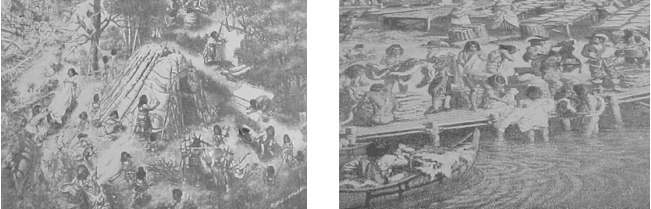
Although not as controversial as their father, Claude Petitpas Jr., and half-brother, Barthélemy Petitpas, the children of Claude Jr. and his second wife Françoise also left a mark on Acadian history. Unlike their Cajun cousins, they had avoided the Deportation commencing in 1755 by joining other Acadian families on Île Royale. Because of their close association with Abbé Pierre Maillard, a prominent missionary of the Mi'kmaq, after the Fall of Louisburg in 1758 they were granted permission by British Governor Lawrence of Halifax to settle in Chezzetcook, southeast of Halifax. Not only had Louis , son of Claude Jr. and Françoise, worked for Fr. Maillard, but he was named the executor to Fr. Maillard's will in 1759. That same year, Fr. Maillard was appointed agent to the Mi'kmaq by authorities in Halifax out of their fear of the natives and Fr. Maillard's positive influence over them. Then in 1760,Fr. Maillard made a request to Governor Lawrence to allow him to retain the services of Louis and his brother Joseph in Halifax as “. . . they may be useful as interpreters of the Indian Language and otherwise”. Fr. Maillard also recommended Louis and Joseph's brothers Jacques and Jean to the Governor as “. . . the most skilled people in making Dikes & wares to keep off the sea from our March Lands about Mines & Piziquid . . . .” Along with their families and other Acadians from Île Royale, these Petitpas families appear to have settled in the Chezzetcook area on the outskirts of Halifax where they remained until once more uprooted, this time by British Loyalists following the American Revolution. Today,a number of their descendants, including members of mymaternal and paternal families, can be found in the Tracadie and Larry's River areas of eastern Nova Scotia where I was born and grew up.