Why Did the Petitpas and Guédry Families Settle at Merliguèche?
Where persons decide to settle and raise their families is not happenstance. There are specific reasons for their choice of residence - as job suitability, available land, family already established there and other criteria.
Why would Claude Guédry and Marguerite Petitpas move from the relatively secure village of PortRoyal where her father, the clerk of the court, and her mother lived to the distant outpost of Merliguèche, mostly inhabited by Mi'kmaq? At least one of Marguerite's siblings, her brother Claude Petitpas, moved to this area about the same time as Claude Guédry and Marguerite Petitpas. Life had to be more difficult for Claude and Marguerite at Merliguèche -surviving on fish from the seas; animals, plants and nuts from the forests and vegetables from their garden plot; raising a family in the wilderness without help from their parents and withstanding the frigid winters alone and far from family.
One plausible reason for settling at Merliguèche was that this was “family land” and thus likely free land. As the document attached describes, the Petitpas family acquired the Merliguèche region when Catherine Bugaret's father, Bernard du Gueret dit St. Martin, received it as a concession from the King of France about 1636. Catherine Bugaret was the only known child of Bernard du Gueret dit St. Martin and thus would have inherited the Merliguèche concession. Note that the surname du Gueret was altered to Bugaret in later documents referring to Catherine.
The attached document is just one paragraph of a much larger 58-page document entitled Memoire de l'Île Royalle (Recollections of Île Royale) located at the Archives Nationales (France), MG1, DFC. Dépôt des fortifications des colonies, folios 1-29v. The attached pages are folios 28 and 28v. Jacques L'Hermitte wrote the document. He was an engineer sent to Acadia to survey potential harbor facilities and natural resources such as timber for the navy. The document is dated December 1716; therefore, the phrase “about 80 years ago” would represent approximately 1636.
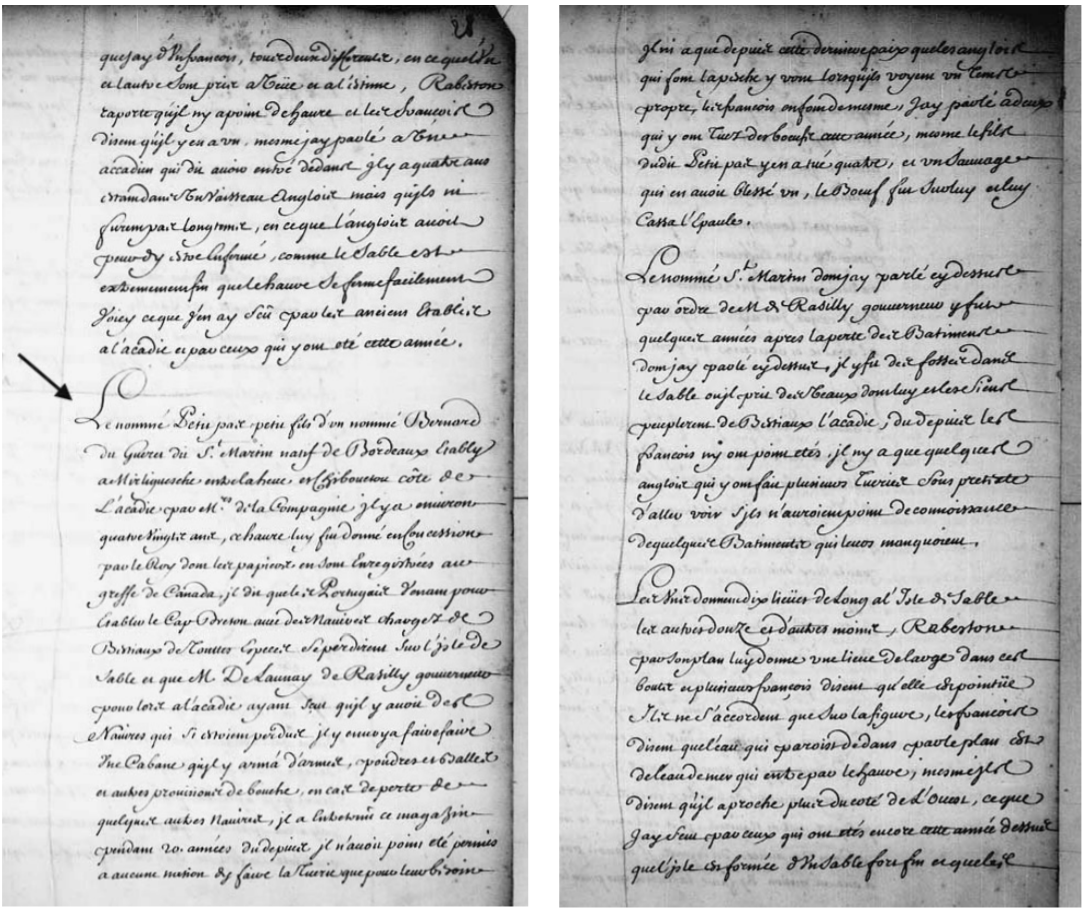
Translation
The named Petitpas, 1 grandson of one Bernard du Gueret dit Saint-Martin, a native of Bordeaux established at Mirliguèche, between La Hève and Chebucto 2 coast of Acadia, through the gentlemen of the Company 3 about 80 years ago, was given this harbour in a concession by the King, as recorded in papers registered with the Registrar's Office of Canada. He 1 says that the Portuguese, coming to settle Cape Breton with ships laden with livestock of all sorts, were shipwrecked on Sable Island and that M. DeLaunay de Razilly, 4 governor then of Acadia, having known of ships that had been wrecked, sent him 5 to establish a post which he armed with guns, powder and shot and other provisions for sustenance, in case of other ships being wrecked. He 5 maintained this post for the following 20 years. He was not given permission to slaughter 6 except for their subsistence. It has only been since this last peace 7 that the English who run the fishery go there when they see a clear entrance. The French do the same. I spoke with two who killed cattle there this year, even the son 8 of the above-mentioned Petitpas who killed four of them, and an Aboriginal who wounded one; the steer ran into him and broke his shoulder.
Footnotes
- This would have been Claude Petitipas, son of Claude Petitpas and Catherine Bugaret, and husband of Marie-Thérèse, a Mi'kmaq.
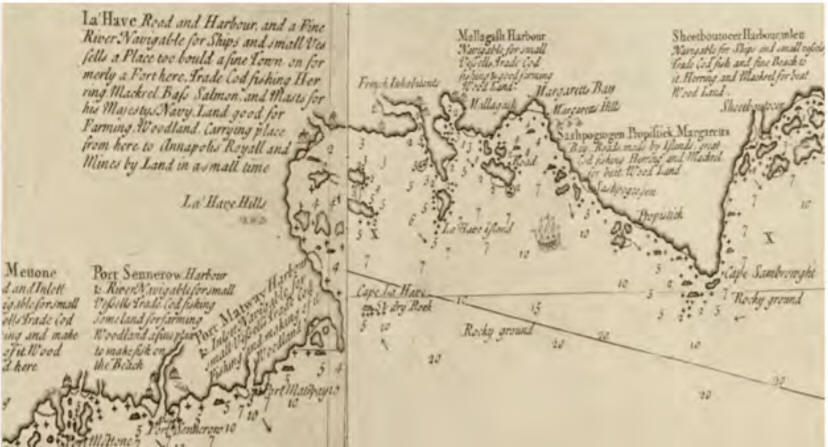
- La Hève is today LaHave and Chebucto is today Halifax. Mirliguèche was located at today's Lunenburg.
- The Company refers to the Compagnie de Razilly-Condonnier.
- Claude Delauney de Razilly, brother of Isaac de Razilly, had been granted Sable Island, La Hève and Port-Royal by the King and in 1636, with the death of his brother Isaac de Razilly, had inherited Isaac's share of Compagnie de Razilly-Condonnier.
- Bernard du Gueret dit Saint-Martin (His daughter Catherine spelled the surname Bugaret.)
- He could not slaughter any of the livestock.
- Established by the Treaty of Utrecht signed in March and April 1713
- A son of Claude Petitpas and grandson of Claude Petitpas and Catherine Bugaret