Two Homes Built by Exiled Acadians in Connecticut
Acadian history is replete with the suffering that the deported Acadians underwent within the English colonies of North America, England and western France. Too little food, not being able to practice their Catholic faith, children being removed from parents and lack of work are but a few of their hardships. Islands of hope did spring up occasionally where courageous men attempted to help the Acadians as Anthony Benezet in Philadelphia and Henry Callister in Oxford, Maryland.
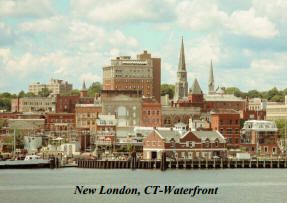
A brief note in the diary of Joshua Hempstead on Wednesday, 21 January 1756 notes "a Ship arrived with 300 french Nuterals (sic) from Nova Scotia. Both Sexes &c." 1
As the 277 ragged, starving Acadians, some suffering serious illness, slowly trudged from the 166-ton Elizabeth to the New London docks, the townsfolk surely kept their distance, wondering how they should approach these French-speaking Catholics and how they would care for them. They had left their Annapolis Royal lands a prosperous people and arrived in New London a desperate lot.
Soon other Acadians began arriving. The next day, 22 January, a sloop under Captain Worster delivered another 173 souls from the Minas Basin to the Connecticut shores. Then on 30 January Captain Samuel Forbes anchored his 87-ton sloop Dove in the harbor and offloaded an additional 114 Acadians from Annapolis Royal. Finally, on 22 May 1756 the 139-ton sloop Edward under the hand of Captain Ephram Cooke arrived at New London after encountering a bad storm that drove it into the harbor at Antigua. Almost 100 Acadians died of smallpox while kept onboard at Antigua. On arriving in Connecticut months after leaving their Annapolis Royal homes, the remaining 180 Acadians struggled from the Edward to the New London shores. Immediately their meager belongings were burned to prevent an outbreak of disease in the town. Approximately 744 Acadians survived the treacherous journey amid storms, starvation, cold and disease and arrived in New London, Connecticut. 2
Connecticut distributed the Acadians among 50 towns and New London was alloted 12 of them. 4 Desperate and poor the Acadians sought work to support their families. Capt. Nathaniel Shaw, a wealthy merchant and ship owner of New London, wanted to help them and hired approximately 35 Acadians to construct his new home. most of these Acadian men must have journeyed from neighboring towns or perhaps, hearing of work, some Acadians destined for other towns were able to settle in New London at least temporarily.
Shaw Mansion
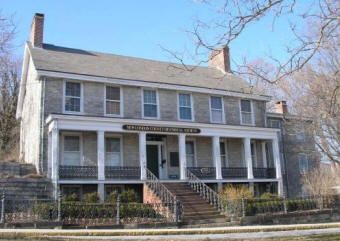
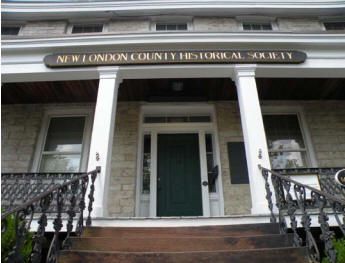
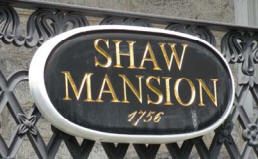
Begun in early 1756, Captain Shaw built a stone house using granite cut by 35 Acadians from the ledge at the back of his property. 5 At the time Captain Shaw resided in a frame dwelling toward the rear of his property, which stretched to the Thames River in front. Commencing from a rock-hewn foundation, the Acadians began constructing a large Georgian-style granite home. After two years of hard work, the Acadians finished the home in 1758. As a testament to their outstanding workmanship, the home stands today in excellent condition.
A flight of brown stone steps leads to the main entranceway. Supported by seven square posts and surrounded by an ornate iron fence, the spacious porch extends across the front of the main building. Inside the large front door, a central hallway greets the visitor. From this hallway four large rooms open. A beautiful quarter-turn stairway at the rear of the central hallway climbs to a large square hall on the second level.
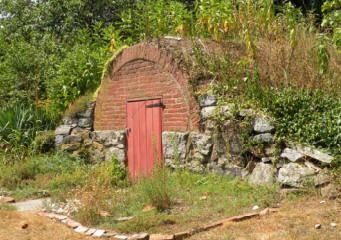
Here five bedrooms served the Shaws and their guests. The third floor of the main house contains six rooms and a square hall. A stairway from this level leads to the dark, low attic. All of the walls of the house are plastered. Seven fireplaces provide warmth from the cold Connecticut winters. Dr. Nathaniel Shaw Perkins, a later owner, added a stone annex to the right of the main house in 1845. About 1843 a root cellar was built in the rear yard. 6
The three-story home has seen American history unfold within its walls. Nathaniel Hale briefly visited the Shaw Mansion about 1775. It was the headquarters of George Washington during the American Revolution when he stayed at the Shaw Mansion on the 9th and 10th April in 1776. During the American Revolution Nathaniel Shaw Jr. was the Naval Agent for Connecticut and the Shaw Mansion served as the Naval War Office during this time. 7 On the 6th of September 1781 Benedict Arnold led his British invaders into New London and proceeded to burn the town. As they approached the stone Shaw Mansion, they lit it on several sides, but soon realized it was difficult to set ablaze. The soldiers looted the interior of the house and were successful starting several small fires around the exterior. Fortunately, a neighbor approached the house as the soldiers departed and, using a pipe, he broke open a barrel of vinegar. He climbed to the roof and pour vinegar down the roof until the flames were out. Because of his quick-thinking and decisive action, only the kitchen suffered damage. 8 9 Since 1907, the Shaw Mansion has served as the headquarters of the New London Historical Society. It stands today as a testament to the hard work and superb craftsmanship of the exiled Acadians.
The Shaw Mansion at 11 Blinman Street in New London is open to the public for tours.
Nathaniel Hempstead House
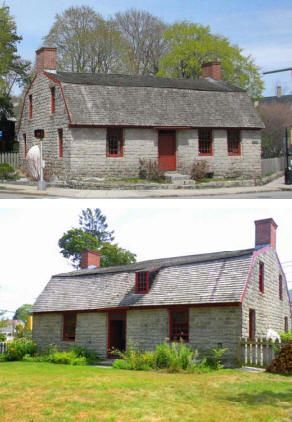
Shortly after the Acadians in New London completed the Shaw Mansion, they were hired by Nathaniel Hempstead to construct a stone house less than a quarter mile distant from the Shaw Mansion. The Acadians cut granite from a ledge at the base of the house. The cut granite was laid in regular horizontal courses with a small amount of mortar to secure it - providing a wall twenty-four inches thick. This type of stonework with regular horizontal rows is characteristically French. English stonework is typically rubble work. Thus, it appears likely that the Acadians brought this technique with them to New London rather than learning it locally. 10 11 The Shaw Mansion and the Nathaniel Hempstead House are unique in New London with their stonework.
Nathaniel Hempstead had his home built in front of his grandfather Joshua Hempstead's 1678 wood frame house.
The one and one-half story, gambrel-roofed Nathaniel Hempstead House has four rooms on the ground floor with a chimney at each end of the house. The second floor has two large rooms. Two stone steps lead to the large, wooden front door. Completed in 1759, the house originally was on the waterfront before Bream Cove was filled in. 10
Interestingly, the Nathaniel Hempstead House contains the first confirmed evidence of stone blasting in the northeastern United States. A partial cellar was created under the house by blasting the stone ledge. The stone from the blasted ledge was hammered into small paving blocks and used to build the house. A single surviving round, drilled blast hole one inch in diameter and eight inches in depth survives in the cellar. 12
Owned today by Connecticut Landmarks, the Nathaniel Hempstead House at 11 Hempstead Street in New London is open to the public for tours.
Acadian House
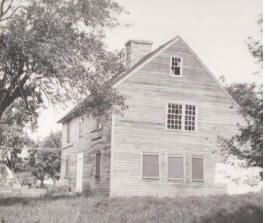
Although not built by Acadians, the Acadian House in Guilford, Connecticut housed an Acadian family when they first arrived in Guilford in the Spring of 1756. Built in 1670, the classic two story,saltbox Acadian House was home to the family of René Hébert and Marie Boudreau with their son Pierre, daughter-in-law Elisabeth Dupuis and at least five grandchildren. They were deported from Grand-Pré, Acadia. 13 14
The Acadian House at 37 Union Street in Guilford is a private home today and not open to the public.
References
- Hempstead, Joshua; Diary of Joshua Hempstead of New London, Connecticut Covering a Period of Forty-Seven Years from September, 1711 to November, 1758 (The New London County Historical Society; New London, CT; 1901) p. 662
- Hebert, Tim; "Acadian-Cajun Genealogy & History" Website ("Exile Destination: Connecticut" Webpage; Last Viewed: 4November 2014) http://www.acadian-cajun.com/exco.htm
- The Public Records of the Colony of Connecticut from May, 1751, to February, 1757, Inclusive (Press of the Case,Lockwood & Brainard Co.; Hartford, CT, 1877) Volume 10, p. 425
- Ibid.; pp. 452-453
- Federal Writers' Project; Connecticut - A Guide to Its; Roads, Lore and People (American Guide Series) [Houghton Mifflin Company;Boston, MA; 1938) p. 263
- Rogers, Ernest E.; Connecticut's Naval Office at New London during the War of the American Revolution (The New London CountyHistorical Society; New London, CT; 1933; Collections, Volume II) pp. 68-72
- Ibid.; pp. 72-75
- Ibid.; p. 73
- Andriopoulos, Evan; "The Burning of New London" Website(Last Viewed: 4 November 2014), p. 12 of 17
http://www.battleofgrotonheights.com/The_Burning_of_New_London.html - Luyster, Constance; Connecticut Historical Commission "Nathaniel Hempstead House, New London Connecticut" ("National Register of Historic Places Inventory - Nomination Form"; United States Department of the Interior, National Park Service - National Register of Historic Places; Washington, DC; Entry Number 70.12.09.0040; 2 December 1970)
- Weaver, Martin E.; "A Short Note on the Nathaniel Hempstead House in New London Connecticut" ( Bulletin of the Association for Preservation Technology ; Volume 8, No. 3; 1976) pp. 83-87
- Gage, James E. and Gage, Mary E.; "Stone Structures of Northeastern United States" Website ("Stone Splitting Methods" Webpage; ast Viewed: 4 November 2014), p. 1 of 9
- Lafreniere, Albert N.; "Acadians in Guilford, Connecticut" (Acadian & French-Canadian Ancestral Home Website by Lucie LeBlanc Consentino; "Acadians Guilford Connecticut" Webpage; Last Viewed: 4 November 2014)
http://www.acadian-home.org/acadians-guilford-ct.html - Guilford Preservation Alliance: "Historic Guilford" Website (HGWT; "Acadian House of Guilford, Connecticut" Webpage; Last Viewed: 4 November 2014)
http://www.historicguilford.org/hti/2012/03/acadian-house-of-guilford-connecticut/