Guédry et Petitpas Reunion 2024
GUÉDRY ET PETITPAS REUNION
16-17 AUGUST 2024
ST. ALPHONSE, NOVA SCOTIA
RECAP
The Guédry and Petitpas families met again in 2024 during the Congrès Mondial Acadien in St. Alphonse, Nova Scotia - a small community in the Clare Municipality along Baie Sainte-Marie. Augustin Guédry and Marie Jeanson founded St. Alphonse in 1787. It was originally called Chéticamp-de-Clare, but in 1932 the name was changed to St. Alphonse to avoid confusion with the town of Chéticamp on Cape Breton.
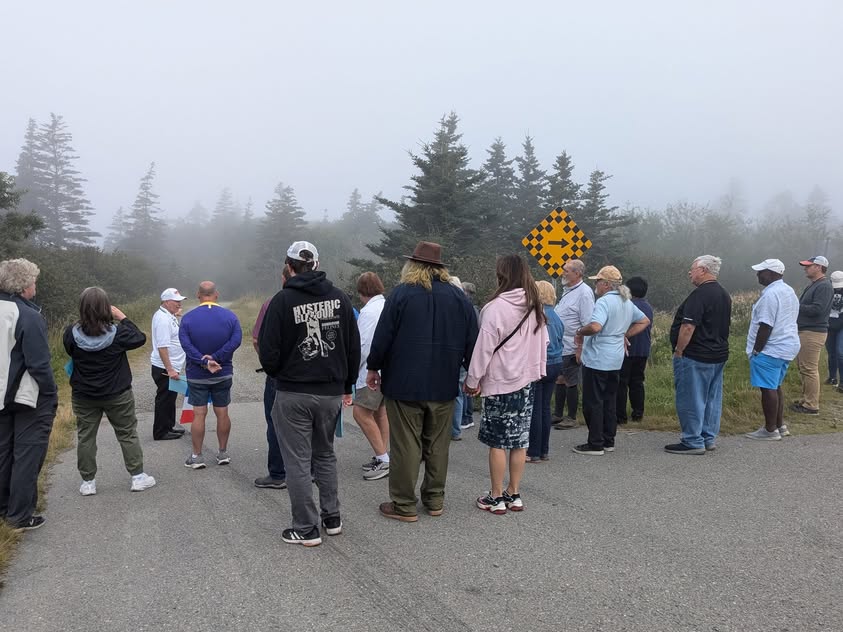
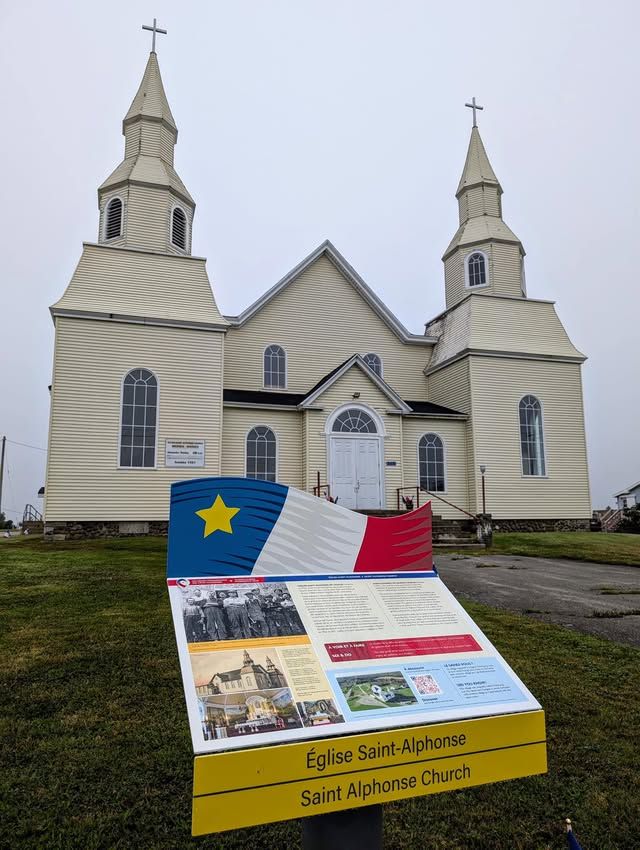
On Friday, 16 August 2024, folks arrived early in the morning for a guided auto tour of the Clare area concentrating on historic Acadian and Guédry-related sites. We divided the folks on the tour in two groups of 27 people in each. The tour covered the area from Cap Sainte-Marie south of St. Alphonse to Belliveau Cove. Highlights included Pointe-à-Major where the first Acadians to reach the Clare area settled briefly and established the first Acadian cemetery in Clare, Cap Sainte-Marie with its rocky ledge and lighthouse that for many years had Albert Jeddry as the lighthouse keeper, Philippe Geddry's home (the son of Augustin Guédry and Marie Jeanson), Bear Cove where Augustin Guédry and his family landed just prior to settling at today's St. Alphonse, the beautiful Stella Maris (St. Mary's) Catholic Church in Church Point, the remains of the recently-burned Bangor Sawmill where a number of Guédry lumbermen worked, Guédry's Corner, a small village settled by the Evariste Geddry family, La Vieille Maison, an Acadian museum in Meteghan that is one of the last Acadian homesteads and St. Alphonse Church, built in 1922 and containing a beautiful grotto, seven wonderful murals around the altar and the marble Madonna Statue in the parking area. We had an authentic Acadian lunch at the Wheelhouse Restaurant in Belliveau Cove overlooking the Baie Sainte-Marie.
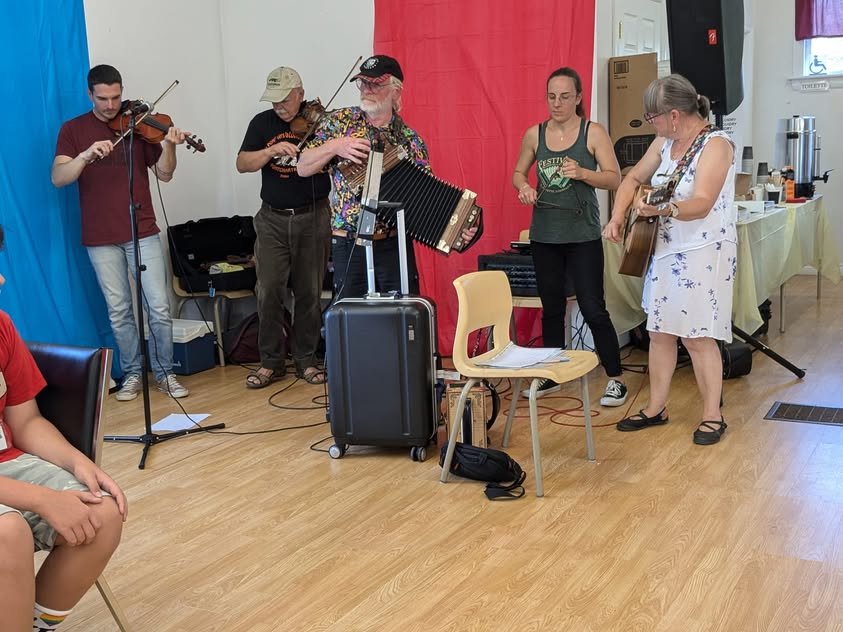
Friday evening, we enjoyed an old-fashioned Acadian Kitchen Party with boiled lobster and chicken fricot prepared and catered by Pierre Boissonnault of La Pointe Seafoods in Belliveau Cove. The supper was outstanding and enjoyed by all. Folks also enjoyed lots of time to visit and get to know each other. After supper the French Cajun Band "Bal de Maison" provided two hours of Cajun music for all to enjoy. The musicians in "Bal de Maison" hail from the interior of France and have had a lifelong passion for Cajun music. They have played together for two decades. Although they have visited Louisiana over 20 times, this was their first time in Nova Scotia. The crowd was enthusiastic and some even danced a two-step and waltz during the evening.
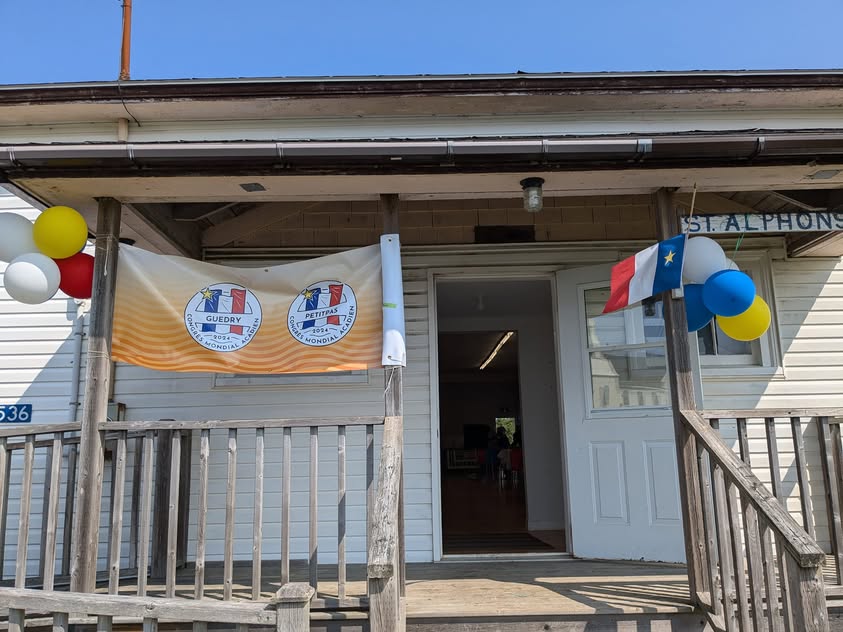
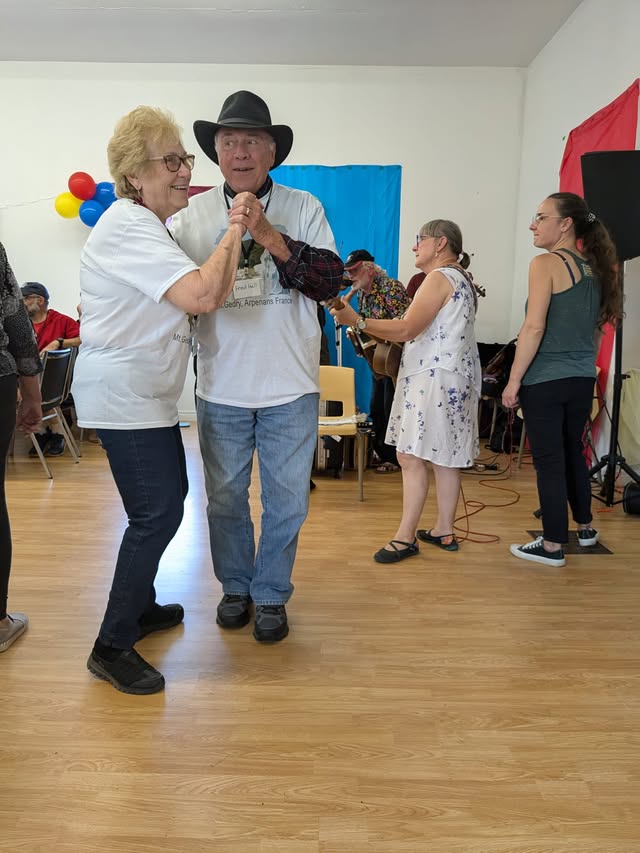
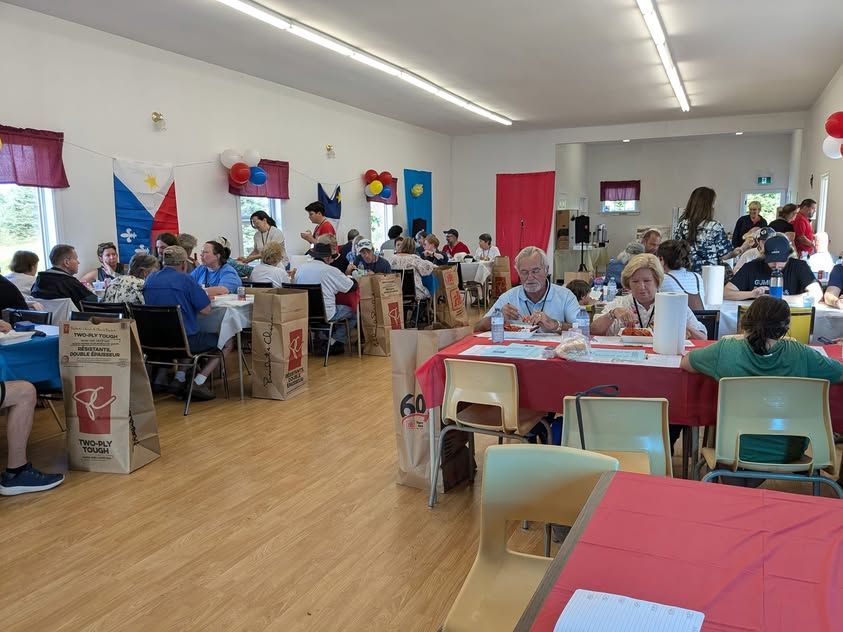

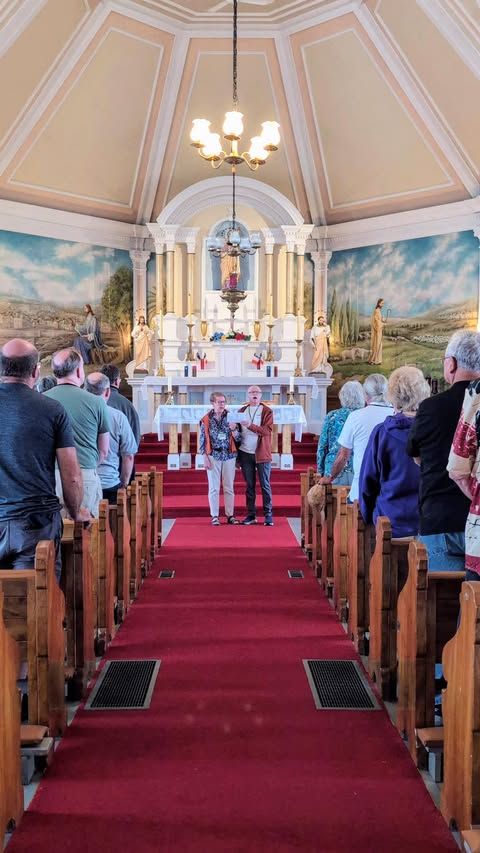
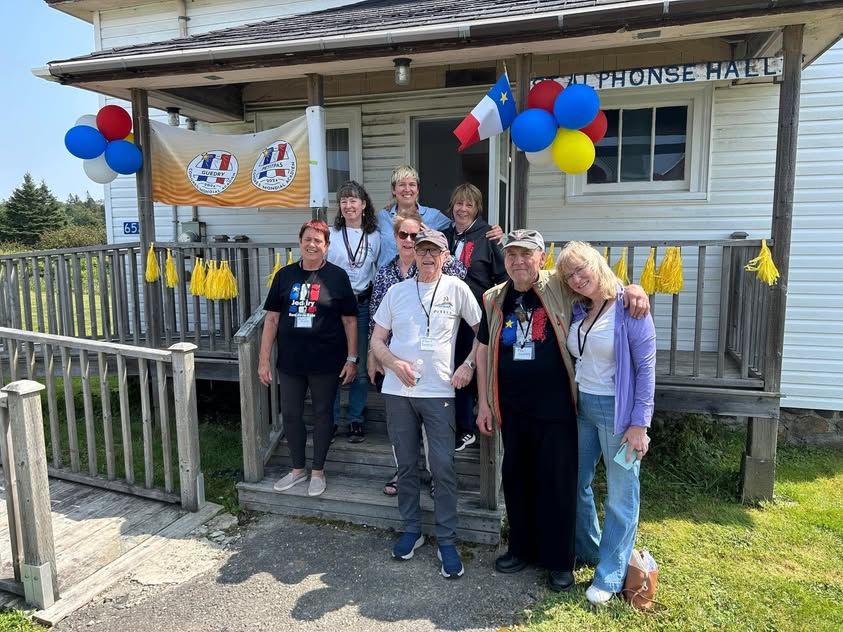
As Saturday morning appeared along the beautiful shore of Baie Sainte-Marie, folks arrived for our Reunion. After registering at St. Alphonse Church Hall, we crossed Highway 1 to visit the historic St. Alphonse Catholic Church and open our Reunion with Albert and Simone Geddry leading us in the Ave Maris Stella (Acadian National Anthem). Former Member of Parliament for the Clare area Wayne Gaudet presented a superb talk on the several beautiful murals surrounding the altar and their painter Pius LeBlanc.
We then returned to the Church Hall for opening remarks followed by Martin Guidry, dressed as an Acadian of the 1750s, presenting a talk entitled "History of the Acadians in the Baie Sainte-Marie Region". After the presentation all enjoyed an authentic Râpure (Rappie Pie) for lunch. During the day lots of time was built into the agenda so folks could visit, view the many posters displayed and touch the Guédry Rock from Merliguèche. At mid-afternoon we inducted six family members into the Les Guédry et Petitpas d'Asteur Circle of Distinction which honors those in our family, living or deceased, who have brought distinction to the Guédry or Petitpas surname in any of their variations. Those honored included Dirk Guidry (for his artistic innovation), Brigadier General Robert E. Guidry (for his military service and civilian entrepreneurship), André Pettipas (for his life of musical innovation on the stage), Rev. Jean-François Petitpas (for his Canadian military ministry and his superb research on the origins of the Petitpas family), Augustin Guédry (for his founding of Chéticamp-de-Clare / St. Alphonse) and Shirley M. Guidry (for his WWII military service and long-time civilian ministry in his community; Shirley is the last-known survivor of WWII in the Guédry family).
Daniel Guidry, our first President of Les Guédry et Petitpas d'Asteur surprised Martin Guidry with a Special Recognition Award for leading the family association for the last 25 years and organizing our family reunions at all the Congrès Mondial Acadien events since 1999, the Grand Réveil Acadien events in Louisiana and other reunions over the years. The Award included an induction into the Les Guédry et Petitpas d'Asteur Circle of Distinction, a certificate and a special commemorative Canadian coin.
Jason Guidry then led everyone in Family Bingo and gave directions to nearby Mavillette Beach for those that wanted to watch the sunset over Baie Sainte-Marie and get their feet wet. Approximately 85 folks attended the two-day Guédry et Petitpas Réunion at St. Alphonse, Nova Scotia.
Thanks to all who helped plan and put on the Reunion. Special thanks to the Reunion Planning Committee who worked almost two years planning this reunion - Jason Guidry, Rayanne Mailman-Guidry, Nathalie Geddry, Marie-Claude Geddry, Randy Jeddry and Martin Guidry. Thanks also to Albert and Simone Comeau Geddry for leading us in Ave Maris Stella during the opening ceremonies and to Allie Guidry, Rachel Killingsworth and Jeff Killingsworth for manning the Sales and Registration Tables and helping with setup and takedown ac vi es. We appreciate the help of Irene Jeddry and Jeanine Maillet for reserving the Hall and opening and closing the Hall for us during the Reunion. Finally, a big thanks to all that helped with the meals and that brought dishes Friday and Saturday evenings. And for all of you that pitched in during setup, takedown and throughout the Reunion, we really appreciate all you did.
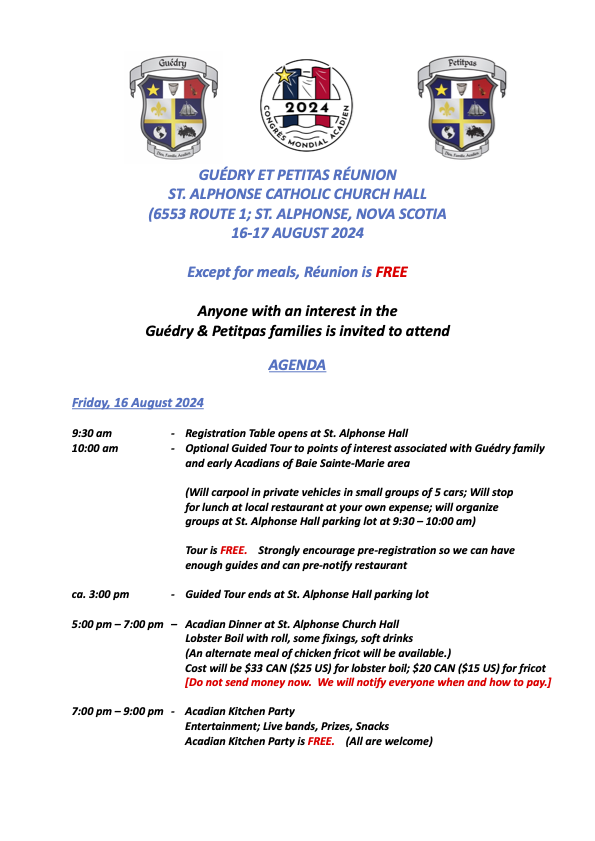
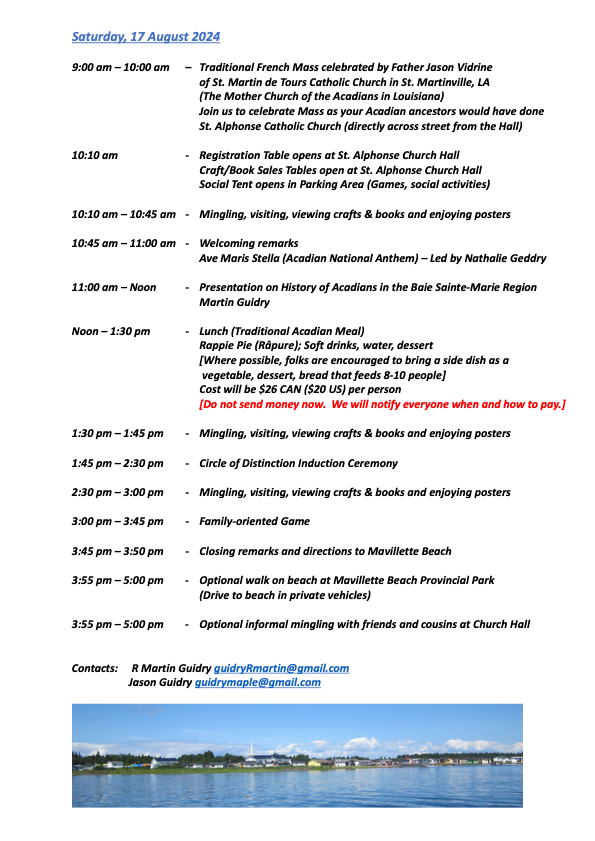
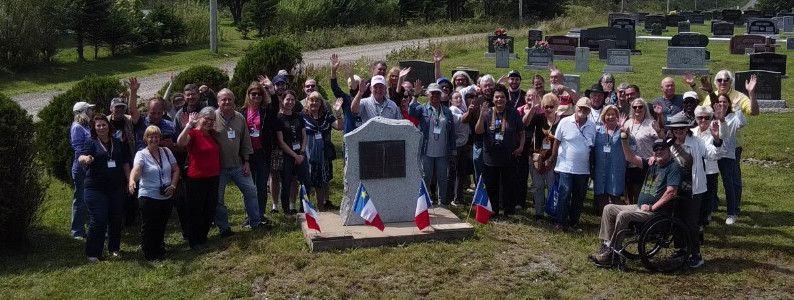
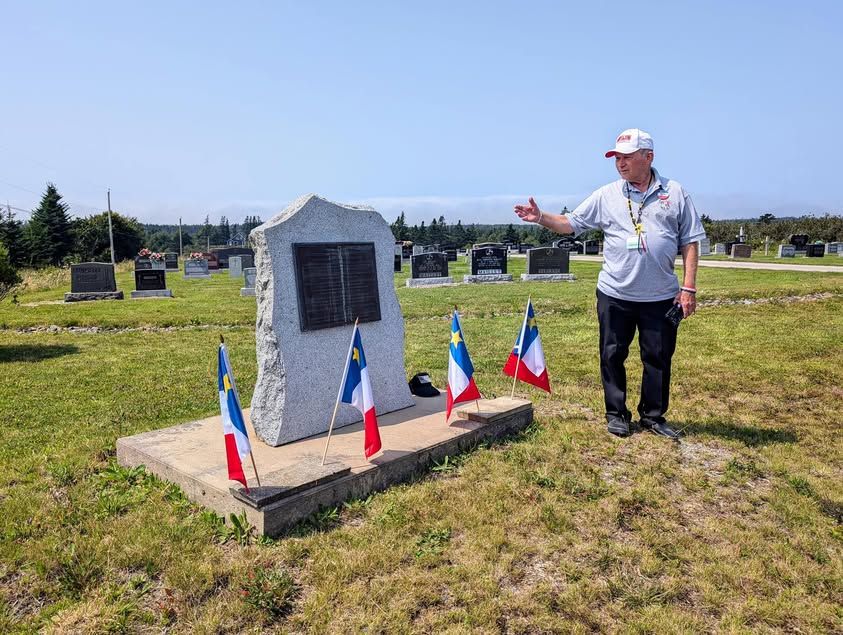
Attached is the Agenda for the Reunion, the guide for the Auto Tour of Clare and a photograph by Mike Casper of many Reunion participants around the Memorial Plaque honoring Augustin Guédry dit Grivois and Marie Jeanson located behind St. Alphonse Catholic Church.
BAIE SAINTE-MARIE TOUR
16 August 2024
This tour encompasses many Acadian historic sites and Guédry-related sites along Baie Sainte-Marie from Cap Sainte-Marie to Belliveau Cove. There are other historic sites along Baie Sainte-Marie outside of this range. Because of time limitations, most of the historic churches and cemeteries are not stops on the tour.
- St. Alphonse Catholic Church [6553 Highway 1; St. Alphonse]
Today St. Alphonse Catholic Church is one of four Catholic congregations comprising the Paroisse Notre Dame d'Acadie. Established as a Catholic parish in 1922 when the present church was built. The first pastor was Père Alphonse B. Côté. The church parish comprised the communities of St. Alphonse-de-Clare (originally called Chéticamp), L'Anse-à-l'Ours (Bear Cove), le Cap-Ste-Marie (Cape-St. Mary's) and the eastern portion of Mavillette. The patron saint is St. Alphonse-de-Liguori. Besides the beautiful church building, note the grotto inside that is built of wood, but painted to appear to be stone. It is a replica of the Notre-Dame-de-Lourdes grotto in France. Also, take a moment to view the seven murals near the altar painted in 1946 by Pius LeBlanc of Little Brook. Finally, see the marble statue of the Madonna erected in 1953 with the large rosary at its base. The cemetery is at the rear of the church and there you will find many graves of Geddry, Gedry, Jeddry, Jedry and Gidry family members. At the rear of the parking area near the entrance to the cemetery, take a moment to read the historic plaque honoring Augustin Guédry and Marie Jeanson, the founders in 1787 of the town of Chéticamp. The name was changed to St. Alphonse-de-Clare in 1922 to avoid confusion with the town of Chéticamp on Cape Breton with their postal and other services.
[From the church parking lot, turn left onto Highway 1 and go approximately 4 km. Turn right onto John Doucette Road.] - Malivette Beach Provincial Park [Along John Doucette Road; Malivette]
A beautiful 1.5 km long sandy beach protected by marram grass-covered dunes with boardwalks. Beautiful views of La Baie Sainte-Marie.
[Continue along John Doucette Road until intersection with Cape St. Mary's Road. Turn left onto Cape St. Mary's Road. (Note Jeddry Road on your right just after turning onto Cape St. Mary's Road.) Follow Cape St. Mary's Road until Lighthouse Road and turn right onto Lighthouse Road. Park near end of Lighthouse Road.] - Cape St. Mary's Lighthouse and Park (End of Lighthouse Road; Cape St. Mary's)
Take a moment to view the beautiful Cape St. Mary's Lighthouse and the surrounding park which contains interpretative panels on the history of the lighthouse, founding the village and local marine ecology also a granite monument memorializing Clare seaman lost over the years. The first lighthouse was built in 1868 with the present structure dating to 1969. Walk to the shore to see the rocky cliffs up close and outstanding views of La Baie Sainte-Marie. Albert Jeddry, son of Eddie Jeddry, was the lightkeeper at the Cape St. Mary's Lighthouse for several years. Several Geddry/Jeddry fishermen used to depart from the small port here and head into Baie Sainte-Marie to catch fish and lobster.
[Backtrack along Cape St. Mary's Road - passing John Doucette Road on your right - and continue to Highway 1. Turn left onto Highway 1 and pass St. Alphonse Catholic Church. Drive a short distance until Bear Cove Road - the first road on your left. Turn left onto Bear Cove Road and stop briefly or slow down.] - Original Augustin Guédry Land Grant (Bear Cove Road at Highway 1 - north end; St. Alphonse)
Stop briefly after turning onto Bear Cove Road. This tree-cover, hilly land stretching 2/3 mile toward St. Alphonse (to your left) and 1/3 mile to Meteghan (on your right) encompassed the original land grant to Augustin Guédry. This area must have seemed like a paradise to Augustin and his family as they moved their home from Gilbert's Cove to the soon-to-be Chéticamp (later renamed St. Alphonse). Surely, with the English creeping closer and closer to Gilbert's Cove, it was time to “escape” a second time and move south to this area. Augustin Guédry and his family lived on land just to the south of Highway 1.
[Continue down Bear Cove Road for 1.1 miles until a sharp bend to the right. Park near here. The short dirt path on the left leads to Bear Cove where Augustin Guédry and his family landed in 1787. You may take the short hike (approx. 0.1 miles) - just beware of uneven surfaces.] - Bear Cove (At major right-hand curve on Bear Cove Road; 1.1 miles from Highway 1; St. Alphonse)
As you reach a strong right-hand curve on Bear Cove Road, look to your left and there is a trail leading down to a small cove of Baie Sainte-Marie. This is Bear Cove where Augustin Guédry and his family landed in 1787 after leaving their home at Gilbert's Cove just south of Plympton on Baie Saint-Marie. If you have a moment hike the short distance (approx. 200 yards) to see Bear Cove, but beware of the uneven terrain.
[After leaving Bear Cove, backtrack on Bear Cove Road for 1.1 miles to Highway 1. Turn left onto Highway 1 and continue approx. 0.7 mile until you see a small house on the left with five windows in a row on second story at 7051 Highway 1. - Philippe Geddry House (7051 Highway 1; Meteghan)
This was the house of Philippe Geddry, father of Evariste Geddry and son of Augustin Guédry and Marie Jeanson. Note the”pop-out” extension on 2nd floor with two windows and the centered chimney. The beams under the house still have some of the original tool marks from its construction. Evariste Geddry was born in this house. It has been modified over the years.
[Continue down Highway 1 for 1.8 miles until you see a small road on the left leading to Smuggler's Cove. Turn left onto the road to Smuggler's Cove and park in the parking area a short distance further.] - Smuggler's Cove Provincial Park [Le Fourneau] (Smuggler's Cove Road off Highway 1; Meteghan)
During Prohibition in the 1920s, this small cove was used to smuggle rum and liquor to the thirsty souls of Baie Saint-Marie. See the Interpretive Panels detailing the history of this site. Of course, no Guédry would have purchased these illegal libations. Spectacular views
[After leaving Smuggler's Cove, turn left onto Highway 1 and drive approx. 1.8 miles to Peter Dugas Road. Watch carefully for Peter Dugas Road. Turn left onto Peter Dugas Road and drive onto the wharf.] - Meteghan Wharf (End of Peter Dugas Road on Baie Sainte-Marie; Meteghan)
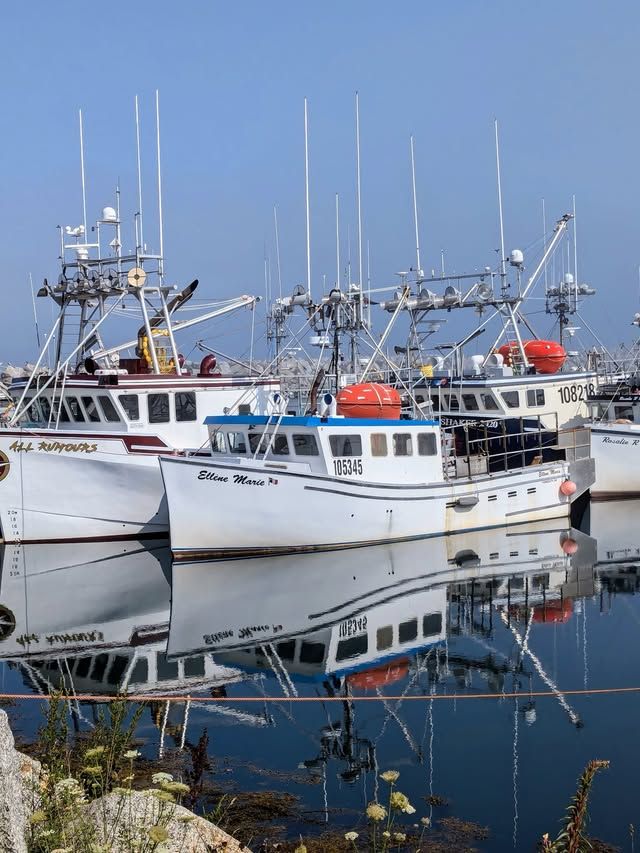
Drive briefly onto Meteghan Wharf so folks can see the scallop draggers, trawlers, herring seiners, ground fish and lobster boats. The busiest port in Clare. There is an interpretive panel. Today several Jeddry fisherman depart in their watercraft from this wharf for lobster and fish.
[Backtrack along Peter Dugas Road from Meteghan Wharf to Highway 1. Turn left onto Highway and go approx. 0.2 miles to the parking lot of Stella Maris Catholic Church.] - Stella Maris Catholic Church and Cemetery (Highway 1-0.2 miles from Peter Dugas Rd; Meteghan)
Many Geddry's and Jeddry's are buried in this cemetery. Find the grave of Jérôme - an amputee that mysteriously appeared on the beach at Sandy Cove in Clare in 1863 and lived for over 60 years in Clare - many of those in Meteghan where he died. His grave is on the Highway 1 side of the cemetery near the parking lot. Meteghan was founded in 1785 by Prudent Robichaud, Joseph LeBlanc and other Acadian families. The name Meteghan is thought to derive from the Mi'kmaq “Mitihikan” which means “blue rocks”.
[Turn right onto Highway 1 and travel to The Wheelhouse Restaurant (3334 Highway 1) at Belliveau Cove.]
Wheelhouse Restaurant (3334 Highway 1 at Belliveau Cove) - LUNCH We will eat lunch there at each person's expense. Click this link for their menu: https://www.wheelhouseseafoodpasta.ca/menu
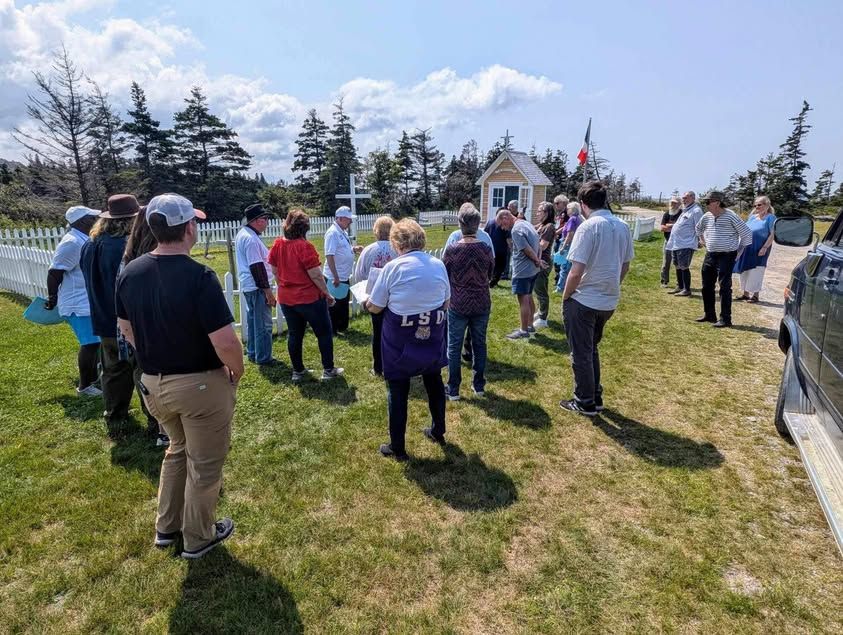
[Turn right onto Highway 1 from Wheelhouse Restaurant and travel 1 mile to Major Point Road. Turn right onto Major Point Road and go ¾ mile to its end.] - Pointe-à-Major Historic Site (245 Doucette Point Road; Belliveau Cove)
Site of the first Acadian Cemetery in Clare and site of the first Mass in Clare. It was used from at least 1771 when Marie Doucet, wife of Amable Doucet, died and was buried here (See the stone marker) until 1790 when a new cemetery in Church Point was consecrated. It is possible that some of the Acadians wintering here in 1755-1756 that died also are buried in the Point-à-Major cemetery. The cemetery was consecrated in 1774 by a missionary priest Père Joseph-Mathurin Bourg.
The small chapel dates from 1892 and replaced a smaller one built in 1889. It contains some religious and historic materials. Note plaques, cairn and signs in area giving historical information.
In the winter of 1755 Pierre “Piau” Belliveau led approximately 120 Acadians to this site as they escaped exile from Annapolis Royal. They traveled overland crossing North Mountain to Chute's Cove before using small fishing boats for the rest of the journey. They overwintered here in rudimentary shelters before leaving in the spring of 1756 crossing the Bay of Fundy to the Saint John River in New Brunswick, which was still under French control. They eventually went to the La Baie des Chaleurs in northeastern New Brunswick. Several of the group died during the winter and were buried in this vicinity.
Shortly after these 120 Acadians settled at this location, 232 Acadian refugees arrived in the “Pembroke”. The “Pembroke” had left from Annapolis Royal (Goat Island) with its imprisoned Acadians for New York; however, the Acadians under the leadership of Charles Belliveau had overcome the crew and gained control of the “Pembroke”. They sailed back to the Bay of Fundy and stopped at Point-à-Major in December, 1755. In early January 1756 they set sail for the St. John River across the Bay of Fundy.
The first Acadians to arrive in Clare and settle permanently were Joseph Dugas, his wife Marie-Josephe Robichaud and their daughter Isabelle. They arrived on 5 September 1768 after walking from Annapolis Royal. They settled at L'Anse-des- LeBlanc - about 0.3 miles east of Pointe-à-Major. Shortly after arriving, on 25 September they had their second child and named him Joseph. They remained here alone through the winter of 1768-1769. In the spring of 1769 ninety-eight additional persons (14 families) arrived. Most of them settled just east of Joseph Dugas at L'Anse-des-Belliveau (Belliveau's Cove) and included Jean Belliveau, his wife Marie- Madeleine Gaudet and their three adult sons. Jean Belliveau was the brother of Pierre “Piau” Belliveau and was with the original 1755 group. He founded the town of Belliveau's Cove. By 1774there were 30 Acadian families between Saint-Bernard and Church Point.
[Travel back along Doucette Point Road for ¼ mile to the intersection with Point Road on the right. Turn right on Point Road and travel 0.15 miles to the house at 40 Point Road. This is Colonel Anselme Doucet House.] - Colonel Anselme Doucet House (40 Point Road; Pointe-à-Major)
In 1775 Captain Pierre Doucet, whose family had been deported to Massachusetts, settled at Clare a few hundred meters across Grosses Coques River from Pointe-à- Major's Cemetery. He operated the ship “Hannah” between Halifax, New England and the West Indies and opened the first store in Clare near his house. He and companions also built dykes and aboiteaux in the area salt marshes to harvest hay. Pierre's son Anselme Doucet was a Major and the Commanding Officer of the Nova Scotia Militia. He later was promoted to Colonel. At his death in 1861 he was buried in the cemetery at Church Point. He owned most of the land at Pointe-à-Major and gave his name to Pointe-à-Major. His home is two-story with five windows across the 2nd floor and 4 windows and door on the 1st floor. There is a one-story wing attached on the right of the house. Both the main house and the wing have a chimney.
[Return to Doucette Point Road and turn right. Return to Highway 1 and turn right. Travel 1 mile to 2692 Highway 1 and note the Joseph Dugas Home with a dormer at the center of the roof.] - Joseph Dugas House (2692 Highway 1; Grosses Coques)
Joseph Dugas & Marie-Joseph Robichaud and their daughter Isabelle were the first Acadians to permanently settle in Clare in 1768. Two weeks after their arrival in Clare, they had a son Joseph. The couple initially lived at L'Anse des LeBlanc just east of Point- à-Major. Their son Joseph Dugas, the first person born in Clare, settled at Grosses Coques and built this house - the oldest house in Clare.
[Continue on Highway 1 for 0.5 miles to 2539 Highway 1 and note the Stone Cross on the left.] - Site of 1st Church in Clare (Stone Cross) (2539 Highway 1; Bourneuf Wharf Road is across the highway, Grosses Coques)
This is the site of the 1st church in Clare that was built in the fall of 1774 by Abbé Joseph- Mathurin Bourg. At the time this church was centrally-located to the Acadian population. In the spring of 1789, a new church was built at Church Point near Baie-Sainte-Marie behind the St. Mary's Catholic Church. There is a small commemorative plaque on the Stone Cross.
[Continue down Highway 1 for 1.9 miles to 1932 Highway 1 on the left - a white house with four windows across front, red door and chimney centered on roof. White double rail fence around yard.] - Frédéric Belliveau House (1932 Highway 1; Church Point)
This was the house of Frédéric “Tikine” Belliveau and was built in 1817. It is on Ticken Cove. In the massive fire of 1820 in Clare, this house was one of only three that escaped destruction. Shortly before the fire, the ground around the house had been plowed and thus prevented the fire from reaching it.
[Continue down Highway 1 for 0.6 miles to St. Mary's Catholic Church on your right.] - St. Mary's Catholic Church & Cemetery & Sainte-Anne University (1713 Highway 1; Church Point)
Although St. Mary's Catholic Church has been closed since 2019, it is the tallest wooden church and one of the tallest wooden buildings in North America. The 5th church built near Church Point. it is 190 feet tall. Master carpenter Léo Melanson and 1500 parishioners built the church. Outside the church note the monument to Pére Jean-Mandé Sigogne (1763-1844) - one of the most beloved and influential priests of the Acadians and Mi'kmaq of the French Shore.
The 1st church was built in 1774 at Grosses Coques where a marker commemorating it exists today.
A 2nd chapel , built in 1786, was just behind the present church on a point of land jutting into the bay. Today an Old Stone near the lighthouse marks the location. This stone also commemorates the first visit of a bishop to Church Point. Mgr. Pierre Denaut, bishop of Québec, arrived in this area on 3 June 1803.
The 3rd church , built by Père Sigogne, was where the present cemetery is. It burned in 1820 and a 4th church was erected at the same location and remained from 1829 - 1905.
The cemetery across Highway 1 contains several interesting graves including Joseph Dugas (first settler of Clare), Anselme Doucet (war hero and early settler of this area) and Frances Geddry (wife of Leander Dugas). Pére Sigogne's Tomb Sainte-Anne University is the only French language university in Nova Scotia. It was founded in 1890 by Père Gustave Blanche, a Eudist priest, to provide higher education to Acadians of the region. In addition to a full academic program, the university also houses the Centre Acadien, Université Sainte-Anne . Founded in 1972 by J. Alphonse Deveau, the Centre Acadien is a central repository of Acadian cultural documents and genealogical information. The Cente is located on the 2nd floor of the Louis R. Comeau Library Building.
Pére Sigogne's Tomb is located in front of the Gustave-Blanche Building at the University Sainte-Anne.
[Turn right from church parking lot and travel 0.6 miles to Isaac LeBlanc Road on your right. Turn right onto Isaac LeBlanc Road and go to 33 Isaac LeBlanc Road.] - Hilaire LeBlanc House (33 Isaac LeBlanc Road; Last house on left; Church Point)
Built in 1874, this was the house of Hilaire LeBlanc and his family. Hilaire was a blacksmith and a direct descendant of Joseph Dugas - the first settler of Church Point. This house is one of the few remaining examples of the old Acadian architecture of Clare - the Nova Scotia Vernacular Style. There have been additions to the rear over time. The main building and kitchen wing on the right are the original construction. After Hilaire's death, his son Isaac LeBlanc received the home and lived here for many years. Isaac was the Customs Officer at Church Point, then became the Commissioner of Oaths, Magistrate, Justice of the Peace and finally Clerk and Treasurer of the Municipality of Clare from 1915-1938.
[Return to Highway 1 and turn right onto Highway 1. Travel 5 miles to Clare Veterans Center (the old Royal Canadian Legion Hall) on your left. Park here briefly.] - Royal Canadian Legion Hall (9938 Highway 1; Saulnierville)
Take a short walk to the Veterans Monument to the right of the building. Note the plaque memorializing Emery Louis Geddry Emery Louis Geddry - the only Canadian of the Guédry family to lose his life in battle during WWII. Rifleman Emery Louis Geddry died on 28 September 1944 at the age of 22 from wounds received during the assault on Calais, France. He was the son of Joseph Isaac Geddry and Françoise Marie Dugas of Meteghan.
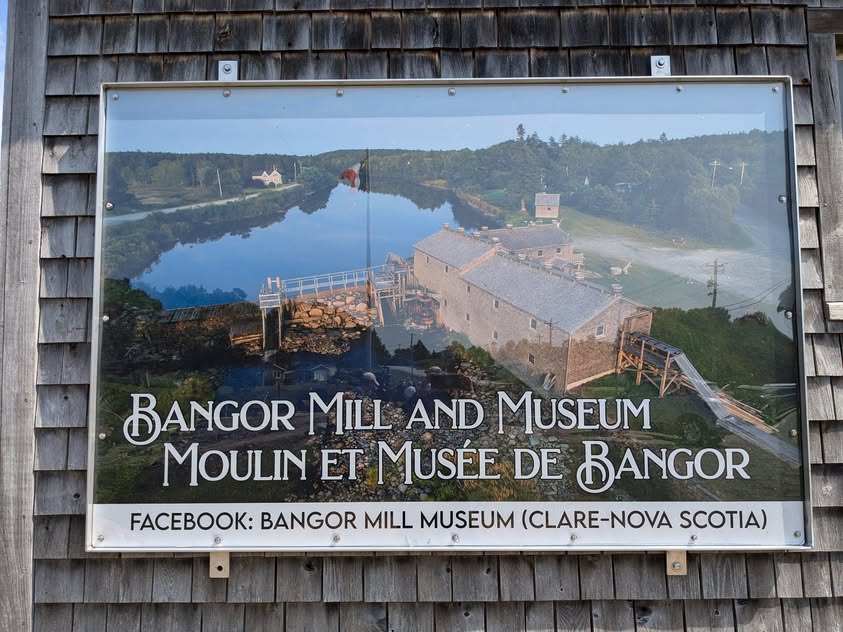
[From Royal Canadian Legion Hall parking lot turn left (south) onto Highway 1 and travel ca. 1 mile to Eustace Comeau Road. {At 0.9 miles note the beautiful Sacré-Coeur Catholic Church on your left - built in 1880 and the oldest church in Clare. The cemetery a bit behind the church contains Geddry and Jeddry graves. Every August, the church hosts an amazing quilt exhibition.} Turn left onto Eustace Comeau Road and travel 1.8 miles to intersection with Maza Road and turn right onto Maza Road. Travel 1.2 miles on Maza Road to the remains of the Bangor Sawmill.] - Bangor Sawmill (728 Maza Road; Bangor)
The Bangor Sawmill is a restored 19 th -century water-powered turbine lumber sawmill. It is one of the last functioning mills of this kind in North America. Lumbering was a major industry in this region and many Geddry and Jeddry men worked as lumbermen in this mill. Take a quick look around at the difficult and dangerous work that these men accomplished. The Meteghan River is used to power the sawmill.
[From Bangor Sawmill turn left on Maza Road and travel 0.3 miles to 2nd Division Road. Turn right onto 2nd Division Road and travel 0.5 miles to Placide Comeau Road. Cross Placide Comeau Road and park briefly.] - Geddry's Corner (Placide Comeau Road at 2nd Division Road; Meteghan Station)
Five generations of the Geddry family lived in these homes.(C) James Jeddry House (A) Evariste Geddry House (831 Placide Comeau Road; Gray house with porch) [b. 1820, d. aft 1890] (B) Alexandre Jeddry House (1637 2nd Division Road at corner of 2nd Division Road and Placide Comeau Road; Small porch & bay window; Built ca. 1890) [b. 1863, d. 1896] (C) James Jeddry House (1627 2nd Division Road; White with hip roof & wrap-around porch; Built ca. 1912) [b. 1888, d. 1960] [Brigadier General Albert Geddry born here in 1940] (D) Gustave Geddry House (1620 2nd Division Road; Light brown with single dormer above door) [Started construction 1938 & completed in 1948] (E) Brigadier General Albert Geddry was born in James Jeddry house and lived several years of his youth at his parent's (Gustave Geddry's) houses here and in Meteghan. Several of the Geddry men worked on the railroad. You can see the railroad line just past Placide Comeau Road. James Jeddry died in 1896 from injuries suffered in a railroad accident where he had a leg severed and only lived several hours. He died at his home. Gustave Geddry also was severly injured in a railroad accident, but survived.
[Go to Placide Comeau Road and turn left from 2nd Division Road onto Placide Comeau Road. Travel 2.6 miles on Placide Comeau Road to Highway 1. Turn left on Highway 1 and travel 0.6 miles to 9105 Highway 1.] - Gustave Geddry House (9105 Highway 1; Meteghan)
This was house of Gustave Geddry, father of Brigadier General Albert Geddry, and his wife Zita Doucet. Note the cone-shaped spire on the left roof with the lightning rod atop it. Gustave moved here after leaving Geddry's Corner. Albert Geddry spent much of his youth here. The house two doors down at 9103 Highway 1 was that of the parents of Simone Comeau, Albert's wife today.
[Continue on Highway 1 for 0.1 miles and cross the Meteghan River. On your right will be A. F. Theriault & Son Shipyard on the Meteghan River.] - A. F. Theriault & Son Shipyard and Meteghan River (9027 Highway 1 at Meteghan River; Meteghan)
Established by Augustin Theriault in 1938, it is one of the largest privately-owned shipyards in Canada's Atlantic region. Currently, it is in its fourth generation of Theriault ownership and has built over 1000 boats. Note the Meteghan River just beyond the shipyard.
[Continue on Highway 1 for 2.3 miles to La Vieille Maison on your right.] - La Vieille Maison (Acadian Museum; Antoine Theriault House) (8312 Highway 1 just past Bonaventure Road; Meteghan)
La Vieille Maison is the last of the early Acadian settler homesteads. It was originally built in Comeauville in 1796 by Antoine Theriault. It was moved to Meteghan in 1958 by Adolphe Robicheau - a world-renowned ballet dancer.
[Turn left onto Highway 1 from La Vieille Maison and travel south until you see Comeau Lumber Company on your left at 7578 Highway 1 just outside of Meteghan.] - Comeau Lumber Company (7578 Highway 1; Meteghan)
The Comeau Lumber Company is a good example of one of the lumber companies that have operated in this area. The Geddry and Jeddry men worked for many years as foresters and lumbermen and likely some worked here. After trying several other jobs including making coffins, Edmond M. Comeau began operating a sawmill in 1904 which he ran for over 50 years. It eventually evolved into a lumber company and in 1942 he incorporated it with his sons. He produced from 2-4 million board-feet of lumber annually depending on demand and employed up to 65 local people.
[Continue on Highway 1 to the St. Alphonse Church Hall and park in the parking lot to conclude the tour.] - St. Alphonse Catholic Church [6553 Highway 1; St. Alphonse]
Today St. Alphonse Catholic Church is one of four Catholic congregations comprising the Paroisse Notre Dame d'Acadie. Established as a Catholic parish in 1922 when the present church was built. The first pastor was Père Alphonse B. Côté. The church parish comprised the communities of St. Alphonse-de-Clare (originally called Chéticamp), L'Anse-à-l'Ours (Bear Cove), le Cap-Ste-Marie (Cape-St. Mary's) and the eastern portion of Mavillette. The patron saint is St. Alphonse-de-Liguori. Besides the beautiful church building, note the grotto inside that is built of wood, but painted to appear to be stone. It is a replica of the Notre-Dame-de-Lourdes grotto in France. Also, take a moment to view the seven murals near the altar painted in 1946 by Pius LeBlanc of Little Brook. Finally, see the marble statue of the Madonna erected in 1953 with the large rosary at its base. The cemetery is at the rear of the church and there you will find many graves of Geddry, Gedry, Jeddry, Jedry and Gidry family members. At the rear of the parking area near the entrance to the cemetery, take a moment to read the historic plaque honoring Augustin Guédry and Marie Jeanson, the founders in 1787 of the town of Chéticamp. The name was changed to St. Alphonse-de-Clare in 1922 to avoid confusion with the town of Chéticamp on Cape Breton with their postal and other services.
END OF TOUR (Total of 50 miles of driving)