
Three Remarkable Acadian Women - Heroines of Their Communities
From the early days of the Acadian colony in the mid-1600s the Acadian woman has been the backbone of the family. She kept the home, raised the family, cooked the meals, healed those with sickness and scrapes and often worked alongside her husband in the fields. As Acadia expanded and communities developed, her societal role often increased and some Acadian women became the bedrock of their communities. They devoted their lives for the good of their community - serving with no compensation except the inner joy of helping others and the gratitude of the village. Often overlooked by history, but never by their families and communities, these women truly provided critical services to their Acadian villages.
Marguerite-Blanche Thibodeau Cyr, Malvina Ménard Labine and Geneviève Petitpas Pellerin - three remarkable Acadian women spanning several generations and from different Acadian regions - strong women who helped their communities to survive and move forward.
Marguerite-Blanche Thibodeau Cyr (Tante Blanche)
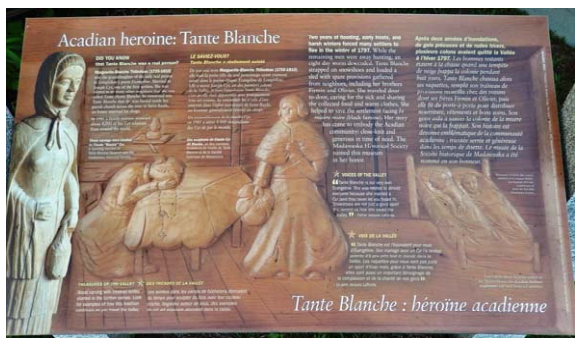
Born about 1738 in Acadia to Jean-Baptiste Thibodeau and Marie LeBlanc, Marguerite-Blanche Thibodeau married Joseph Cyr about 1758 and their early life as fugitives of the Acadian deportation began. They constantly moved north ahead of the British soldiers trying to capture them. Initially, they settled near the First Nation village of Ekoupag (today, Maugerville, New Brunswick). After the American Revolution the government confiscated the Acadian farms near Ekopaug and granted the lands to Loyalists. Marguerite and her family moved further north on the Saint John River to an area below the Great Falls. In 1785 they received a land grant along the Saint John River in what is today the Madawaska region of Maine.
In the 1790s about thirty families lived in the Madawaska area surviving through farming, fur trading, producing maple syrup and lumbering. Grain production provided needed income to the community. In 1795 the floods came destroying much of the crops. Early frosts came in 1796 destroying more crops and leaving little food for the families to survive. The floods and frost continued and by 1797 the Acadians families had to send a plea to the government for assistance. In September 1797 a two-inch snowfall occurred that covered the ground and homes; they were now desperate. The famine was upon them. Many lost hope; their dreams shattered. There had been no chance to build up stores lost over the past two years. Government help was not arriving. Some villagers left for Québec, but most stayed in Madawaska living on wild meat and herbs.
With starvation looming the men readied a hunting party during winter 1797 and left the women and children. Everything rested on a successful hunt and the hope that the families could survive long enough. Day by day the families waited for the hunters to return, but there was no sign of them. For eight days snow fell; all food was gone; the last cow had been slaughtered and eaten. It is at this time of lost hope that Marguerite-Blanche donned her snow shoes, packed what little clothing and provisions she had and trudged from door to door providing what she could to each family, collecting what little excess they may have for another family. She rationed what little provisions the community had so all could survive. She gave care to those that needed it, lifted the morale of those losing hope and sustaining the villagers despite the terrible conditions.
Day after day she appeared at each doorstep to help in any way she could. After an almost endless wait the men returned from the hunt with game for the village. Unfortunately, one man had died and another was near death, but the village survived - thanks to Marguerite-Blanche and the successful hunt. The next spring the government supplies did arrive - much needed and very welcome.
Marguerite-Blanche Thibodeau Cyr became endearingly known as Tante Blanche (Aunt Blanche) as she dedicated the rest of her life to caring for the sick and poor of her community. She was greatly revered in her community as she cured the sick, chased out evil spirits, lifted the down-trodden and reconciled enemies. When she died in 1810, her body was exposed in the chancel of St-Basile Catholic Church - an honor without precedent to a layperson. Her memory remains strong today among the Acadians of Madawaska and beyond. Many consider Tante Blanche to be Maine's first nurse. The Tante Blanche Historic Museum in the Madawaskan town of St. David stands as a memorial to the “angel of Madawaska”.
Read more about Marguerite-Blanche Thibodeau Cyr (Tante Blanche), the heroine of Madawaska, at:
https://fiddleheadfocus.com/2019/02/12/news/community/tante-blanche-was-maines-heroic-nurse/
https://citeseerx.ist.psu.edu/viewdoc/download?doi=10.1.1.529.6996&rep=rep1&type=pdf
https://www.acadian.org/blanche.html
Malvina Ménard Labine
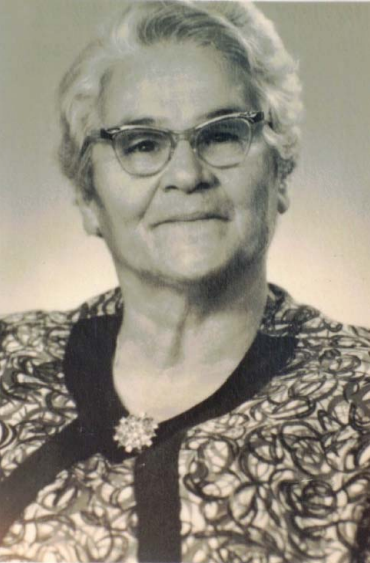
The daughter of Emilien Ménard and Léona Limeges, Malvina Ménard was born in 1893 at Azilda within a large nickel-mining region of Ontario. In 1912 Malvina married Joseph-Venance-Aristide Guildry dit Labine, son of Joseph Aristide Guildry dit Labine and Marie Louise Germain dit Bélisle, at Blezard Valley near Azilda. During the next 28 years twenty children were born to the couple - sixteen of them surviving infancy. Suddenly, in July 1941 while at market, Joseph died of a heart attack. Wiidowed at age 47 with nine children under sixteen years of age and nothing but debts to her name, Malvina reassessed her life.
Born with a tough, never-give-up attitude, she sold five horses and her jalopy with bad brakes and bought a new tractor and truck. With the financial help of three sons working in the mines Malvina began life anew. Soon she replaced her shack of a home with a new home she built herself - a plain, strong home with room for all her family. She continued to work ever harder on the farm - pressing hay, threshing grain, picking potatoes and other crops, hoeing the garden, cooking meals and sewing and knitting clothes for the family. In addition, she worked odd jobs where she could find them - installing a heavy culvert on the roadway or serving as janitor at the new school. Her children helped where they could. With her children she was a loving, but strict mother - enforcing discipline and teaching them well.
Sooner than she expected, almost all her children had grown and left home. Now she had a big, empty home so she began to take in foster children. But she didn't just request a foster child, she asked for four foster children at once. After receiving two brothers and two sisters for foster care, Malvina then requested four additional foster children. Her new family continued to grow until she raised twelve foster children.
Born with a heart of gold and lots of compassion, Malvina was always there to help the less fortunate. A poor young boy never had the opportunity to fish; Malvina bought him a new rod and had her son take him fishing. A young girl's family could not afford a coat for her; Malvina helped the family buy a nice coat. More importantly, she kept up with each of 'her kids' to ensure they were doing well in school and often took them on outings. When a neighbor was sick, Malvina was there helping. When local miners went on strike and couldn't afford essentials for their family, Malvina quietly gave them cases of canned goods, children's clothes and baby food. She always kept ample supplies of meat, beans, corn, shortening, peanut butter, tomato juice and up to 400 loaves of day-old bread in the freezer. When a neighbor lady saw hard times and needed help, Malvina quietly supplied her from her storehouse of goods - taking only a heartfelt “Thank You” for her good works.
With so many children and grandchildren and having helped so many in the town, Malvina was affectionally known by everyone as “Granny”.
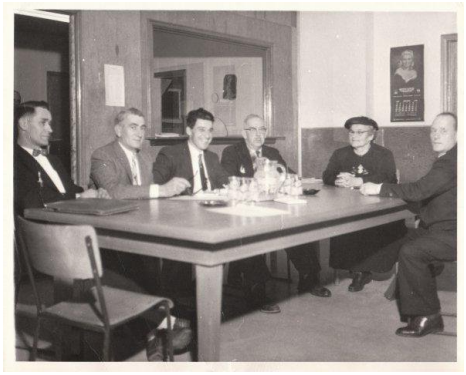
Growing from a rural farming community to a suburb of Sudbury in the decade of the 1950's, Rayside Township with Azilda as its hub faced new challenges that were not being addressed to the satisfaction of Malvina and the local folks. Tyne Castonguay, the incumbent reeve (magistrate), seemed to care more for his patent medicine business than running the township. Malvina Labine had a reputation for getting things done so local folks asked her to run for reeve in the upcoming election. At first doubtful about running, she eventually consented. Once in the race, she ran hard and won the election. And, as is her style, her election party was at the town hall where she passed out doughnuts, sandwiches and coffee to campaign workers of both sides. So where did Malvina Labine garner all her support to defeat the incumbent reeve? Remember all those local children, women and families she helped over the years. They never forgot her and turned out in droves to vote for their dear friend. Of course, having sixteen children and numerous grandchildren didn't hurt either. Malvina Ménard Labine served as reeve of Rayside Township from 1959-1961 and was as successful running Rayside Township as she was in every other endeavor she attempted.
After living a hard, but fulfilling life, Malvina Ménard Labine died in Sudbury in 1967. She is buried in Chelmsford - not far from where she lived most of her life. Truly, Malvina Ménard Labine was a woman “who could do anything”.
You can read more about Malvina Ménard Labine in this article:
https://archive.macleans.ca/article/1959/3/14/the-womanwho-can-do-anything
Geneviève Petitpas Pellerin
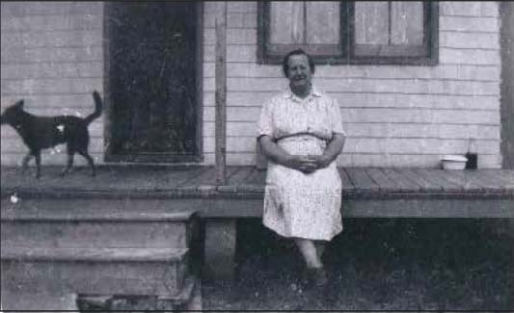
The daughter of Peter Petitpas and Sophie Linden, Geneviève Petitpas was born at Larry's River, Nova Scotia on 14 March 1889 and married Augustus Pellerin in Larry's River on 5 February 1907. To the Acadian community in the Tor Bay area, she was simply Mémie (grandma) - a special name reserved for the most caring and loving ladies of the community.
A generous lady with exceptional cooking skills, Geneviève never let a visitor leave her home without samples of her wonderful culinary creations. From her mother Sophie she learned the much-needed skills of a mid-wife - a important role in the isolated Tor Bay area.
For over 40 years Geneviève assisted mothers in birthing their children - helping deliver at least 247 crying babies. Even with the death of her husband in 1948 and her age taking its toll, this outstanding Mémie did not stop. A loyal neighbor Charles Avery would take her by horse and wagon or sleigh to expectant mothers throughout the countryside. Often in winter husbands had to shovel the winter snow to allow her to reach their expectant wives. To all that she touched, her loving nature and self-confidence brought a sense of calm and relief as they awaited her arrival.
Geneviève Petitpas Pellerin died at Larry's River on 31 January 1981 at the age of 93 having spent her entire life caring for her community. She was laid to rest in St. Peter's Catholic Cemetery in Larry's River. A grateful community was present as her coffin was slowly lowered into the ground.
Her memory and service to her Tor Bay community are still being recognized. Recently, Geneviève Petitpas Pellerin was honored by her Tor Bay community when she was inducted into the Tor Bay Acadians' Honour Roll. In 2021 her Petitpas family inducted her into the Les Guédry et Petitpas d'Asteur Circle of Distinction.