Cajun Musicians in the Family - An Early History
Those of you who have attended our reunions from 1999 through 2014 know that the Guédry and Petitpas families have a number of outstanding musicians. These include the late Tommie Guidry (diatonic accordion, vocals), Oran Guidry Jr. (bass), Nathalie Geddry (Acadian vocalist), Lyle Guidry (diatonic accordion), Gavin Guidry (diatonic accordion), "Nonc" Jules Guidry (diatonic accordion), the late Ron "Black" Guidry (guitar, vocals) and Christine Guidry Law (diatonic accordion) and her outstanding family band - all of whom have entertained us at the reunions. The spectrum of musicians in our families is quite diverse including religious, gospel, blues, Cajun, Acadian Maritime, zydeco, rock and roll, swamp pop, hard rock, West Coast blues, Louisiana funk, children songs, ballads and other genre. From the early days many Guédry and Petitpas musicians played in their homes and never ventured far with their music.
Here we are trying to capture some of the earliest Guédry Cajun musicians who played outside the home and made recordings of their music. Almost certainly we will not capture everyone in this effort as many are unknown currently. We start with the early Cajun musicians of the first half of the twentieth century. We know of no Guédry musicians who performed or recorded earlier than the 1920s.
If any of our readers do know of Guédry or Petitpas musicians from the early days, please email us or write a short article about them so we can publish it in our next "Generations" newsletter. In the future we plan to publish additional articles about talented Guédry and Petitpas musicians.
Evolution of Cajun Music Venues
The Guédry family has a rich musical history - from mastering instruments, composing outstanding songs and singing a variety of music. Nothing is known to exist about their musical talents while in Acadia, during the deportation years 1755 - 1763 or the first years after their arrival in Louisiana. Certainly the first Guédry's played and sang Acadian ballads on the front porch or in the kitchen with a small group of family and friends visiting. This is still done today in South Louisiana and Acadian regions of Nova Scotia - although the variety of music has expanded.
These talented musicians also would play at the Bal de Maison (i.e., house dance). Each week a family would announce that they were having a Bal de Maison at their place on Saturday evening. Invitations would be spread late in the week on foot or by horseback; the musicians would be secured; the furniture would be moved back to make room for dancing and the windows opened to catch the evening breeze and let the music flow outdoors. After a hard week's work, the invited guests would arrive on horseback or by buggy, enjoy beverages and snacks and chat until the Acadian band began to fill the air with lively two-steps and soft waltzes. Suddenly couples were on the dance floor enjoying the music. The only instruments were fiddles for the tune and spoons or the ti-fer (triangle) for percussion.
An area was set aside with quilts on the floor for the babies and youngsters to sleep while Mère and Père danced. As Mère laid the babies down, she would whisper "fais do do" (short for "fais dormir" or "go to sleep"). She wanted them to go to sleep quickly as she didn't want Père dancing too much with the other ladies.
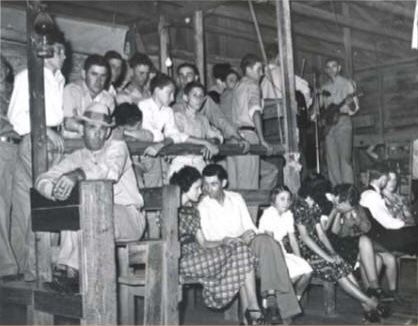
About the time of the Civil War the La Salle de Danse (dancehall) became popular in South Louisiana. Resembling a Bal de Maison, they differed in that they were held at the same location each Saturday evening, an admission was charged, food and drinks were sold and they were community affairs. The young ladies had dance cards, which the gentlemen would sign for their turn to dance with her. Her mother was watching closely from the balcony during each dance to ensure the young men behaved as true gentlemen. Travel by buggy was slow, so folks would leave early to be sure and arrive at the dancehall in time to catch the beginning strains of the music. At many of these dancehalls one could listen to a Guédry musician slicing through a two-step and watch the couples swirl around the dance floor. Fiddle and ti-fer (triangle) or spoons were the only instruments used so the dancers had to be near the bandstand to hear the music as it was not amplified.
In the 1890s the diatonic accordion from Germany arrived in South Louisiana and quickly joined the fiddle, tifer and spoons. Electronic amplification made its debut in the 1930s and South Louisiana embraced it. Two-steps and waltzes could be heard easily throughout the dancehall. Initially, a Model-T was used to provide the power needed, but eventually electricity reached most outlying rural areas that had dancehalls. Dancehalls remained very popular until the 1970s. Some still remain; however, they quickly are becoming a rarity. Over time the range of instruments used in Cajun music has expanded to include the guitar and drums.
In recent years festivals and concerts have replaced the dancehall as the place to hear Cajun music. As a "living organism", Cajun music is continually evolving with new music being added. The old tunes, however, are still played and remembered. Likewise, the two-step and waltz remain the standard dances, but many variations of these are now seen as couples move counterclockwise around the dance floor.
First Commercial Cajun Recording
Joe Falcon on diatonic accordion and his wife Cleoma Breaux on guitar recorded the first commercial Cajun record Allons à Lafayette (Let's Go to Lafayette). After driving from Rayne, LA to New Orleans, Joe and Cleoma recorded the song on 27 April 1928 at the Columbia Phonograph Company studio in New Orleans. Hoping that Allons à Lafayette would sell at least 250 copies, Columbia later announced that it was an immediate success as it sold almost 20,000 records. It was a hit in the Cajun country near Lafayette where folks would buy 2 or 3 copies so they had an extra record when the first one got worn out. The success of Allons à Lafayette set the stage for many more Cajun recordings in the ensuring months and years ahead.
Interestingly, Allons à Lafayette was the B-side of the record although it was the song that the Cajuns back home loved. The A-side song was The Waltz That Carried Me to My Grave. The A-side of most copies was seldom played and remained in pristine condition.
Almost unknown to many is that there was a recording of a purported Cajun song three years prior to Joe Falcon and Cleoma Breaux's record. On 22 January 1925, Dr. James F. Roach, a New Orleans surgeon, recorded two folksongs at the Junius Hart Piano House in New Orleans for the Okeh label. The first song was Gue Gue Solingail (Song of the Crocodile), which was purported to be "Cajan". The flipside of the recording had Reflets Dans L'Eau (Reflections in the Water). At the time Dr. Roach had a widespread reputation as an amateur singer and radio personality. Okeh never released the record; however, Dr. Roach did release it later on his own Roach label. Although an article on 15 July 1925 in the "The Talking Machine World" magazine (Volume 21, Page 12) stated that this was the first "Cajan" recording, many refute this claim since Dr. Roach had no Acadian ancestry nor do the songs appear to be of Cajun origin. They were African-Creole songs popular in New Orleans at the time.
Guidry Brothers
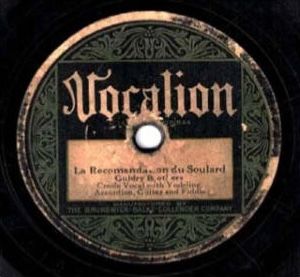
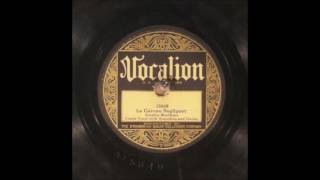
Among the earliest known musicians in the Guidry family are the Guidry Brothers . Little is known of this South Louisiana group of three or four musicians that used the fiddle, accordion and guitar. Their names are unknown; however, they did have one recording session in New Orleans, Louisiana on 1 October 1929 with Vocalion Records in which they recorded six songs. Their best-known song was Le Garçon Négligent from which several famous songs evolved including Big Texas and Jambalaya.
View Guidry Brothers discography
Adolph "Bixy" Guidry
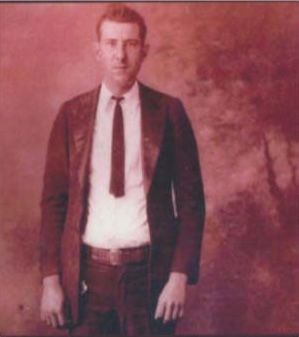
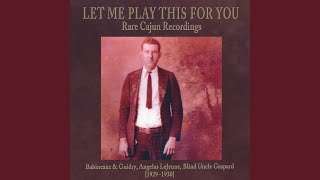
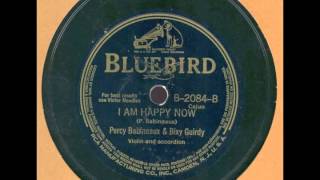
Adolph "Bixy" Guidry and Percy Babineaux recorded together and, as with the Guidry Brothers, first recorded in late 1929 - the beginning of the Great Depression. Because of the scarcity of money at that time, their records sold poorly and their recording career ended abruptly. In New Orleans for the Victor Talking Machine Company on 6 November 1929, Bixy Guidry and Percy Babineau recorded eight songs. Two of the songs were not released until 1941 on the companion label Bluebird Records. Bixy Guidry played the accordion and sang while Percy Babineaux played the fiddle. For over fifty years their records sat in vaults - almost unknown. Only recently have they been rediscovered and reproduced - exhibiting the rare mix of beauty, eloquence, intensity and originality that is characteristic of their music.
Born in November 1904 in Cankton, LA, Adolph "Bixy" Guidry was the son of Arthur Guidry and Marcelite Arceneaux. Raised in the countryside near Cankton with his 14 siblings, Bixy showed a strong affinity for music from an early age. Characteristic of many young Cajun musicians, as a young boy he nailed a strap to each end of a board for his thumb and fingers and then hammered nails along the middle portion to simulate an accordion. Several years later his mother bought him an accordion and he soon learned to play it. During his late teens he was playing house dances (bals de maison) in the Cankton area.
In 1928 typhoid fever struck his family and three of his siblings died. Bixy caught the fever and was quite ill for several months before fully recovering. In 1930 Bixy married Beulah Duhon and they had one son Raymond.
In the 1920s, Bixy met a young fiddler named Percy Babineaux and they began playing together. Percy lived in the neighboring town of Carencro. After their recording session in New Orleans, Bixy and Percy continued playing together in the local area. Every Sunday they would play at Bixy's house. Their pioneering songs influenced later Cajun recordings. With Bixy's accordion sighing mournfully and Percy's keening fiddle, the Cajun duo seemed to be an intoxicating loose and ragged pair.
Bixy Guidry died in 1938 at about 34 years of age and is buried in Saints Peter and Paul Cemetery in Scott, LA. Although the cause of his death is uncertain, he may have had an allergic reaction. After Bixy's death Percy Babineaux continued to play Cajun music with other musicians.
View Adolph "Bixy" Guidry discography
Oran "Doc" Guidry
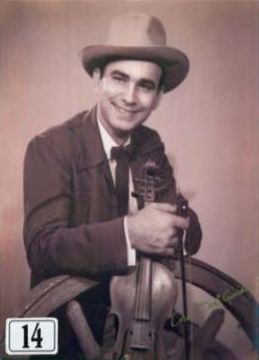
Cajun musicians today often describe the fiddle as the most difficult instrument to master. Oran "Doc" Guidry not only mastered the fiddle; he was one of the greatest Cajun fiddlers in South Louisiana.
Born in Lafayette, LA on 28 April 1918 to Cleopha Guidry and Edith Martin, Doc Guidry lived in the small community of Scott, just west of Lafayette, from 1918 until 1942. Here he learned to play the fiddle at age 12 from his father, who was a front-porch fiddler that played after finishing his work on the farm. Initially Cleopha began teaching Doc's older brother Nason how to fiddle - during which time Doc would listen intently.
Then, while Cleopha was in the fields working, Doc would take the fiddle out and teach himself the tunes he heard at Nason's lessons. When Nason discovered that Doc was playing the fiddle during the day, he began to beat Doc out of jealousy, but Doc persisted in playing the fiddle. One day Cleopha heard Doc playing and was so impressed that he quit playing and gave Doc his copy of a 1624 Maggini violin. Doc took a correspondence course on playing the violin and actually learned to read music to some extent.
In 1932 at the young age of fourteen Doc began playing dances near Lafayette with Joe Fabacher and the Jolly Boys of Lafayette. About 1934 the Jolly Boys with Doc recorded an album with Decca Records in Dallas, TX; however, no copies of the recording session or records from it have been found.
In 1934 Doc and his brother Nason, now playing bass guitar, joined accordionist Lester Hoffpauir and the trio performed at dances in the Lafayette area.
Two years later in 1936 Doc Guidry began playing with Happy Fats LeBlanc and the Rayne-Bo Ramblers. Happy Fats needed a fiddle player for his band and he approached Doc about playing with him. During their conversation he asked Doc about his future plans and Doc told him he wanted to go to school and study medicine. Shortly afterwards the Ramblers played in Morse, LA and Happy Fats introduced Oran Guidry as Doc. The nickname stuck and forever after he was known as Doc - even his listing in the telephone book had Doc Guidry.
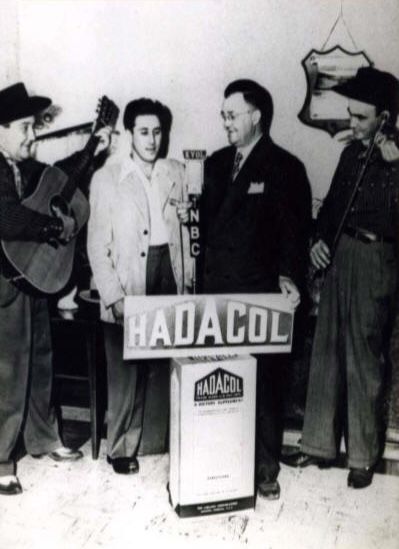
While still with Happy Fats LeBlanc, on 21 February 1937 Doc recorded ten songs in Dallas, TX on the Decca label with Joe Fabacher and the Jolly Boys of Lafayette including "La Valse de Lafayette". A year later on 1 April 1938 Doc Guidry teamed up with Joe Werner and the Ramblers to record eight songs at the St. Charles Hotel in New Orleans, LA for Bluebird Records. Two of the songs also sold on the Regal Zonophone label.
The next day on 2 April 1938 Doc returned to the St. Charles Hotel in New Orleans and with Happy Fats Leblanc and the Rayne-Bo Ramblers recorded ten songs on the Bluebird label in a two-hour session. In another two-hour session at the St. Charles Hotel on 23 October 1938 this band recorded twelve songs for Bluebird.
Doc's association with Happy Fats was a long one - lasting off and on until the 1970s. Over the years the schedule of the Rayne-Bo Ramblers was quite busy - including as many as nine performances per week on several radio shows and in dancehalls including KROF in Abbeville, LA, KSLO in Opelousas, LA and KVOL in Lafayette, LA as well as the Showboat Club in New Iberia and Clem's Dancehall in Abbeville.
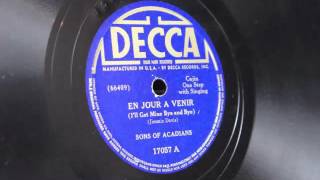
In late 1938 Doc and his brother Nason left the Rayne-Bo Ramblers and Doc formed his own band Doc and the Sons of the Acadians. The musicians included Doc on fiddle, Nason on guitar, their cousin Ray Guidry on tenor banjo and Sidney Guidry (of the Alley Boys of Abbeville band) on guitar and vocalist. The Sons of the Acadians played locally in the Lafayette area. On 5 September 1939 at the Rice Hotel in Houston, TX they recorded twelve songs on the Decca label.
With the beginning of World War II, about 1942 Doc moved just across the Louisiana border to Orange, TX to assist in the war effort. Orange had a large wartime shipbuilding industry and the nearby community of Port Arthur, TX had two major oil refineries. Here Doc met fiddler Cliff Bruner and the two of them played in clubs throughout the Orange, Port Arthur and Beaumont areas.
During 1944 Doc returned to the Scott, LA area. At this time Jimmie Davis (of You Are My Sunshine fame) was campaigning for Governor of Louisiana.
Doc was at a campaign rally in Carencro, LA in 1944 and was introduced to Jimmie Davis. In those days all campaign rallies needed a musician or band to bring the crowds and entertain them. Mr. Davis hired Doc immediately and he followed the campaign that day to New Iberia and subsequently to campaign rallies throughout Louisiana. Davis won the election and had Doc play in his two other campaigns in 1959 and 1971. Doc and Jimmie Davis also played together in several major venues including the Louisiana Hayride and the Grand Ole Opry in the 1950s.
After 1944 Doc and Happy Fats LeBlanc continued to play together occasionally - even as both pursued their separate careers. In late 1944 after the campaign, Doc moved to Baton Rouge, LA and joined the Tony Chatoni Band. They played dances in the Baton Rouge area from 1944 through 1947. In these gigs Doc played both fiddle and mandolin and years later would relate that this was his favorite band due to their high calibre of musicians.
In 1946 Happy Fats and Doc formed a new group Happy, Doc and the Boys and in June of that year headed to Cosimo Matassa's recording studio on Rampart Street in New Orleans. Here they recorded eight songs for the soon-to-be legendary record producer Jay Miller on his new Fais-Do-Do label. Jay would later have his own studio in Crowley, LA. This session produced the outstanding song Allons Danser Colinda that became a Doc Guidry staple.
In 1947 Doc moved back to the Lafayette. Later that year Happy, Doc and the Boys had another recording session with Jay Miller - this time in his Crowley studio. Although only recording four songs for his Fais-DoDo label, one was the outstanding hit Chere Cherie. Later in 1947 Doc Guidry formed a new group Sons of the South that played dances around Lafayette from 1947 until 1951. From 1948 through 1950 Happy Fats and Doc sponsored a talent show on Saturday mornings at the Rose Theater in Opelousas, LA. It was broadcast on KSLO radio.
During 1949-1951 Doc recorded with several bands including Happy, Doc and the Boys; Happy & The Doctor & the Hadacol Boys and Bill Hutto with Doc Guidry and His Sons of the South. The four sessions were at Jay Miller's studio in Crowly for Jay's Fais-Do-Do and Feature labels.
On 6 March 1953 Doc teamed with ex-Governor Jimmie Davis to record eight songs in Nashville, TN for the Decca label. The year 1955 saw Doc reduce his fiddle playing and begin other jobs as farming and announcing the Sunday Cajun quarterhorse races at the Forrest Club in Breaux Bridge, LA. He continued to play fiddle occasionally with Happy Fats, Doris Matte, Vin Bruce and Al Terry in the 1950s and 1960s. In 1962 Jimmie Davis helped Doc secure a civil service job on the Alcohol, Beverage and Liquor Control Board from which he retired eventually.
Throughout the 1960s Doc Guidry continued recording with sessions in 1962 (with Vin Bruce on Floyd Soileau's new Swallow label), June 1964 (Happy Fats and Alex Broussard on the Swallow label), April 1966 (solo album featuring Doc Guidry on Carl Rachou's La Louisianne label) and 1968 (Vin Bruce on the La Louisianne label). In Oct 1972 Doc recorded with Vin Bruce's band for the La Louisianne label. His last recording session was in May 1980 with Marc Savoy for Arhoolie Records. Thus culminated a truly outstanding recording career spanning 43 years.
In 1989 Doc Guidry fell on the steps in front of his home and broke his wrist. He seldom played the fiddle after this incident. On 10 November 1992 Doc passed away and is buried at St. John the Evangelist Catholic Cemetery in Lafayette.
Oran "Doc" Guidry married his second wife Evelyn Matherne of Houma, LA. The author does not know the name of his first wife. With his first wife Doc had two sons - Oran Guidry, Jr. (an excellent bassist) and Ronald Guidry - both of Lafayette.
Over the years Doc Guidry has received many accolades. In 1983 he was selected as a member of the Country Music Hall of Fame (Nashville, TX). He entered the Louisiana Hall of Fame in 1992 and in 1997 was selected as a charter member of the Cajun French Music Association Hall of Fame (Eunice, LA). In 2015 Oran "Doc" Guidry was inducted posthumously into the Les Guédry et Petitpas Circle of Distinction.
Among aficionados of Cajun music Doc Guidry is considered the greatest Cajun fiddler to pick up the instrument.
View Oran "Doc" Guidry discography

John Nason Guidry
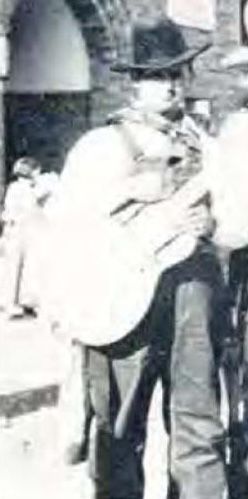
Nason Guidry, the brother of Oran "Doc" Guidry , was the elder son of Cleopha Guidry and Edith Martin. Born on 2 September 1914 in Lafayette, LA, Nason and his family moved to Scott, LA when he was four years old. When he was sixteen years old, his father began to teach him how to play the fiddle; however, his younger brother Oran mastered the fiddle much faster than Nason. A bit jealous at Oran's skill, Nason would beat his brother. Soon, however, he began to play bass and guitar and became very proficient at them.
In 1934 Nason on bass, his brother Oran on fiddle and Lester Hoffpauir on accordion began playing dances in the Lafayette area.
On 2 April 1938 Nason on bass along with Doc Guidry, Happy Fats and the Rayne-Bo Ramblers recorded ten songs for the Bluebird label at the St. Charles Hotel in New Orleans during a two-hour session. In another two -hour session at the St. Charles Hotel on 23 October 1938 Nason, Doc, Happy Fats and the Rayne-Bo Ramblers recorded another twelve songs for Bluebird.
In the latter part of 1938 Nason's brother, Oran "Doc" Guidry formed the band Doc and the Sons of the Acadians with Doc on fiddle, Nason on bass, Ray Guidry on tenor banjo and Sidney Guidry on guitar and vocalist. They played many dances around Lafayette.
When not playing Cajun music in the evenings, Nason owned Guidry's Furniture and Glass Shop in Lafayette, LA. Interestingly, on his World War II Draft Card, Nason listed his occupation as "Musician, Sons of Acadians, KVOL, Lafayette LA".
On 15 February 1974 John Nason Guidry died at the age of 59 years. He is buried next to his brother Oran "Doc" Guidry in St. John the Evangelist Catholic Cemetery in Lafayette, LA.
Ray Ophie Guidry
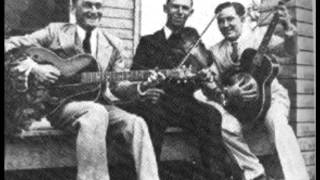
A cousin of Oran "Doc" Guidry and Nason Guidry, Ray Guidry was born in Scott, LA on 1 February 1921 to Ophie Guidry and Lena Deshotel. He listed his occupation on his World War II Draft Card as a musician. Enlisting in the U. S. Navy during World War II, he served from 26 June 1944 until 19 February 1946.
In 1936 as a lad of 15 years Ray joined the Cajun band Happy Fats and the Rayne-Bo Ramblers along with his cousins Oran and Nason. Ray played the tenor banjo as the band played dances in the Lafayette area. On 2 April 1938 Ray on tenor banjo along with Doc Guidry and Happy Fats and the Rayne-Bo Ramblers recorded ten songs for the Bluebird label at the St. Charles Hotel in New Orleans during a two-hour session. In another two-hour session at the St. Charles Hotel on 23 October 1938 Ray, Doc, Happy Fats and the Rayne-Bo Ramblers recorded another twelve songs for Bluebird.
In the latter part of 1938 Oran "Doc" Guidry decided to form his own Cajun band Doc and the Sons of the Acadians. Nason and Ray both left the Rayne-Bo Ramblers to play join Doc and cousin Sidney Guidry in the new band. They played at dances near Lafayette. On 5 September 1939 Doc, Ray and Sidney recorded twelve songs for Decca Records at the Rice Hotel in Houston, TX.
Little is known of Ray's life and musical endeavors during the period 1940 - 1970; however, in September 1970 he played banjo on Rufus Thibodeaux's new album "The Cajun Country Fiddle of Rufus Thibodeaux". It was recorded at Carl Rachou's studio in Lafayette, LA and released on his label La Louisianne Records.
In October 1973 Ray Guidry on banjo again recorded with Rufus Thibodeaux at Rachou's Lafayette studio for the La Louisianne label to produce the album "Cajun Fiddler".
Ray Guidry died in Lafayette, LA on 28 September 1996 and is buried at Saints Peter and Paul Catholic Cemetery in Scott, LA.
View Ray Ophie Guidry discography
Alley Boys of Abbeville
Sidney Moise Guidry & Murphy Guidry
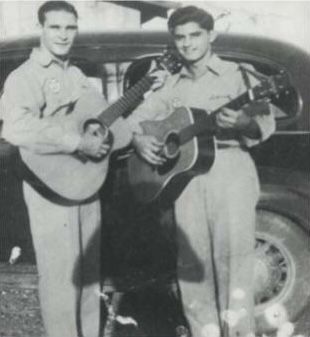
In the late 1930s Sidney Guidry on rhythm guitar and vocals, Murphy Guidry on rhythm guitar and vocals, Maxie Touchet on drums, Frank Mailhes on fiddle and vocals and Lourse Leger on unamplified steel-bodied National guitar formed the Cajun band Alley Boys of Abbeville. Although Sidney and Murphy did record occasionally with other bands, they primarily played with the Alley Boys of Abbeville. Not having a diatonic accordion was unusual for a Cajun band, but the Alley Boys were reflecting the changes occurring in Cajun music since the mid-1930s when Western swing and jazz began to influence the music. Lourse Leger played the steel-bodied National guitar lap-style and the group used three lead singers along with two rhythm guitars, drums and fiddle - the lead instrument.
When playing at dancehalls, the Alley Boys used a very rudimentary sound system attached to a car battery. Sidney Guidry once commented that they really didn't need the amplification as they were loud enough anyway. Besides dances, they also played weekly on Lafayette radio station KVOL where they received no pay, but could promote their upcoming personal appearances. The Tuff-Nutt Company did sponsor them, but this also included no pay. Instead they were given snappy uniforms similar to those worn by attendants at Texaco gas stations. There were no complaints as Sidney noted: "You have no idea how bad times were in South Louisiana around 1938-1939. Man, times were tough and although Tuff-Nutt didn't pay us, we were happy to have the clothes."
The Alley Boys of Abbeville were quite popular in the Lafayette area - known for their energy, exuberance and engaging style.
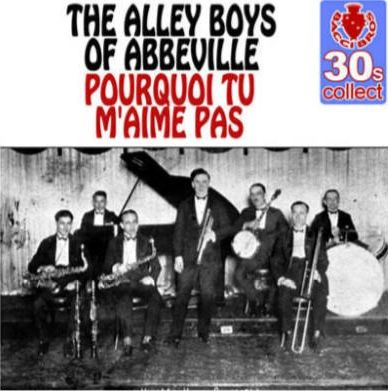
In 1939 several recording companies came to the Lafayette area seeking French bands to record. The Alley Boys of Abbeville sang many of their songs in English; therefore, Sidney Guidry translated them to French. Afterwards the Vocalion Company retained the Alley Boys to record the first field recording session in Memphis, TN. Being local boys, this was the first trip away from home for most of the band. For $125 they hired a taxi driver to take them to Memphis - quite a difficult drive in 1939 considering the condition of the roads and the distance. The $125 was roundtrip so the taxi driver had to wait for them to complete the recording session. And it must have been a full taxi with the driver, five musicians, three guitars, a fiddle and a set of drums. The drive was a non-stop, day-long drive that was exhausting. To rest, the guys took turns napping on the floor of the taxi. Once reaching Memphis, the band had to book a rooming house.
In those early days musicians did not receive royalties on their songs, but received a single recording fee. The Alley Boys of Abbeville got $25 per recording. In a marathon session at the Vocalion studio they recorded two takes of sixteen songs in two days on 30 June and 1 July 1939. Twelve of the sixteen songs were released by Vocalion.
The boys remembered the recording session as a great experience. At the rooming house they slept two to a bed and two on the floor. Those in the beds were unfortunate since bed bugs bit them ferociously. This was their first experience with bed bugs so they switched lodgings to a motel with ugly orange bed sheets.
Born in Grand Bois, a small village in St. Martin Parish, LA on 1 June 1922, Sidney Guidry, son of Joseph Leo Guidry and Eva Guidry, began playing at 8 years of age on a handmade cigar box guitar - eventually graduating to a real four-string guitar. By the age of thirteen he was playing with local bands. He purchased a Gretsch six-string guitar for $35 - $18 of which he had saved from working in the fields. His brother gave him the balance. So committed to the guitar was he that he practiced long hours - until his fingers would bleed. The first band with which he played was the Moonlight Stars - a country music and blues band with whom he played for two years. The Alley Boys of Abbeville were forming and they recruited Sidney as their youngest member at 17 years of age. A highlight of their time together was opening for the Grand Ole Opry's Lew Childre, which required that they leave home again and go on the road.
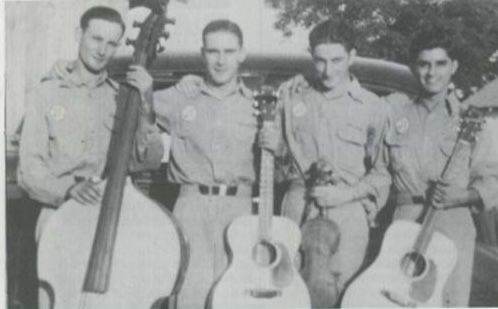
After the mammoth recording session in Memphis with the Alley Boys of Abbeville and opening for Lew Childre, Sidney was recruited by Oran "Doc" Guidry to be in his new band Sons of the Acadians that included Doc Guidry on fiddle, Ray Guidry on tenor banjo, Sidney Guidry on guitar and Nason Guidry on bass. On 5 September 1939 Doc, Ray and Sidney travelled to the Rice Hotel in Houston, TX where they recorded twelve songs for Dave Kapp of Decca Records. They also had a daily radio show when they were in the Lafayette area. After a disagreement with Nason Guidry over the whoops and shouts while playing the Cajun music, Sidney returned to the Alley Boys of Abbeville with whom he stayed until World War II. In 1942 Sidney worked a short while with Roy's Taxi Company of Lafayette, LA.
Sidney joined the U. S. Marines during World War II and served from 28 April 1943 until 22 November 1944 in C Company, 1st Battalion, 23rd Regiment of the 4th Marine Division. After the war he again played Cajun music for a couple of years then decided to quit being a full-time musician. He continued to play occasionally for family and friends at home. His most requested songs during his playing days were Abbeville Breakdown, Jolie Petite Fille and Moi et Ma Belle.
In 1945 Sidney married Lena Angelle with whom he had three sons. After she died in June 1983, he married a second time to Yvonne Robin on 11 November 1983. On 28 July 1993 Sidney Guidry passed away at Lafayette General Hospital in Lafayette, LA. He is buried at St. Joseph Catholic Cemetery in Cecilia, LA.
Very little information is available about Murphy Guidry. He was born before 1922 and played rhythm guitar with the Alley Boys of Abbeville. He did not record with any other bands.
View Sidney Moise Guidry and Murphy Guidry discographies


Selena Guidry & Mary Guidry
Women's Home Music represents the oldest form of Acadian music - the period when the only "instrument" was one's voice. The theme of the music was their heritage. Much of today's Cajun dance music is rooted in the unaccompanied singing of Home Music. The unaccompanied ballads sung yet today in the homes is based on the cultural heritage of the old Acadian homeland and "modernized" by the experiences since the arrival of the Acadians in Louisiana. Home Music has been sung primarily by women in their homes since the late 1700s and continues today.
As part of her doctoral thesis studies in the 1950s, Elizabeth Brandon recorded Selena Guidry in her home in New Iberia, LA singing several old Acadian folksongs including Vive l'Amour (Long Live Love) and Mon Aimable Brune (My Lovely Brunette). Nothing else is known about Selena Guidry at this time.
Elizabeth Brandon also recorded Mary Guidry at her home in Kaplan, LA. Mary has an extensive repertoire of Acadian ballads. In the song Dieu Laurent, recorded in 1952, she sings a duet with Leo Meaux. Marie Aimee Landry, daughter of Hubert Landry and Eumia Broussard, was born in 1896 and married Galbert Guidry, son of Felix Guidry and Marcelite Schexnayder, on 29 November 1914 in Kaplan, LA. They lived in the Kaplan, LA area in 1940 where Gilbert built canals and Mary did housework. By 1940 they had four sons and three daughters ranging from 6 years to 22 years. Mary Guidry died on 14 February 1982 in Kaplan and is buried with her husband in Cossinade Cemetery just north of Kaplan.
Dieu Laurent (Mary Guidry & Leo Meaux)
https://www.allmusic.com/album/la-musique-de-la-maison-mw0000804923
View Selena Guidry and Mary Guidry discographies