DNA & Genealogy - A Brief Primer
Using DNA as a genealogical tool is growing throughout the worldwide genealogy community. Surname groups and geographical groups using DNA testing are expanding. The Guédry family is considering some limited genealogical DNA testing to solve difficult problems in the family genealogy. In the near future we may begin a more widespread DNA project on the Guédry and Petitpas families to learn more about our respective genealogies and ancestral backgrounds. If you decide to have your DNA tested for genealogical purposes, consider having it done at FamilyTreeDNA so that we will have all of our family DNA results at one laboratory.
DNA and Genealogy
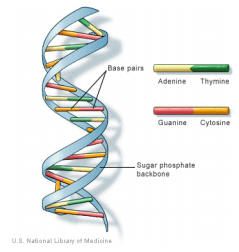
DNA (deoxyribonucleic acid) is the molecule in which all living organisms encode their genetic makeup for transfer to their offspring. Nucleic acids, proteins and carbohydrates are the three macromolecules essential for life. The basic structure of DNA is two molecular strands wound around each other to form a double helix. The two strands are connected to each other through a series of ladder-like steps composed of the nucleobases guanine (G), adenine (A), thymine (T) and cytosine (C) arranged in a strict order. These ladder-like steps are where the genetic information is encoded. (See Figure) And that is the chemistry lesson for today.
To use DNA as a genealogical tool, we do not need to know any of the chemistry. It is a very simple concept. DNA is a very complex molecule and the parts of DNA used for genealogical purposes are totally different than those used for medical and crime-solving purposes.
Having your DNA analyzed is a simple, multi-step process:
- Determining which DNA tests you would like to order
- Selecting a reputable laboratory to do the analyses and to maintain the results
- Ordering a DNA sample kit
- Collecting a sample of your DNA and returning it to the DNA analytical laboratory
- Having your DNA sample analyzed at the lab for the tests you ordered
- Receiving your results
- Comparing your results to the analyses of other folks who have had their DNA analyzed for the same tests that you ordered
DNA testing will not tell you who your ancestors are nor will it give you a genealogical chart. DNA must be used in conjunction with old-fashioned genealogical research. DNA testing can confirm your genealogical research or indicate that there may be errors in your research. DNA testing can assist you in overcoming “brick walls”. DNA testing can provide information on your ethnic ancestry. DNA testing can assist adoptees and also may indicate that one’s biological parent(s) are not the same folks as those that raised them. DNA testing may also connect you to “cousins” you have never met before.
DNA testing is a powerful tool for the genealogist. Today, through cutting-edge research, new types of DNA tests in the genealogical arena are being found. And, once you have had your DNA sample taken, the lab maintains the excess sample under ideal conditions so that you can have additional tests run on your DNA without having to resample.
KEY DNA TESTS
Selecting the DNA tests that you desire requires some thought as to what you want to achieve. Each set of tests costs significant dollars; therefore, you want to consider exactly what you are trying to achieve so you can conserve monetary resources and maximize results. Fortunately, most DNA analytical laboratories allow you to upgrade tests for a very modest fee and to add additional tests later.
Some folks decide to do the complete suite of DNA tests initially while others with limited resources may do only one or two of the tests now and consider others later. Perhaps you are joining a genealogical research project for your surname and only need the Y-DNA test for the project. So you only order the Y-DNA test at this time. Or maybe you want to identify the ethnic ancestry of your maternal line and thus only order the mtDNA test. Whether you order the complete DNA suite of tests or a limited subset of tests, either approach is fine and nothing is lost. Upgrades and additional testing can be done later if needed.
Three are three primary DNA tests:
- Y-DNA (Y-chromosome DNA)
- mtDNA (Mitochondrial DNA)
- atDNA (Autosomal DNA)
Each test provides different information about our genealogical (family) tree.
Y-DNA
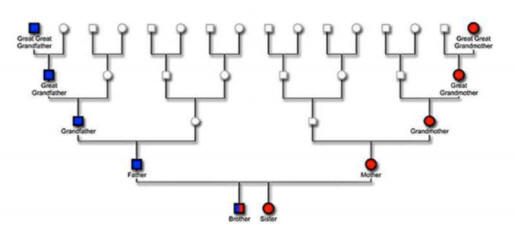
Y-DNA testing focuses on the Y-chromosome which only males have. Men inherit the Y-chromosome from their father, who got the same chromosome genetic material from their father, etc. along the direct paternal line. The Y-chromosome passes almost unchanged along the direct paternal line; therefore, it provides an “eye” into one’s paternal past for several hundred years. (See the blue squares of Chart) Although females cannot be directly tested for Y-DNA since they have only X-DNA, they can access their paternal Y-DNA information by having their paternal grandfather’s, father’s, paternal uncle’s or brother’s Y-DNA tested.
Y-DNA can provide information about one’s ethnic ancestry along his direct paternal line. Y-DNA generally follows a person’s surname unless an adoption occurred or one’s biological father is not the father that raised him (e.g., an “unexpected” pregnancy).
Analytical laboratories sell Y-DNA test kits by the number of markers that you want tested. Generally, the more markers tested, the greater the accuracy of the results (i.e., that two people with near identical results are related). Test kits for 12, 25, 37, 67 and 111 markers are sold. It is recommended that at least 37 markers be tested.
mtDNA
mtDNA passes from the mother to all of her children - both male and female. Only females can pass mtDNA to their offspring. Males have their mother’s mtDNA, but cannot pass it to their offspring. Like Y-DNA, mtDNA passes almost unchanged from one generation to the next over hundreds of years. It provides genealogical information on one’s direct maternal line. (See the red circles in Chart) Both males and females can be tested for mtDNA.
mtDNA can provide information about one’s ethnic ancestry along his/her direct maternal line.
mtDNA test kits are sold for either “HVR1 + HVR2” regions or for the Full Sequence (which covers the “HVR1 + HVR2” regions and more). It is recommended that the Full Sequence mtDNA be used.
atDNA
Autosomal DNA passes down from all of your ancestors. At the moment of conception, a child receives approximately 50% of his autosomal DNA from each of his parents. The specific atDNA each child receives is random so siblings do not receive the same atDNA mix.
Each succeeding generation from the past contributes less and less atDNA to the newly-conceived child. For example, a child's four grandparents contribute approximately 25% each of his atDNA. A child's eight greatgrandparents contribute approximately 12.5% each of his atDNA and so on. The actual percentage contributed can vary with each ancestor. The amount of atDNA contributed by an ancestor from the fifth generation (and farther) back becomes so small as to be difficult to detect.
Autosomal DNA provides genealogical information about our uncles, aunts and cousins primarily. (See the white squares and circles in Chart) Unlike Y-DNA and mtDNA which provide information over hundreds of years, atDNA only provides information for a few generations back - generally fifth cousins and closer.
One caveat - for close-knit ethnic groups in which genealogical lines cross frequently (i.e., a person is related to another person along more than one genealogical line), the atDNA test can overstate the relationship. For example, the atDNA may indicate a 2nd - 4th cousin relationship whereas the actual relationship may be 3rd - 5th cousin. The Acadians meet the “close-knit” criteria since Acadian villages were often isolated and contained members of only a few closely-related families.
atDNA can provide information about the percentages of one’s ethnic ancestry from different regions of the world.
Only one type of atDNA test kit is sold. Over 700,000 markers are analyzed in the test.
Other Tests
There are other DNA tests as the Big Y DNA Tests and Y-DNA SNP tests; however, these are less frequently used by genealogists at this time.
DNA Analytical Laboratories
There are several genealogical DNA analytical laboratories providing test kits and analyzing the samples; however, most offer very limited services.
The major DNA analytical laboratories offering genealogical tests are:
(1) AncestryDNA (from Ancestry.com)
AncestryDNA offers only the autosomal DNA test (called AncestryDNA) for $99. AncestryDNA does maintain a database of results from its tests.
You can access the AncestryDNA website at http://dna.ancestry.com .
(2) 23andMe
23andMe only offers the autosomal DNA test for $99. 23andMe maintains a database of results from its tests.
You can access the 23andMe website at https://www.23andme.com .
(3) FamilyTreeDNA
FamilyTreeDNA offers the full suite of DNA tests including Y-DNA, mtDNA and atDNA.
Their Y-DNA tests are Y37 (37 markers) at $169, Y67 (67 markers) at $268 and Y111 (111 markers) at $359. Their mtDNA tests are mtDNA+ (HVR1+HVR2) at $69 and mtFullsequence (Full Sequence) at $199. Their atDNA test is Family Finder (>700,000 markers) at $99.
FamilyTreeDNA offers two ways to save money with their testing. You can join one or mo re surname or geographical projects listed on their website and receive a discounted price. Also, periodically FamilyTreeDNA has sales of its products. Surname and geographical projects can be joined initially or at any time after having your DNA testing done.
FamilyTreeDNA maintains the largest database available for results from each of their DNA tests. They provide excellent graphics and tables of your results as well as tutoring lessons, interpretation aids, blogs, forums and FAQs.
FamilyTreeDNA also has a service for transferring autosomal DNA results from other laboratories to their website which increases their database size and enhances opportunities for matches.
FamilyTreeDNA maintains the integrity of your original DNA sample and lets you upgrade to a more comprehensive test (e.g., from Y67 to Y111) at a discounted price. They also can provide additional tests without having to resample your DNA.
FamilyTreeDNA processes the public participation kits for the National Geographic Genographic Project. (See http://isogg.org/wiki/Genographic_Project )
You can access the FamilyTreeDNA website at https://www.familytreedna.com .
I have used FamilyTreeDNA for Y-DNA, mtDNA and atDNA tests on myself and would recommend them as an excellent analytical firm for DNA testing.