Should the Guédry Surname Really Be Melançon?
A DNA Genealogical Study
Should the Guédry family surname actually be Melançon? Seems far-fetched at first, but let's delve a little deeper at some strange coincidences and occurrences. You may begin to wonder what the truth really is. Fortunately DNA provides a pathway for us to determine the correct answer to this question.
Origins
Pierre Melanson dit Laverdure, a French Hugenot, was born in France and lived his early life there; however, with the French Catholic government severely persecuting the Protestant Hugenots, Pierre left France for the safety of England in the early 1600s. There he met and married Priscilla by whom he had at least three sons and a daughter. 1 , 2 , 3 , 4 , 5 , 6 , 7 , 8 , 9In the Spring of 1657 Pierre Melanson, his wife and at least three sons embarked on the vessel Satisfaction under Captain Peter Butler for North America. The Melansons formed part of the 'company' that Sir Thomas Temple was transporting to Acadia - over which he would serve as the English Governor. After the Satisfaction first landed at Boston on 16 July 1657 where Sir Thomas Temple presented his papers of appointment, it proceeded to the fort at the mouth of the St. John River on the Bay of Fundy. Here the Melanson family along with several other passengers debarked to begin a new life. With the signing of the Treaty of Breda in 1667 and Acadia being returned to France, Pierre Melanson left Acadia for the Protestant town of Boston to escape the wrath of the Papists. He took with him Priscilla and one son John. Two of his sons, Pierre Jr. and Charles, had converted to Catholicism, married Acadian women and opted to remain in Acadia with their young families. After reaching Boston, Pierre and his son John took their 'dit' name Laverdure and were known as Pierre Laverdure and John Laverdure henceforth. Pierre Jr. and Charles retained their Melanson surname in Acadia. 1 , 2 , 3 , 4 , 6 , 7 , 8 , 9 , 10
Little is known of the origins of Claude Guédry dit Laverdure (also known as Claude Guédry dit Grivois). Evidence indicates that he was born in France and came to Acadia from there. Claude first appeared in the record in 1681 when he and Keskoua, a Mi'kmaq, had their daughter Jeanne baptized near the mouth of the St. John River. 11
Births
John Laverdure, son of Pierre Laverdure and Priscilla, likely was born ca. 1645-1650. He is thought to have been the youngest of the three sons of Pierre Melanson dit Laverdure and Priscilla. Pierre Melanson Jr. was born ca. 1632 and Charles Melanson was born ca. 1642. The ages of Pierre Melanson Jr. and Charles Melanson appeared in the Acadian census records of 1671, 1686, 1693, 1698 and 1700. 4 , 5 , 12 , 13 , 14 , 15 , 16 , 17Claude Guédry dit Laverdure was born ca. 1648-1651 based on Acadian census records from 1686, 1698 and 1708. 13 , 16 , 18
The “dit” name Laverdure
We do not know the exact origins of the 'dit' name Laverdure. The term “dit” derives from the French verb “dire” which means “to say”. “Dit” is the past participle of “dire” and thus would mean “said” or perhaps “called”. Many compare “dit” names to nicknames or aliases. “Dit” names were quite common in France in the 1600s. The 'dit' name could refer to any of several things about the person such as a description of the person, a character trait, a place of origin, an occupation, a first or full name of an ancestor or land inhabited by an ancestor. The French term “laverdure” or “la verdure” means the greenery, the foliage or the forest scenery. One might infer that the “dit” name Laverdure could describe that a person lives in or near the forest or perhaps that a person works in the forest as a woodsman, hunter or trapper.Several early settlers in Acadia used the “dit” name Laverdure including Pierre Melanson dit Laverdure and his son John Melanson dit Laverdure as well as Claude Guédry dit Laverdure, François Leclerc dit Laverdure (a soldier), Germain Doucet dit Laverdure (an associate of Charles de Menou d'Aulnay) and his son Pierre Doucet dit Laverdure. 7(pp. 233-234)
Occupation
John Laverdure was a seaman or mariner. While living at Boston, he sailed with several captains including Captain Thomas Cole at Naskeag and at Machias and with Henry Lawton, John Glover and William Waldron on the Endeavor to trade along the eastern New England coast, the Azores and Barbados. 1(pp. 35-42) , 2(p. 22)Claude Guédry and his sons were known as excellent coasting-pilots out of Merliguèche Bay where they lived. They often were hired to pilot ships from Merilguèche to Halifax and also through the dangerous waters of Cape Sable to Port-Royal. 19
Education and Signature
John Laverdure apparently received some education in England prior to sailing to Acadia and perhaps further education in Boston. He entered into contracts and signed his name with style and grace. 1(p. 15) , 2(pp. 39,41) , 20Claude Guédry also must have received some education. In 1695 he took the Oath of Allegiance to the English King William III and signed his name with a beautiful flourish. 21
Note the similarities of the two signatures - the beautiful style of writing, the similar slant of letters, the almost identical 'd' in Laverdure and Claude and the very similar 'L' in Laverdure and Claude.

Languages Spoken
John Laverdure definitely spoke English and the language of the Natives. He lived in Boston and did commerce there. Additionally, he sailed on the Endeavor and enticed the Natives in their tongue to board the ketch. He likely also spoke French from his early days living near the mouth of the St. John River. 1(p. 35,42)
Claude Guédry spoke French and almost certainly spoke Mi'kmaq from having lived among these Native people at Merliguèche. He also had two daughters-in-law that were Métis - both daughters of Philippe Mius d'Azy and Marie, a Mi'kmaq. Jean-Baptiste Guédry married Madeleine Mius d'Azy and Paul Guédry married Anne-Marie Mius d'Azy. 28(pp. 1206-1207) Claude likely also spoke some English since he and his family traded with New England fishermen entering Merliguèche Bay for supplies and fresh water.
John Laverdure Disappears
After moving from the St. John River area of Acadia to Boston about 1667, John Laverdure worked as a mariner. In 1675 he entered into a partnership with Henry Lawton, John Glover and William Waldron. Together they leased the ketch Endeavor from Simon Lynd at Boston with the stated intention to transport cargo and to trade with the eastern New England coast, the Azores and Barbados. Their real intention, however, was to sail in search of Natives. New England frontier settlements recently had experienced several severe Native raids and Henry Lawson had been issued a commission to capture any Natives involved in these attacks.
The four mariners purchased some trade goods as tobacco, pipes, buttons and textiles as well as bread and flour and then set sail eastward along the Atlantic coast. At Machias, because John Laverdure could speak the Native language, they enticed eight Native men, women and children to board the Endeavor where they were secured in the hole. The ketch then headed to Cape Sable where John Laverdure was able to convince nine additional Native men, women and children to come onto the Endeavor. They also were captured and included a sagamore and his wife. These Natives had not taken part in the recent attacks and, furthermore, had a peace agreement with New England.
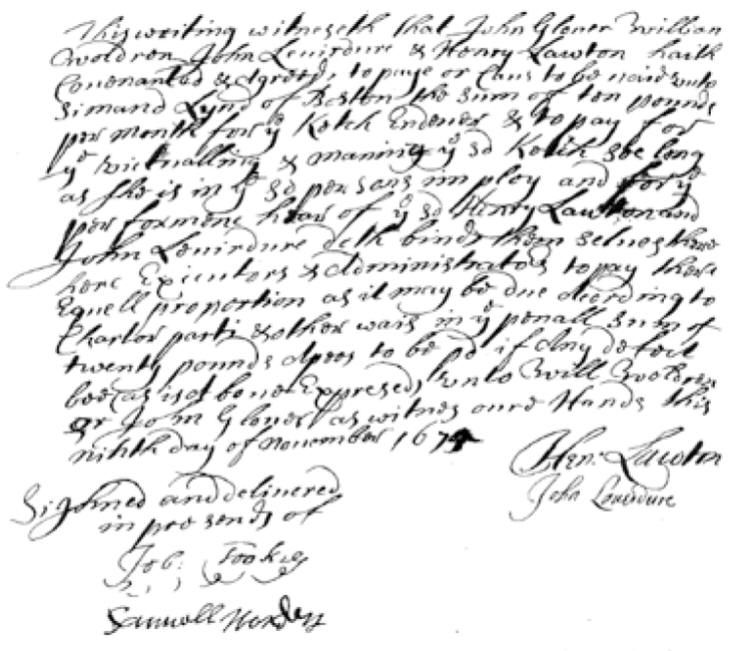
Henry Lawton and his partners transported the seventeen Natives to Fayal Island in the Azores and sold them as slaves. Word of the capture and sale of these innocent Natives soon spread among the Natives of New England and even the English, who feared the Natives would ignore the peace agreement and join in raids on New England settlements. The four partners and the captain of the Endeavor, John Horton, were arrested in August 1676. Lawton and Waldron were sent to prison without bail while Glover, Horton and John Laverdure were granted bail in the form of surety bonds of £100 each to guarantee their appearance in court.
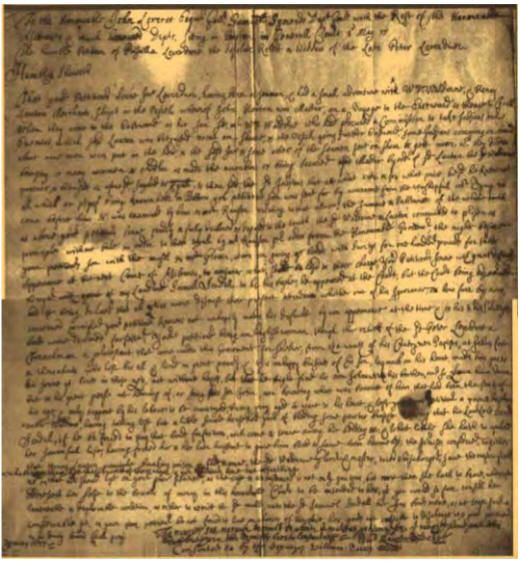
John Laverdure's mother Priscilla convinced her landlord Samuel Sendall to put up the money for John's bail. On 5 September 1676 when the court convened, John Laverdure did not appear. When John Laverdure could not be produced, Samuel Sendall and, through their guarantee to Sendall, Pierre and Priscilla Laverdure forfeited the surety bond and the £100. This was a significant financial setback for Pierre and Priscilla. Although quite elderly, Pierre Laverdure travelled to Acadia in search of his son - hoping he may be with one of his brothers. He was not found and shortly afterwards Pierre Laverdure died. 1(pp. 41-46) , 2(p. 37) , 20 , 23 , 27 , 28
Priscilla petitioned the court to release Mr. Sendall and thus her from the surety bond, but it was to no avail. John Laverdure was still missing in May 1677 and no definitive record of his whereabouts exists after his bail hearing. 1(pp. 46-49) , 24 , 28
What did happen to John Laverdure? Could he have stayed in Acadia and hid from authorities there? Perhaps he even changed his name to secure his “new” life?
Interestingly, near the beginning of the 1678 Census of Port-Royal there is mentioned “la Verdure 2”. 25 Could this be John Laverdure? Or could it have been his older brother Pierre Melancon dit Laverdure Jr.? We do not know.
No definitive record of John Laverdure has been found after 1676. Perhaps he stayed in Boston and changed his name to avoid detection. There was a John Melleson who registered the births of five of his children in Boston from 1681 to 1689. We have no reason to believe that this John Melleson was actually John Laverdure. This John Melleson seems to have been born about 1642 in London, England to a John Melleson. The name Melleson and its spelling variations as Mellson were found in several areas of New England at this time period. For example, there was a John Mellson living in Maryland in 1686. 1(pp. 45-46) , 26(p. 1425) , 28
Claude Guédry Appears
On 2 June 1681 Claude Guédry dit Laverdure first appeared in the known written record. He and Keskoua, a Mi'kmaq, baptized their young daughter Jeanne Guédry at Menagoued near the mouth of the St. John River. 11

In the 1686 Census of Acadia Jacques Meulles recorded at Merliguèche (near today's Lunenburg) the young family “La Verdure, 35; sa femme, 25; et un Enfant” (La Verdure, 35; his wife, 25; and a Child”). Based on the location and their ages, this family would be Claude Guédry dit Laverdure, his wife Marguerite Petitpas and their son Jean Baptiste Guédry. We know from the 1698 and 1708 censuses that Claude Guédry was born ca. 1648, Marguerite Petitpas was born about 1660 and Jean Baptiste Guédry was born about 1684. 13 , 16 , 18
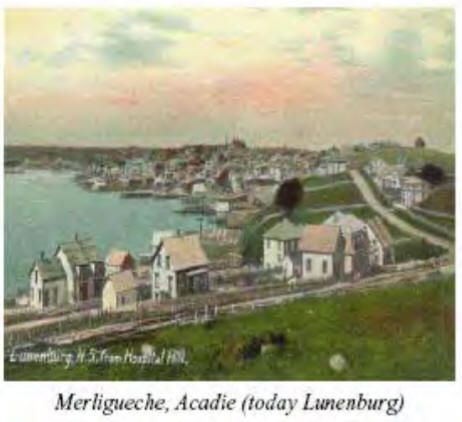
Merliguèche was a lightly-settled area of Acadia near present-day Lunenburg and just east of LaHave. In the late 1600s and early 1700s the Guédry, Petitpas and Mius families along with the Mi'kmaq inhabited the area around Merliguèche - likely less than 400 people.
In the 1630s the harbor and surrounding lands of Merliguèche were granted to Bernard du Gueret dit Saint Martin (Bernard Bugaret) by the King. 27 Bugaret was a carpenter who had come to this area at least twice in the 1630s and 1640s to obtain wood for the French. Bernard Bugaret was the maternal grandfather of Marguerite Petitpas, wife of Claude Guédry. Her father and mother were Claude Petitipas and Catherine Bugaret. Thus it is reasonable that Claude Guédry and Marguerite Petitpas would settle on the land of their family, which they likely obtained at no cost.
Marital Connections
Sons in both the Melanson and Guédry families married daughters or granddaughters of Philippe Mius d'Entremont and Madeleine Hélie.
Pierre Melanson dit Laverdure Jr., son of Pierre Melanson and Priscilla, married Marie-Marguerite Mius d'Entremont, daughter of Philippe Mius d'Entremont and Madeleine Hélie, about 1665. 1(p. 113) , 2(p. 39) , 28(pp. 1148,1201)
Jean-Baptiste Guédry, son of Claude Guédry and Marguerite Petitpas, married Madeleine Mius d'Azy, daughter of Philippe Mius d'Azy and Marie (a Mi'kmaq) and granddaughter of Philippe Mius d'Entrement and Madeleine Hélie. 28(pp. 772-773, 1201, 1206)
Paul Guédry, son of Claude Guédry and Marguerite Petitpas, married Anne Marie Mius d'Azy, daughter of Philippe Mius d'Azy and Marie (a Mi'kmaq) and granddaughter of Philippe Mius d'Entrement and Madeleine Hélie. 28(pp. 772, 1201, 1207)
Charles Melanson dit La Ramée, son of Pierre Melanson dit Laverdure and Priscilla, married Marie Dugas, daughter of Abraham Dugas and Marguerite-Louise Doucet and sister of Martin Dugas, who was the first husband of Marguerite Petitpas. After Martin's tragic death by drowning, Marguerite Petitpas married Claude Guédry. 1(p. 63) , 2(p. 41) , 28(pp. 562, 568, 771-772, 1146) In addition, three of the children of the Melanson and Guédry families are named Pierre, Charles and Jean. Pierre Melanson dit Laverdure and Priscilla named their three sons Pierre (b. ca. 1632), Charles (b. ca. 1642) and Jean or John (b. ca. 1645-1650). 4 , 5 , 12 , 13 , 14 , 15 , 16 , 17 , 28(p. 1145) Claude Guédry and Marguerite Petitpas called three of their nine sons Jean-Baptiste (b. ca. 1684, Charles (b. ca. 1686) and Pierre (b. ca. 1698). 13 , 16 , 18 , 28(pp. 771-772)
Boston Connections
We have already mentioned the strong connections of John Laverdure with Boston - his home from about 1667 until his disappearance in 1676 and the home of his parents from ca. 1667 until their deaths.
Claude Guédry dit Laverdure also had strong connections with Boston. Fishermen from Boston often entered Merliguèche Bay to obtain supplies as food and fresh water from the Guédry family. In 1723 Claude Guédry and several of his family were captured by the English, brought to Boston and kept there for approximately a year. There he privately baptized two of his granddaughters, daughters of Augustin Guédry and Jeanne Hébert. In 1726 one of his sons and a grandson, Jean-Baptiste Guédry and Jean-Baptiste Guédry fils, were hung for piracy in Boston and buried on Bird Island in the Boston Harbor. 26(pp. 1601-1604, 1617-1618, 1623, 1625) , 29 , 30
Baptism of twins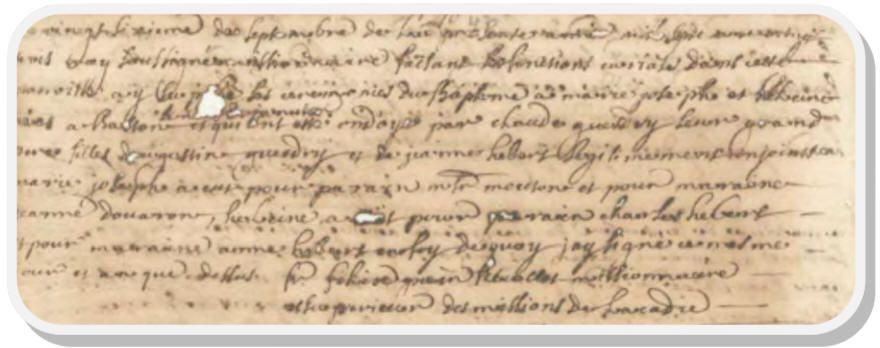
DNA
The numerous coincidences and strange occurrences in the lives of John Laverdure and Claude Guédry certainly can lure one to believe that they may be one and the same person. They were born about the same year, they both carried the 'dit' name Laverdure, they both knew the sea and the boat, they had strong marital connections, they both could speak French, English and Native languages convincingly, they were both educated and could write, their signatures were remarkably similar and they both had interesting Bostonian and Acadian connections. And, lastly, John Laverdure disappeared from the scene at approximately the same moment that Claude Guédry appeared. But all of this circumstantial evidence does not prove they are one and the same person.
DNA, the building block of life itself, offers us the genealogical tool we need to prove a direct relationship between John Laverdure and Claude Guédry. The Y-DNA analysis of direct descendants of both men should prove the validity of the hypothesis.
Y-DNA from the Y-chromosome is passed from father to son almost unchanged through many generations. All sons of a man inherit the identical Y-DNA from their father. The Y-DNA from a man's great great paternal grandfather is same as the man's Y-DNA. Y-DNA traces a direct paternal line.
If a direct paternal descendant of Claude Guédry and a direct paternal descendant of John Laverdure (or one of his brothers Pierre or Charles) had their Y-DNA analyzed and their results matched, then the evidence is very great that John Laverdure and Claude Guedry were the same person (i.e. had the same direct paternal ancestor - Pierre Melanson dit Laverdure). If they do not match, then John Laverdure and Claude Guedry were different persons without a direct paternal relationship.
Ideally, one would want to test two or more descendants of John Laverdur (or his brothers) and of Claude Guedry to minimize the potential of an unknown adoption or paternal event in which an individual may think they are a direct descendant by birth, but actually are not a birth descendant.
Y-DNA tests are identified by the number of markers analyzed. Initially, only the Y-DNA12 test was available in which 12 markers are analyzed. As DNA testing laboratories enhanced their laboratory capabilities, the number of markers being tested has grown. Today, Y-DNA67 and Y-DNA111 tests are the standards.
The only genealogical DNA testing firm offering Y-DNA tests today is FamilyTreeDNA.com. 31 This firm has an excellent reputation and a large database of persons who have had their Y-DNA analyzed.
“To match” in Y-DNA parlance means that the “numbers” assigned to the Y-DNA markers in the two sets of results should be the same or nearly the same for all markers tested. The more markers that are the same, the greater the probability that the two individuals share a direct paternal ancestor with the genealogical timeframe (approximately 12 generations). For Y-DNA67 testing the two individuals should share 60 of 67 markers or greater to be considered a match and thus have a high probability of having the same direct paternal ancestor. For example, if two individuals match 65 of 67 markers, there is a 95% probability that they have a direct paternal ancestor within 14 generations. If they match 66 of 67 markers, they have a 95% probability they have a direct paternal ancestor within 9 generations.
At least four direct paternal descendants of Claude Guédry have had their Y-DNA analyzed at the Y-DNA67 or Y-DNA111 level. Interestingly, they descend from three sons of Claude Guédry. They are Richard Martin Guidry (Y-NA111, Louisiana, Augustin Guédry and Jeanne Hébert), Daniel Charles Guidry (Y-DNA111, Louisiana, Paul Guédry and Anne-Marie Mius), Mark Labine (Y-DNA67, Minnesota, Pierre Guédry and Marguerite Brasseau) and Michael Guidry (Y-DNA111, California, Augustin Guédry and Jeanne Hébert). For the Y-DNA67 analyses all four persons match each other on at least 63 of 67 markers indicating all four have a very high probability of descending from the same direct paternal ancestor - Claude Guédry. This has been confirmed using standard genealogical techniques.
At least three direct paternal descendants of Pierre Melanson dit Laverdure Jr., brother of John Laverdure, have had their Y-DNA analyzed at the Y-DNA67 or Y-DNA111 level. They are Douglas Melancon (YDNA67, Louisiana, Pierre Melanson dit Laverdure Jr. and Marguerite Mius d'Entremont), Paul Edward Melanson (Y-DNA111, Ontario, Pierre Melanson dit Laverdure Jr. and Marguerite Mius d'Entremont) and William D. Manassau (Y-DNA67, Oregon, Pierre Melanson dit Laverdure Jr. and Marguerite Mius d'Entremont). For the Y-DNA67 analysis all three persons match each other on at least 61 of 67 markers indicating all three have a high probability of descending from the same direct paternal ancestor - Pierre Melanson dit Laverdure.
None of the three Melanson Y-DNA67 analytical results match any of the four Guédry Y-DNA67 results. For example, Douglas Melancon and Richard Martin Guidry differ on 21 of 67 markers while Douglas Melancon and Mark Labine differ on 20 of 67 markers. Douglas Melancon and Michael Guidry differ on 18 of 67 markers. All three of the Melanson Y-DNA67 analytical results differ by more than 8 markers from each of the four Guédry Y-DNA67 analytical results.
One can confidently state that John Laverdure and Claude Guédry were NOT the same person and did not share a direct paternal ancestor.
This DNA genealogical study is one real-life example of how DNA can be used to help solve genealogical questions and break “brick walls”.
References
- Melanson, Margaret C.; The Melanson Story - Acadian Family, Acadian Times (Margaret C. Melanson; Toronto, Canada; 2003) pp. 3-16
- Melanson, Michael B.; Melanson - Melançon: The Genealogy of an Acadian and Cajun Family (Lanesville Publishing; Dracut, MA; 2004) pp. 21-22, 37
- Blythe, Christine; "Empty Nest Genealogy: Pierre dit Laverdure and Priscilla Mellanson - A Family Mystery" (Internet-Viewed 2 July 2016)
http://www.emptynestancestry.com/pierre-dit-laverdure-and-priscilla-mellanson-a-family-mystery/ - Blythe, Christine; "Empty Nest Genealogy: A Breakthrough in the Mysterious Melanson Genealogy?" (Internet - Viewed 2 July 2016)
http://www.emptynestancestry.com/a-breakthrough-in-the-mysterious-melanson-genealogy/ - Delaney, Paul; "Les Melanson en Angleterre" ( Les Cahiers - Société Historique Acadienne ; Sociéte Historique Acadienne; Moncton, New Brunswick, Canada; Volume 43 No. 3; September 2012) pp. 44-60
- Christening Register; St. Martin-in-the-Fields Anglican Church; Westminster, London, England; 15 Aug 1637, 29 Oct 1636, 19 Apr 1640, 14 Dec 1642
- d'Entremont, Rev. Clarence J.; "New Findings on the Melansons" ( French Canadian and Acadian Genealogical Review ; Roland J. Auger; Haute-Ville, Québec, Canada; Volume II No. 4; Winter 1969) pp. 219-257
- d'Entremont, Rev. Clarence J.; "The Melansons of Acadia Had A French Father And An English Mother" ( French Canadian and Acadian Genealogical Review ; Roland J. Auger; Haute-Ville, Québec, Canada; Volume VI No. 1; Spring 1978) pp. 53-55
- d'Entremont, Rev. Clarence J.; "Les Melanson d'Acadie Sont Français de Père Et Anglais de Mère" ( Les Cahiers - Société Historique Acadienne ; Sociéte Historique Acadienne; Moncton, New Brunswick, Canada; Volume 40, Jul-Sep 1973) pp. 416-419
- Baxter, James Phinney; "Letter of John Adams to Honorable Paul Dudley, Esquire, 22 September 1720" ( Collections of the Maine Historical Society, Second Series, Documentary History of the State of Maine Containing the Baxter Manuscripts , Lefavor-Tower Company; Portland, ME; Volume IX; 1907) pp. 460-462
- Archbishopric of Québec; Québec, Canada; Petit Registre , Registre A, Cahier No. 1, Acadie, 1679-1686, Actes du P. Claude Moireau, p. 3 (Baptism of Jeanne Guédry)
- 1686 Census of Acadia; Archives Nationales d'Outre-Mer, Archives des Colonies, G1, Volume 466, No. 10, folios 6, 24-25
- 1693 Census of Mines; Archives Nationales d'Outre-Mer, Archives des Colonies, G1, Volume 466, No. 14, folio 6
- 1693 Census of Port-Royal; Archives Nationales d'Outre-Mer, Archives des Colonies, G1, Volume 466, No. 13, folio 4
- 1698 Census of Port-Royal; Archives Nationales d'Outre-Mer, Archives des Colonies, G1, Volume 466, No. 18, folios 1, 13
- 1700 Census of Port-Royal; Archives Nationales d'Outre-Mer, Archives des Colonies, G1, Volume 466, No. 22, folio 6
- 1708 Census of the East Coast, Pentagouët and Canibeky; Manuscript 751, E. E. Ayer Collection, Newberry Library, Chicago, IL, Volume IV, folio 42
- Letter de Beauharnois et Hocquart au Ministre (Sep - Oct 1745); Centre des Archives d'Outre-Mer (France), Correspondance Générale - Canada, Fonds des Colonies, C11A 83, folios 18-19
- Agreement of John Laverdure and three others to lease the ketch Endeavor, 10 November 1675; Massachusetts Archives, Boston, MA, Volume 61, folio 116
- Oath of Allegiance in 1695 at Port-Royal; "Liste des Acadiens qui ont prêté le serment d'allégeance au roi d'Angleterre, 1695", 16 August 1695, Massachusetts Archives, (Secretary of the Commonwealth), Boston, MA, Volume 2 [Colonial, Chapter 8 (Nova Scotia and Canada from 1643 to 1719)], folio 540
- Testimony of Thomas Gardner regarding trial of John Laverdure and others, 12 September 1676; Massachusetts Archives, Boston, MA, Volume 61, folio 116
- Purchase of Supplies for Endeavor, 1675; Massachusetts Archives, Suffolk Court Files, Boston, MA, Volume 28, No. 1592, pp. 128-132
- Petition of Priscilla Laverdure for Relief from Loss of Surety Bond, 3 May 1677; Massachusetts Archives, Suffolk Court Files, Boston, MA, Volume 28, No. 1592
- 1678 Census of Port-Royal; Archives Nationales (France), Archives des Colonies, F 774, Series E (dossier personnel Leneuf de La Vallière), carton 277] folio 24
- d'Entremont, Rev. Clarence J.; Histoire du Cap-Sable de L'An Mil au Traité de Paris, 1763 (Hebert Publications; Eunice, LA; 1981) pp. 1422-1428
- Mémoires généraux sur l'Ile Royale (Archives Nationales (France), MG1-DFC, Dépôt des fortifications des colonies) Dec 1716 [Mémoire of Jacque L'Hermitte], folio 28
- White, Stephen A.; Dictionaire Généalogique des Familles Acadiennes - Première Partie 1636 à 1714 (Centre d'Études Acadiennes - Université de Moncton; Moncton, New Brunswick, Canada; 1999) pp. 1150-1151; English Supplement (Centre d'Études Acadiennes - Université de Moncton; Moncton, New Brunswick, Canada; 2000) p. 248
- Catholic Diocese of Baton Rouge; Baton Rouge, LA; St. Gabriel Catholic Church Records (Registers of St. Charles-aux-Mines Catholic Church, Grand-Pré, Acadia), Volume 2, Page 42
- A Report of the Record Commissioners of the City of Boston containing the Records for Boston Selectmen, 1716 to 1736 , (Boston, 1885), p. 107.
- FamilyTreeDNA.com website - https://www.familytreedna.com