Who Was the Husband of Hélène Guédry, Daughter of Augustin Guédry and Jeanne Hébert
Hélène Guédry, daughter of Augustin Guédry and Jeanne Hébert, was the twin sister of Marie-Josephe Guédry. Very little about the life of Hélène Guédry has been located in the records.
In a strange twist of events Hélène Guédry and Marie-Josephe Guédry were born at Boston, Massachusetts on 9 January 1723 and there ondoyé by their grandfather Claude Guédry 1 2 3 4 5 . An enfant was ondoyé when there was some urgency at a birth and no priest was in the vicinity. It was done without the formal rites of baptism. Usually at the first opportunity the parents took the child to a priest who provided the formal rites of baptism and recorded the baptism in the church register. Such was the case of Hélène and Marie-Josephe when Père Félix Pain provided the formal rites of baptism for both girls on 26 September 1723 and recorded their baptisms in the Register of St. Charles aux Mines Catholic Parish at Grand-Pré, Acadia. 4 5 6 7
In the early summer of 1722 the Indians of Maine waged a war against the English in New England to retaliate against the English seizing their highest chief Joseph d'Abbadie de Saint-Castin and destroying their village Nanrantsouak - even burning the church and rectory. Governor Shute of Massachusetts issued a declaration of war on 25 July 1722 - a war known by several names including The Three Years War, Rale'sWar, Lovewell's War and Governor Dummer's Indian War. The English Governor of Acadia Richard Phillips was at Canso when Governor Shute declared war. He immediately sent troops along the East Coast of Acadia including Merliguèche where he recovered English vessels and imprisoned Indians and Acadians. Among those captured by the English were Claude Guedry and Marguerite Petitpas and three of their children with families - Augustin Guédry and his wife Jeanne Hébert, Marie-Josephe Guédry and her husband Philippe Doiron (called Gold by the English) with their son and Paul Guédry and his wife Anne-Marie Mius d'Azy.
Perhaps the Acadians were imprisoned because of their strong ties to the M'ikmaq - both through intermarriage and through friendships. The Guédry families first were taken to New Hampshire and then to Boston where they remained in captivity until the summer or fall of 1723 3 5 . By 26 September 1723 the Guédry families had returned to Acadia . On this date Père Felix Pain baptized with church ceremonies Hélène Guédry and Marie-Josephe Guédry and registered their baptisms in the records at St. Charles aux Mines Catholic Church in Grand-Pré, Acadia. Charles Hébert and Anne Hébert sponsored little Hélène while Jean Mouton and Jeanne Douaron served as Marie-Josephe's godparents 1 2 5 .
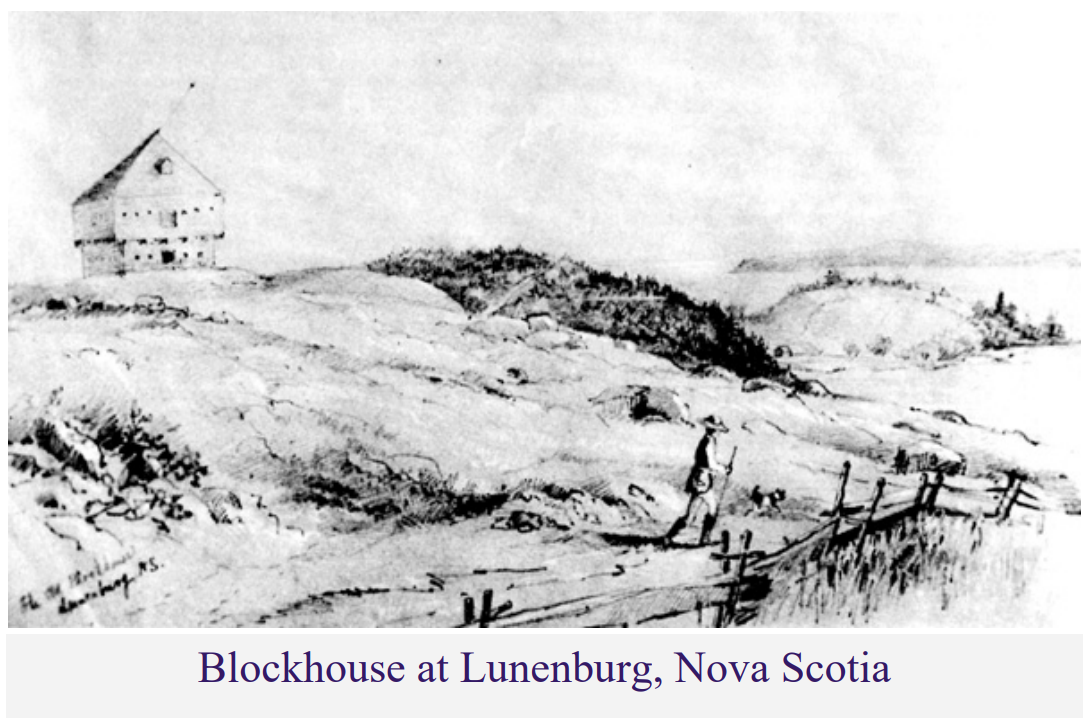
The young twins must have been at Merliguèche (near today's Lunenburg, Nova Scotia) with their parents on 25 August 1726 when their uncle Jean-Baptiste Guédry and cousin Jean-Baptiste Guédry fils along with six Mi'kmaq Amerindians and Métis captured the schooner Tryal in Merliguèche Harbor. Their father Augustin Guédry along with their grandmother Marguerite Peptitpas attempted unsuccessfully to dissuade Jean-Baptiste from taking the schooner 6 .
With ever-increasing tension between the English authorities and the Acadians over the Oath of Allegiance and other issues, many Acadian families sought refuge in the late 1740's and very early 1750's on Île Royale (today Cape Breton Island) and Île Saint-Jean (today Prince Edward Island) - both French territories. In early April, 1752 Marie-Josephe Guédry (age 28 years) and her husband Charles Boutin (age 29 years) were living at Baye des Espagnols on Île Royale (today North Sydney, Cape Breton Island). With the young couple were their three children: Jean Charles (age 5 years), Olive (age 3 years) and Marie Françoise (age 3 months).
Living with the young family was Marie-Josephe's twin sister Eleine (Hélène) Guédry, age of 29 years. Charles Boutin, the son of Jean-Joseph Boutin and Marie-Marguerite Lejeune, was a ploughman (farmer) and married Marie-Josephe Guédry about 1746 7 based on the age of their eldest child.
Living adjacent to Marie-Josephe and Charles were Paul Boutin and his wife Eustache (Ursule) Guédry with her brother Pierre Guédry. They had two sheep and one hen and had made a clearing on which they sowed a peck of oats and a bushel of peas. Paul Boutin was the brother of Charles Boutin while Ursule Guédry and Pierre Guédry were siblings of Charles' wife Marie-Josephe Guédry and her twin sister Hélène Guédry 7 .
During their stay on Île Royale Charles and Paul Boutin with their families almost certainly visited the Fortress of Louisbourg only a short distance to the south of them. There they could receive needed supplies and religious services. A severe drought and poor soil at Baye des Espagnols and surrounding areas did not provide enough food resources in the early 1750's; therefore, in August 1754 a group of 25 Acadians including Charles Boutin, Paul Boutin, Julien Bourneuf, Sebastien Bourneuf, Pierre Guédry, Joseph Guédry, François Lucas, Pierre Erio and Claude Erot with their families left Louisbourg to escape starvation and arrived at Halifax. On 24 August 1754 William Cotterell, the Governor's Secretary in Halifax, wrote to Colonel Sutherland, Commander at Lunenburg (formerly Merliguèche) stating that several of the party were closely related to Old Labrador (almost certainly Paul Guédry, the youngest son of Claude Guédry and Marguerite Petitpas) and were former inhabitants of Merliguèche. He informed the Colonel to treat them kindly, feed them and provide land and tools to them 8 9 .
Interestingly, almost of all of these families were related to Augustin Guédry and Jeanne Hébert. Charles Boutin married Marie-Josephe Guédry, Paul Boutin married Ursule Guédry and Julien Bourneuf married Jeanne Guédry. Pierre Guédry and Joseph Guédry were brothers and also the siblings of Marie-Josephe Guédry, Ursule Guédry and Jeanne Guédry - all children of Augustin Guédry and Jeanne Hébert. Sebastien Bourneuf was the brother of Julien Bourneuf. Hélène Guédry, sister to the other returning Guédrys, also appears to have made the journey from Louisbourg.
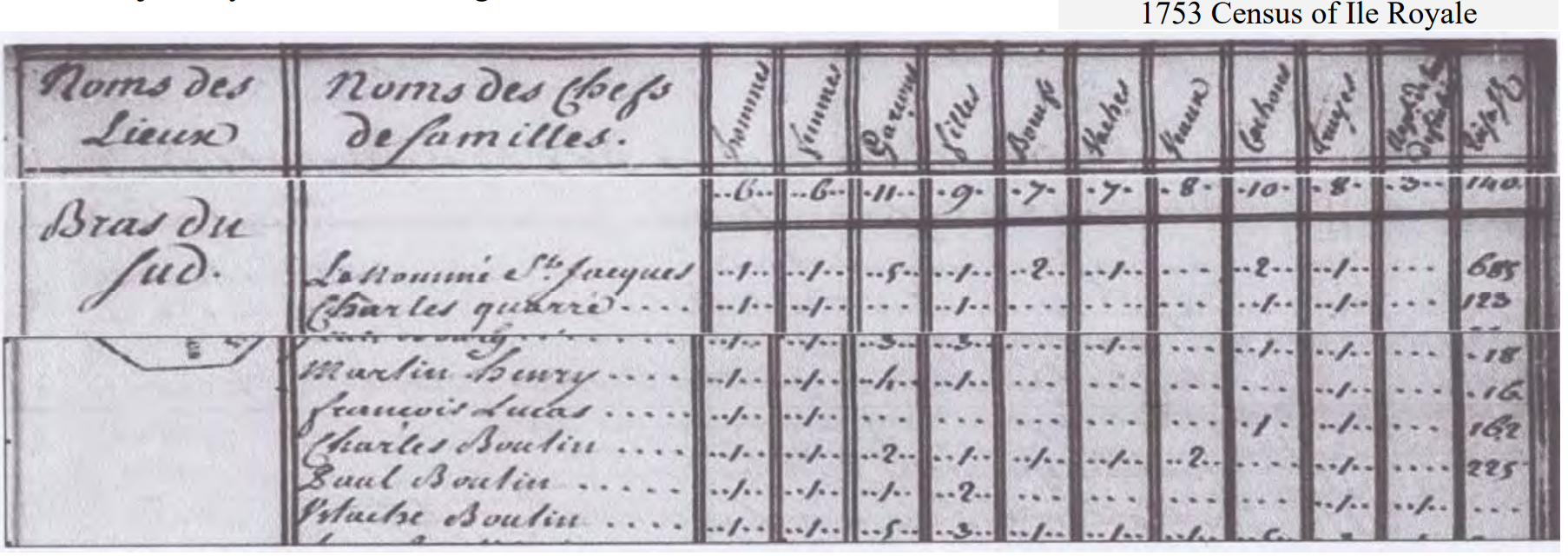
An interesting document The 1755 Victual List for Lunenburg compiled on 29 June 1755 provides the names of the persons in each Acadian family that returned to Lunenburg 10 . In the family of Paul Boutin were his wife Ursula (Guédry) and children Cathrina, Joseph and Joseph as well as Ursula's brother Pierre (Guédry, but called Boutin in the List). Charles Boutin had his wife Maria (Guédry) and their children Jean Charles, Pierre Oliver, Maria Françoise and Magdalene Perpeta. With Julien Bourneuf were his wife Jeane (Guédry), their children François, Jean, Sophia and François as well as his brother Sebastien (Bourneuf) and Leon Deran (Bourneuf). Joseph Gendry (Guédry) was listed by himself. François Loucas was with his wife Hélène and daughter Maria and listed immediately above Charles Boutin, his wife Maria and their children.
None of these people appear on later (1756 or 1757) Victual Lists for Lunenburg indicating that they have left the Lunenburg area by early 1756. We know that a few left Lunenburg to return to Île Royale (Jean Bourneuf with his wife Jeanne Guédry and children as well as two men not related to the Guédry family). The rest of the Acadians at Lunenburg were captured by the English in September 1755 and imprisoned on Georges Island in Halifax Harbor. In December 1755 they were exiled to North Carolina. Here they remained until about 1760 when some found their way to Philadelphia, Pennsylvania and others to Maryland. (See "New Research Reveals Guédrys Exiled to North Carolina" by R. Martin Guidry in Generations; Vol. 7, Issue 1; Winter 2009; pages 12 and following for a detailed discussion of this event.)
Who was this Hélène, the wife of François Loucas? With little doubt she is Hélène Guédry, daughter of Augustin Guédry and Jeanne Hébert and sibling of MarieJosephe Guédry, Ursule Guédry, Jeanne Guédry, Joseph Guédry and Pierre Guédry. In April 1752 she was 29, unmarried and living with the family of Charles Boutin and Marie-Jeanne Guédry, her twin sister.
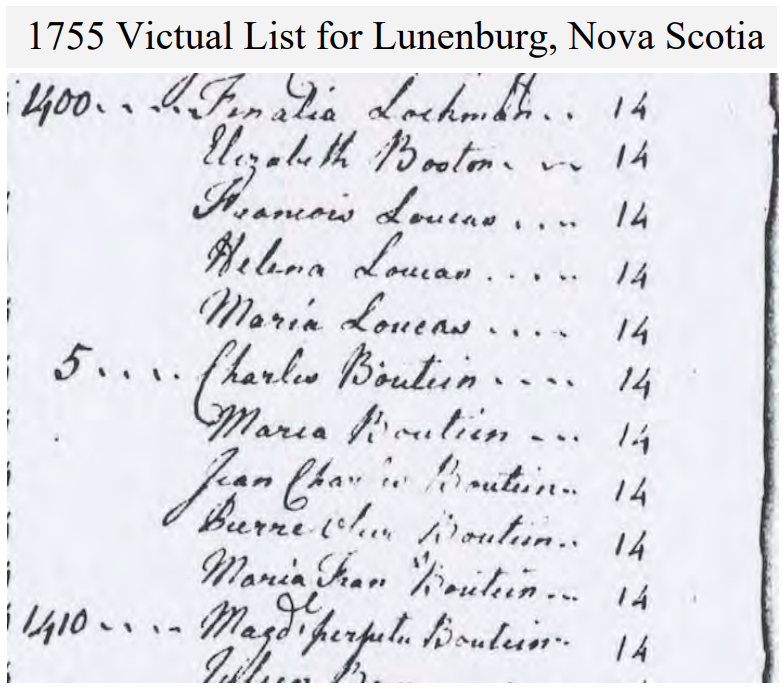
During the summer of 1753 a census of Île Royale was taken 11 . At Bras du Sud on Baye des Espagnols were Charles Boutin with his wife, two sons and one daughter. He had one ox, one cow, two calves, no hogs, one sow, no cleared land and 225 fathoms in garden. Settled just below Charles were his brother Paul Boutin with his wife, one son and two daughters. He had only one sow and one arpent of cleared land with no garden. Immediately above Charles Boutin was François Lucas and his wife. He owned one hog and one sow and had 162 fathoms in garden. From the above Victual List we know that the wife of François Lucas was Hélène. Based on the proximity of François Lucas' home to that of Charles Boutin and Paul Boutin, the wife of François almost certainly was Hélène Guédry, the twin sister of Marie-Josephe Guédry.
It appears that François Lucas and Hélène Guédry married between April 1752 and the summer of 1753. By June 1755 they had a daughter Marie. At this time little is known about the origins of François Lucas. He probably was a worker at the Fortress Louisbourg.
On 7 July 1763 at Snow Hill, Maryland were François Lucas, his wife Anne and their children Rose Lucas, Marie Lucas and Marguerite Lucas 12 13 14 15 . Could this be François Lucas and Hélène Guédry and Hélène is called by the name Anne? Or could Hélène have died and François remarried to an Anne and had a second family? We do not know.
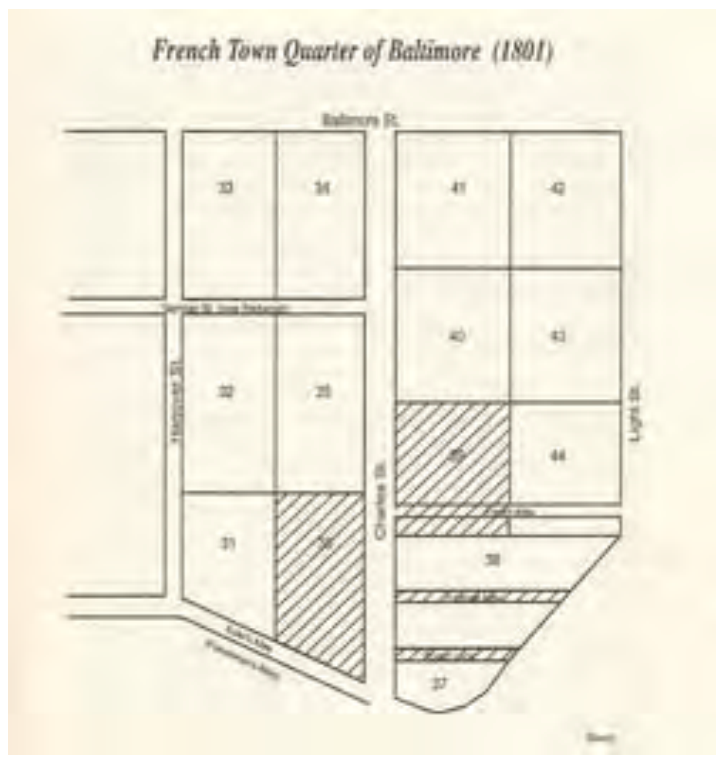
François and Hélène had a daughter Marie born about 1754. The François Lucas family of Snow Hill stayed in Maryland long after the exile and their descendants may still live there today. In 1773 and 1774 on the list of taxables for Westminster Hundred in Baltimore was Francis Lucas 16 . Westminster Hundred occupied the area of Baltimore that is today downtown Baltimore. In 1778 Francis Lucas was on the Spear List as taking Oath of Fidelity. That same year he leased a lot on French Lane in Baltimore - an area inhabited by Acadian families. In 1779 a Francis Lucas leased a lot on Charles Street in Baltimore from John Woodward and in 1786 he leased lot 38 from Dorseys & Chase 17 . All of these locations are within French Town - the Acadian section of Baltimore.
Margaret Lucas on 12 April 1777 submitted an account and receipt for making clothing for Captain George Cook of the state ship Defence 18 . Could this be the daughter of Francois Luças mentioned in 1763? Amelia Lucas received a land assignment from Francis Lucas on French Street in Baltimore during 1790 18 . Also in 1790 Francis Lucas appeared on the U. S. Census with one free male over 16 and four free females in his household 18 . Page 105 of the Baltimore 1798 Tax Book indicates that Francis Lucas paid 30 pounds of taxes on his house, lot and improvements on French Alley in Baltimore 19 . He was assessed additional taxes each year from 1799-1808 20 . The Lucas family continued to live in the Baltimore area well into the 1800's as attested by local records 21 .
On 12 January 1811 Francis Lucas died at the age of 103 years at the poor house in Baltimore 22 .
Although we have no definitive record providing conclusive proof concerning the spouse of Hélène Guédry, daughter of Augustin Guédry and Jeanne Hébert, it certainly appears that she married François Lucas about 1753 on Île Royale.
References
- Pollard, Nora Lee; Diocese of Baton Rouge Church Records (Diocese of Baton Rouge-Department of Archives; Baton Rouge, LA, 1978, 1999), v. 1 p. 59; v. 1A p. 88.
- Register of St. Charles aux Mines Catholic Parish, Grand-Pre, Acadia, 1707-1748, v. 2 #42. (Located at the Catholic Diocese of Baton Rouge Archives in Baton Rouge, LA).
- d'Entremont, Rev.Clarence-Joseph; Historic du Cap-Sable de l'An Mil au Traite de Paris, 1763 (Hebert Publications; Eunice, LA, 1981), pp. 1595-1597, 1615-1616, 1622-1623, 1625.
- White, Stephen A.; Dictionnaire Genealogique des Familles Acadiennes - Premiere Partie 1636 a 1714 en Deux Volumes (Centre d'Etudes Acadiennes - Universite de Moncton; Moncton, New Brunswick, Canada; 1999), pp. 773, Supplement p. 158.
- d'Entremont, Rev. Clarence-Joseph; Ibid., pp. 1139-1141, 1150-1151.
- The Trial of Five Persons for Piracy, Felony and Robbery: Who Were Found Guilty and Condemned, at a Court of Admiralty for the Trial of Piracies, Felonies and Robberies Committed on the High Seas, Held at the Courthouse in Boston, with His Majesty's Province of Massachusetts-Bay in New-England, on Tuesday the Fourth Day of October, Anno Domini, 1726 , Printed by T. Fleet, for S. Gerrish, at the lower end of Cornhill, 1726. (Early American Imprint Series. First Series: No. 2818; Evans 2818). Transcript of trial of Jean-Baptist Guedry pere and Jean-Baptist Guedry fils on pages 2-19. Transcript of trial of Philippe Mius, James Mius and John Missel on pages 19-34. (See page 8.)
- Gaudet, Placide, Report Concerning Canadian Archives for the Year 1905 in Three Volumes - "Journal and Census of Ile Royale, prepared by le Sieur de la Roque under the Direction of M. le Comte de Raymond, in the Year 1752, with Plan and Index", (S. E. Dawson, Printer; Ottawa, Canada; 1906). Volume II, Appendix A, Part I, p. 47.
- d'Entremont, Rev. Clarence-Joseph; Ibid. pp. 1854, 1864.
- Roth, D. Luther, Acadie and the Acadians , (Press of L. C. Childs & Son; Utica, NY; 1891). pp. 204-205.
- 1755 Victual List for Lunenburg, National Archives of Canada (Ottawa, Canada); Depot des Papiers Publics des Colonies; Etat civil et Recensements: Serie MG1, Volume 113 (Winthrop Bell's work sheet notes) [Also available on the Internet at: http://freepages.genealogy.rootsweb.com/~ked1/1755vict.html ]
- Recensement General des habitans des Ports et havres de l'Isle Royale, de la quantite de Bestiaux, Batiments, Chaloupes et Chafaux pour la peche, des terrains defriches, auquel est joins un memoire des observations qui ont etes prises de la situation des dits Ports et havres, de la qualite des terres, prairies et bois qui les avoisinent; fait en Juillet et Aoust 1753, National Archives of Canada (Ottawa, Canada); Depot des Papiers Publics des Colonies; Etat civil et Recensements: Serie MG1, Volume 466 part 3a. (See page 559.)
- List of Acadians in Maryland Desiring to Go to France, 1763, National Archives of Canada (Ottawa, Canada); Depot des Papiers Publics des Colonies; Etat civil et Recensements: Serie MG5, Volume 450, ff. 440-446.
- Jehn, Janet; Acadian Exiles in the Colonies (Janet Jehn; Covington, KY; 1977), pp. 132, 151.
- Rieder, Milton P. Jr. & Rieder, Norma Gaudet; The Acadian Exiles in the American Colonies 1755-1768 (Milton P. Rieder Jr.& Norma Gaudet Rieder; Metairie, LA; 1977), p. 30.
- Wood, Gregory A.; A Guide to the Acadians in Maryland in the Eighteenth and Nineteenth Centuries (Gateway Press, Inc.; Baltimore, MD; 1995), p. 165.
- Wood, Gregory A.; Ibid., pp. 38, 215-216.
- Wood, Gregory A.; Ibid., pp. 199-200, 216.
- Wood, Gregory A.; Ibid., p. 216.
- Wood, Gregory A.; Ibid., p. 225.
- Wood, Gregory A.; Ibid., p. 231.
- Wood, Gregory A.; Ibid., pp. 234, 283, 311, 320, 335-336, 357, Supplement pp. 2-3, 35.
- Wood, Gregory A.; Ibid., pp. 57, 59, 357.