Acadian Historical Sites: Georgia
We continue our series on historical sites of Acadian significance in various U. S. states and Canadian provinces. In this issue we highlight those historical sites in Georgia. The colony of Georgia received approximately 450 Acadians deported from the Chignecto Peninsula (Beaubassin/Fort Beauséjour area) of Nova Scotia. There are conflicting reports on the number of vessels reaching Georgia and the number of Acadians landed on Georgia shores.
Interestingly, Papists (Catholics) were forbidden from entering Georgia and the Catholic religion could not be practiced in Georgia. This created a dilemma for Georgia governor John Reynolds, who was in Augusta when the Acadians arrived unannounced off Tybee Island at the mouth of the Savannah River. As with other colonies, Nova Scotia Governor Charles Lawrence failed to notify Georgia that he was deporting Acadians (French Catholics) to the colony. He simply provided the captain of each vessel with a letter to be handed to Governor Reynolds when the vessel arrived.
Governor Reynolds was in Augusta to distribute presents to the Native American tribes when the vessels arrived. One of the vessels had women and children; a second vessel had men who were in Fort Beauséjour when it surrendered. Out of concern for the women and children, Reynolds sent word from Augusta to let the women and children disembark at Savannah; however, the men were to remain on their ship. Eventually, after Reynold's return to Savannah, the Governor relented and let the men disembark also as did the Acadians on the third ship. There was real concern as Georgia had only 3000 people there and half were slaves. More than 400 Acadian papists were a true concern. Furthermore, Georgia had hostile Native Americans on its western border and it was the weakest of the thirteen colonies with so few inhabitants. Although Reynolds allowed the Acadians to land on Georgia soil, he and his government did not treat them well.
They provided very little sustenance for the Acadians - and then only when absolutely necessary to keep them alive. He let the Acadians build ten barely seaworthy small boats so they could return to Acadia. Two hundred Acadians accepted his offer and departed Georgia, traveling along the coasts to South Carolina, North Carolina and eventually Cape Cod in Massachusetts where seven boats remained with but 99 Acadians. They were arrested and kept in Massachusetts. A few Acadians may have remained in colonies along the way, but the majority were committed to return to Acadia. Many must have died along the way. After the Treaty of Paris in 1763 some Georgia Acadians went to South Carolina and most of the remaining departed for Saint-Domingue (today's Haiti) where their troubles only increased. A very few remained in Georgia.
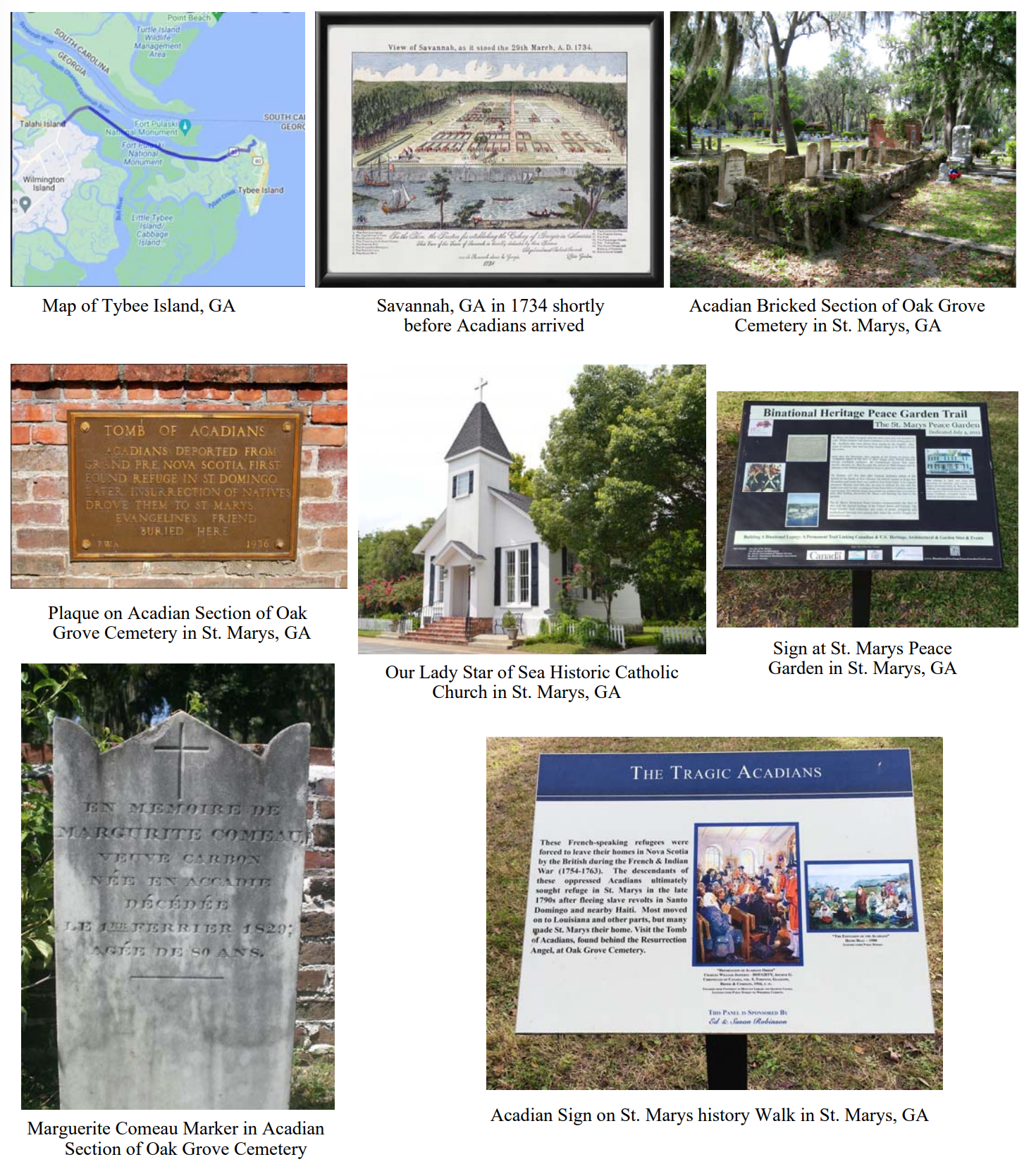
In the late 1790's until 1809 during the slave revolt in Saint-Domingue against the white population, many French fled Saint-Domingue. A few came to Georgia. A number of these French refugees went to Augusta, but a small number of Acadians settled in St. Marys at the southeastern edge of Georgia. Today the old cemetery there still has an Acadian section with the graves of these wanderers searching for a home.
Houses and buildings present in the area during the period that the Acadians were in Georgia (generally 1755-1770), but not connected directly to the Acadians usually are not mentioned below.
Acadian Historical Sites - Georgia
St. Mary's (Camden County)
Original Our Lady Star of the Sea Catholic Chapel (Corner of Bryant and Osborne Streets)
- Built as bank in 1840; Became church in 1847
- Marie Ponce Dufour, an Acadian, purchased the failed bank building in 1847 and converted it to a church
- Acadians worshiped here until 1950s. Recently refurbished and occasionally used for special masses and occasions
Oak Grove Cemetery (Corner of Bartlett Street and Weed Street)
- Established in 1788
- Acadians buried in the walled Acadian Section of cemetery and around it
St. Marys Peace Garden (Corner of Bartlett Street and Weed Street)
- Plaque mentions the Acadians in St. Marys, GA
St. Marys History Walk (Bartlett Street near St. Marys Street West; near 101 Bartlett Street)
- Plaque entitled "The Tragic Acadians" along Walk
Savannah (Chatham County)
Savannah Landing (East of Bay Street at the bottom of the bluffs along the Savannah River)
- Possibly near and opposite end of Price Street
- Ships transporting Acadians disembarked Acadians in harbor here
Tybee Island at mouth of Savannah River
- Off north tip of Tybee Island - likely near east end of Polk Street
- Initial anchorage of ships transporting Acadians when arriving at Georgia
Common westward of Savannah along the bluffs of the Savannah River
- East of Bay Street to Savannah River bluffs between East Broad Street and West Broad Street - likely near Yamacraw Bluff opposite Drayton Street
- Here Acadians built huts in 1761 and lived for the next few years until they left GA
Deportation of Acadians to Georgia
Acadians Arrived in Savannah, Georgia on:
Schooner Jolly Phillip (94-ton; Capt Jonathan Waite)
- Departed Chignecto Peninsula (Fort Beauséjour) - 13 Oct 1755
- Arrived Savannah, GA (off Tybee Island) - 30 Dec 1755
Acadians: Departed with 129, Arrived with 120
Ship Prince Frederick (170-ton; Capt. William Trattles)
- Departed from Chignecto Peninsula (Fort Beauséjour) - 13 Oct 1755
- Arrived Savannah, GA (off Tybee Island) - 30 Dec 1755
Acadians: Departed with 280, Arrived with 210
Sloop of War H.M.S. Syren (30-ton; Capt. Charles Proby)
- Departed from Chignecto Peninsula (Fort Beauséjour) - 13 Oct 1755
- Arrived Charleston, SC - 19 Nov 1755 (Disembarked 21 prisoners)
- Arrived Savannah, GA (off Tybee Island) - 30 Dec 1755
- Escorted two transports to Georgia and carried prisoners & Acadians
- Four babies born on H.M.S. Syren during voyage
Acadians: Departed with 120 Acadians & 21 Acadian prisoners, 47 removed, Arrived with 124
One source mentions that the H.M.S. Syren escorted three transports (a ship with 210 Acadians, a brigantine with 137 Acadians and a sloop with 124 Acadians) arriving on 30 Dec 1755. On 31 Dec 1755 a fourth transport (a sloop with 127 Acadians) arrived. This appears erroneous as no records have been found to verify it.
Total Acadians That Arrived in Savannah, GA: 454
Distribution of Acadians to Georgia Towns
Acadians in Georgia
- Initially the Acadians were supposed to be dispersed to outlying parts of the province - Frederica, Midway, Great Ogeechee, Little Ogeechee, Joseph's Town
- It is uncertain if this dispersal was ever done and, if done, how long the Acadians remained in these places before returning to the Savannah area
- Many Acadians departed Georgia in early 1756 (see below) as they were treated harshly because they were Catholic and French
- Most Acadians that still remained in Georgia in 1757 lived in and around Savannah - illegally cutting and appropriating wood for their own use. The government passed a law to bind them out to persons willing to support them and their families. They would essentially become servants. This would let the Acadians be dispersed throughout the province. Few Acadians were impacted by this as it never was fully implemented.
- Some Acadians built huts near Savannah. They made products as oars, hand spikes and other implements for the West Indies market.
- In 1761 the Acadians near Savannah had to vacate their lands so other inhabitants could have it. They had to move to the Common westward of Savannah and built new huts near the bluff on the Savannah River.
- In 1763 there were 187 Acadians comprising 37 families left in Georgia
Acadians Depart Georgia
- March 1756 - Acadians given permission by Gov. Reynolds to build boats and head for Nova Scotia
- End of March 1756 - Ten small, barely seaworthy boats with approximately 200 GA Acadians reached Wappoo Creek near Charleston, SC. A scout boat led them from Port Royal, SC to Charleston, SC
- When they reached North Carolina, officials requested they stop and settle there. Some apparently did, but others continued north.
- July 1756 - Seven, two-masted boats with 99 Acadians reached Manomet on Cape Cod, MA. They were taken to Sandwich, MA and were detained in Massachusetts.
- August 1756 - Approximately 78 Acadians from GA reached Long Island, NY in small battures on 22 Aug 1756 and were detained in New York as laborers. 21 of these Acadians left for Louisiana in 1764 and became the first Acadians to reach Louisiana
- 1763 - Some Acadians crossed Savannah River to resettle in South Carolina * August 1763 - Approx. 187 Acadians remained in Georgia
- August 1763 - Some GA Acadians left for Monte Christi, Saint-Domingue on a sloop.
- December 1763 - Approx. 90 Acadians left GA for Cape François, Saint-Domingue
- January 1764 - 44 GA Acadians left on the Polly and Deborah for Cap-François, Saint-Domingue
- February 1764 - Essentially no Acadians remained in Georgia
- April 1765 - Over 50% of Acadians that went to Saint-Domingue have died
Acadians from Saint-Domingue Arrive in Georgia
- 1791 - 1804 - Toussaint Louverture, a free black, led a successful slave revolt against the white French residents at Saint-Domingue (Haiti). It was violent and bloody for both sides.
- 1791-1810 - French residents of Saint-Domingue flee the country for Charleston, Baltimore, Philadelphia, New Orleans, Savannah and other locations in the United States. Some French planters took their slaves with them. Acadians were included in those fleeing the violence.
- Some of the fleeing French including Acadians landed at Savannah, GA.
- Most of these French (and possibly a few Acadians) resettled at Augusta, GA
- A small group of Acadians settled at St. Marys on the southeastern edge of GA. They included Acadia native Marguerite Comeau, widow of a Carbon, her daughter Marguerite Carbon with her husband Joseph Desclaux (a Frenchman). They and their descendants lived their lives in St. Marys and contributed to the community in a positive way. They are buried in the Acadian section of the local Oak Grove Cemetery.
Famous Georgians of Acadian Ancestry
Robert Sallette
- Fought against British in American Revolution
- Lived in Liberty County, GA
James R. Randall
- Wrote "Maryland, My Maryland" song
- Editor of "Augusta Chronicle"
- Private secretary of Congressman William H. Fleming
- Private secretary of Senator Joseph E. Brown
- Descendant of René LeBlanc (René's dau. married Cyprien Dupuis; their dau. married William Hooper; He was grandfather of James R. Randall)
James T. Vocelle
- Georgia State Representative from Camden County
- Author about Acadians in Georgia