Acadian Historical Sites: Maryland
We continue our series on historical sites of Acadian significance in various U. S. states and Canadian provinces. In this issue we highlight those historical sites in Maryland - a colony that received Acadians from the Grand-Pré and Pisiguit areas.
For all Acadians deported by the British, the experience was both traumatic and inhumane. The Acadian men and boys were locked up while the women, girls and small children were left at the homes to harvest the crops and provide food their imprisoned husbands and boys. When the Acadians were loaded onto the ships, they could bring none of their property except very small items as money and perhaps minimal clothes. The British were supposed to put no more than two Acadians per ship ton into the vessels; however, this was almost always violated and often 20-40 Acadians in excess of this limit were loaded. The Acadians were packed into the dark, lower deck of the ships with no beds or sleeping areas, no access to fresh air, no toilet accommodations and little light. Occasionally, a few (5 or 6) Acadians would be allowed on the main deck for a few minutes to get fresh air. They were given bad water and little food during the voyage. For a people that were primarily farmers, being on a rolling ship in the ocean was devastating with much sickness - seasickness, diarrhea and other diseases as smallpox which spread quickly among the overcrowded Acadians. Additionally, for the Maryland Acadians and others deported in late October 1755, shortly after the ships entered the Atlantic Ocean, they were struck by a very strong gale - likely a hurricane - which compounded the already exacerbating conditions on board. Two of the four Maryland-bound ships (the Sloops Ranger and Dolphin) suffered severe structural damage and had to enter the Boston harbor for repairs. The selectmen of Boston noted that many Acadians were very sick and they removed Acadians from the two ships to ensure there were just two Acadians per ship ton. After repairs, the ships continued sailing to Annapolis, Maryland; however, the Acadians removed in Boston stayed there. Some Acadians died on this treacherous voyage.
For the Maryland inhabitants, particularly at Annapolis, the experience also was very traumatic. The population of Annapolis was about 900 people - British and Protestant. The Acadians were French and Catholic (Papist) and there were almost 800 of them in four vessels just off the dock on the Severn River. This was not a welcoming sight; in fact, it was frightening to most Annapolis residents. On 18 November 1755, just days before the Acadians arrived, the Cape Ann Earthquake shook the Eastern seaboard causing significant damage in Annapolis and Maryland. The Annapolis residents were still recovering when the Acadians arrived. Additionally, on 9 July 1755 General Edward Braddock, the top British General and a hero, was not only defeated by a much inferior band of French and Indians at the Battle of Monongahela, but he also was killed. The Marylanders were not only worried about the outcome of the war, but also very afraid that Indians would attack them - especially in outlying, rural areas. The air was very tense and the Annapolis residents were afraid of these destitute Acadians, but knew that they had to provide at least some care for them.
The Maryland government decided to distribute the Acadians to eight towns in southern Maryland - Baltimore, Annapolis, Oxford, Princess Anne, Snow Hill, Lower Marlboro, Upper Marlboro and Port Tobacco. Eventually, a few Acadians began to wander northward and some Acadians deported to Pennsylvania migrated south. These Acadians settled in the northern Maryland towns of Newtown (Chestertown), Georgetown, Fredericktown and Elktown.
In the early 1770s, after most Acadians left Maryland for Louisiana in 1766-1769, many of the approximately 100 Acadians remaining in Maryland resettled in Baltimore in an area called Frenchtown along South Charles Street.
There were several Guédry families in Maryland during the 1756-1769 period. Among them were Paul Boutin and Ursule Guédry (Baltimore), Jean-Baptiste Guédry and Anne Dupuis (Port Tobacco), Pierre Guédry and Marguerite Dupuis (Port Tobacco) and Joseph Guédry and Marie Benoit.
Houses and buildings present in the area during the period that the Acadians were in Maryland (generally 1755-1770), but not connected directly to the Acadians usually are not mentioned below.
AcadiansWereHere.org Website
In 2017 Marie Rundquist, Gregory Wood, and Martin Guidry developed the website AcadiansWereHere.org - a Maryland travelogue highlighting the Acadian involvement in Maryland with historical places to visit, copies of documents, photographs and descriptions of Acadian life in each town. In 2018 the Maryland Historical Trust Excellence in Media and Publications Award was presented to the "Acadians Were Here" website. This website is free and can be visited at: http://www.acadianswerehere.org
Acadian Historical Sites - Maryland
Baltimore (Baltimore County)
Philpot's Point
Philpot Street at south end of Thames Street in East Baltimore; At Douglass-Myers Maritime Park near Point Market
- Site where Acadians landed in early 1756 in a vessel captained by Mr. Middleton who brought them from Annapolis
- From here Mr. Andrew Stygar took them to houses and businesses in Baltimore where they were sheltered
French Town or Frenchtown
South Charles Street from West Lombard Street to E. Redwood Street and includes French Alley as well as no longer existing Primrose Alley, Ruxton Land and Frenchman's Alley (also called Euler's Alley)
- French Town is an area where Acadians from Pennsylvania and Maryland who did not migrate to Louisiana gathered about 1773
- Here they lived in small huts along this block of South Charles Street and the four adjoining alleys
- French Town comprised Lots 36 and 39 that included Acadian house numbers 20-86
- Lot 36 was located where Charles Center South with the large "36" now stands
- Lot 39 was across the street where the M&T Bank is now located
- Originally there were four alleys (French Alley, Primrose Alley, Ruxton Lane and Frenchman's Alley) in this area; however, only one remains - French Alley located next to Gian Marco Menswear Store
- Frenchman's Alley (also called Euler's Alley) has been incorporated into Charles Center South and West Lombard Street
- Acadians lived in this area from 1773 until at least the 1830's
- Lot 39 of French Town (now M & T Bank) (Bounded by Charles St. and Primrose Alley) - Acadians lived here
- French Alley (south side of Lot 39) (Charles St. next to Gian Marco Menswear)
- Frenchman's Alley (Euler's Alley) on south side of Lot 36; Now part of West Lombard Street and Charles Center South
- Primrose Alley (about halfway between French Alley and West Lombard Street)
Home of Paul Bigeo
48 S. Charles Street
- At this location Acadian Paul Bigeo lived in his small home from about 1816 until 1822 when he died
- The Bigeo home was located on the west side of South Charles Street nearly opposite Primrose Alley (about halfway between French Alley and West Lombard Street)
- It was 21 feet wide fronting Charles Street and ran back 140 feet
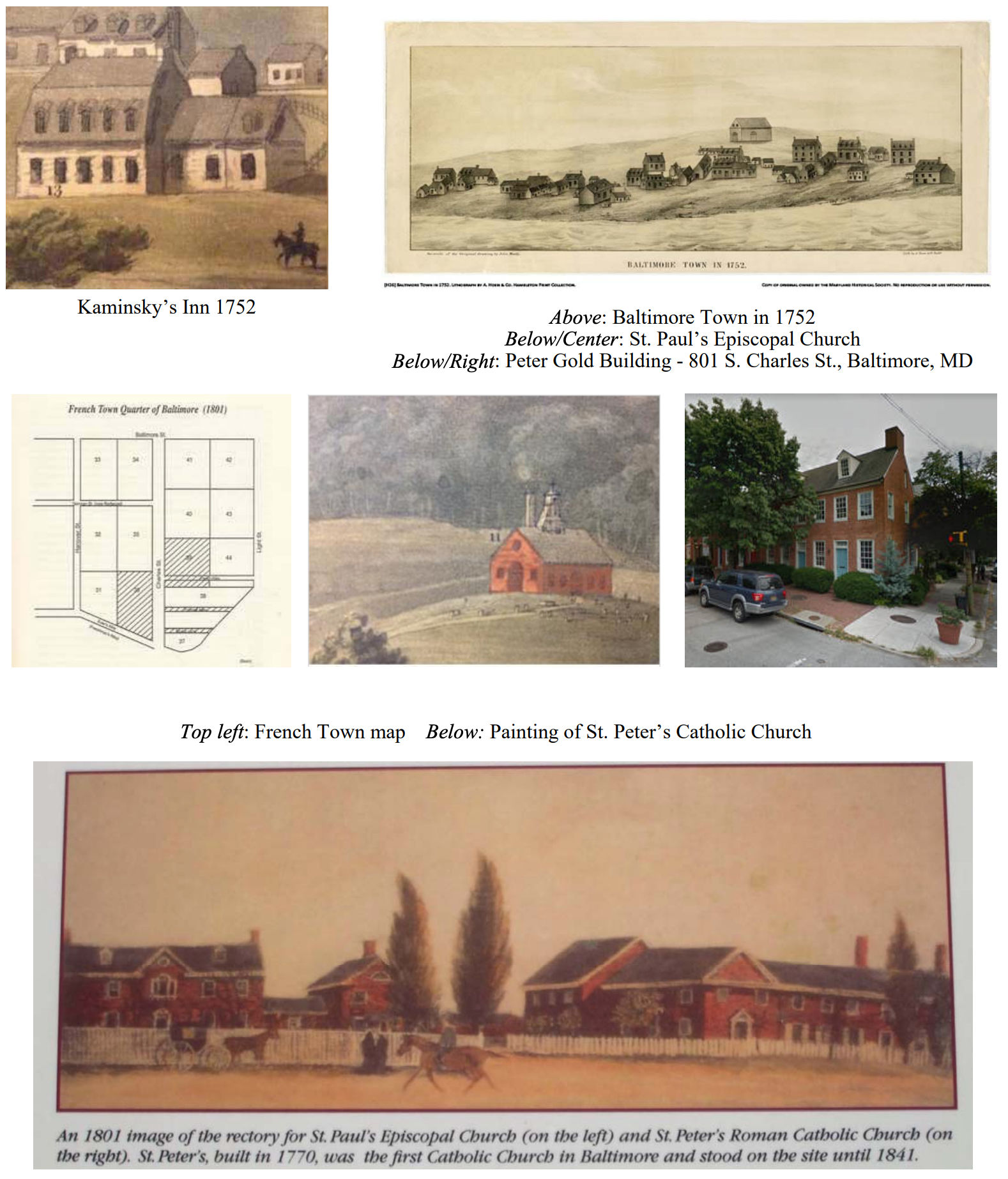
Kaminsky's Inn
Northwest corner of Mercer Street and Grant Street
- Was built about 1750
- Kaminsky's Inn was the last of the buildings existing in Baltimore in 1752 to be demolished
- It was razed in the 1870s to construct three iron-front buildings
- In 1756 several Acadian exiles brought to Baltimore were sheltered in Kaminsky's Inn for a time
- Today the Marriott Residence Inn occupies the former site of Kaminsky's Inn
Interpretative Sign
SW Corner of N. Charles Street at West Saratoga Street
- Contains 1801 Painting of St. Peter's Catholic Church (built 1770) and St. Paul's Episcopal Church Rectory
Charles Carroll Property (Lot 157)
Northwest corner of West Saratoga Street and Little Sharp Street east to North Charles Street and north to West Pleasant Street
- St. Peter's Catholic Church built here ca. 1770
- Small Pro-Cathedral Catholic Cemetery (St. Peter's Kirkyard) located near church
St. Peter's Catholic Church & Pro-Cathedral (1770-1841)
Southeast Corner of Little Sharp Street at West Saratoga Street
- Located on the original Lot 157 purchased in 1764 by Rev. George Hunter from Charles Carroll of Annapolis for a mere £6 42s
- Saint Peter's Catholic Church was built beginning in 1770 fronting Little Sharp Street
- In 1790 when Rev. John Carroll was installed as Bishop of Baltimore and his See encompassed all of the then United States, the small Saint Peter's Catholic Church became his Pro-Cathedral
- Remained the Pro-Cathedral until 1821 when the Basilica was consecrated as a Cathedral
- Saint Peter's Church was enlarged in the 1780s and remained on this site until 1841
- Today, a parking garage occupies the site
- The small Pro-Cathedral Cemetery (St. Peter's Kirkyard) discussed below was located between Saint Peter's Church and North Charles Street
- Saint Peter's Catholic Church was the first Catholic church in Baltimore
Pro-Cathedral Catholic Cemetery (1791-1815)
Also known as St. Peter's Kirkyard; Bounded by West Saratoga Street, North Charles Street & Little Pleasant and located between St. Peter's Catholic Church and North Charles Street
- In 1815 the Pro-Cathedral Catholic Cemetery was closed and all graves were transferred to Cathedral Cemetery by 1821
- Graves not transferred by families were placed in a mass grave at Fremont Avenue lot by trustees
- Now a parking garage and the Mariner Bank Building occupy the Pro-Cathedral Catholic Cemetery site
St. Paul's Episcopal Church
233 North Charles Street; Across intersection from St. Peter's Catholic Church site
- The present Saint Paul's Episcopal Church is the fourth built on this site - the first serving from 1739 until 1784
- When Saint Peter's Catholic Church closed periodically from 1773 until the late 1770s due to financial problems, Acadians of Baltimore attended services and were married at the first Saint Paul's Episcopal Church on this site
- The present church on this site was built in 1856 (See photos near entrance to church)
Old St. Paul's Episcopal Church Rectory (1791 - Present)
24 West Saratoga Street; NW Corner of Little Sharp Street and West Saratoga Street
- Built between 1789 and 1791 to the west of Saint Peter's Catholic Church
- The rectory has served the pastors and congregation of Saint Paul's for over 200 years
- Little Sharp Street (an alley today) separates the Episcopal property from the historic property of Saint Peter's Catholic Church
Catholic Basilica of the National Shrine of the Assumption of the Blessed Virgin Mary
Baltimore Basilica; 1821-Present; 409 Cathedral Street
- Designed by Benjamin Henry Latrobe and built between 1806 and 1821
- The Basilica was the first Catholic Cathedral built in the United States
- The Basilica has witnessed many historical events including the funeral of Acadian benefactor Charles Carroll of Carrollton, the only Catholic to sign the Declaration of Independence
- After 1820 the Acadians of French Town attended Catholic services and received the sacraments at this Cathedral
- Rev. John Carroll, the first Bishop of the United States and the builder of old Saint Peter's Catholic Church, is buried in the Basilica's historic crypt
Edward Fottrell House
Northwest corner of Fayette Street and Calvert Street
- On this site in 1741, Edward Fottrell began constructing a two-story brick home which was the first brick house in Baltimore
- Dr. Fottrell left Baltimore prior to 1755 before completing the house
- In 1756 city officials used the abandoned, unfinished building to house several Acadians newly-arrived in Baltimore
- After ridding the place of the hogs that slept there, the Acadians converted a lower room into a small chapel which was the first Catholic chapel in Baltimore
- Here a priest probably from Carroll's Manor at Doughoregan, conducted Catholic services once a month which were attended by Acadians and other Catholics in Baltimore
- Carroll's Manor at Doughoregan was the estate of Charles Carroll of Annapolis and Charles Carroll of Carrollton, who aided the Acadians greatly during their early years despite the fact that governmental authorities prohibited Catholics from assisting the Acadians
- In 1780 Maryland seized the Fottrell home and land and sold it with the house being razed soon after
- The present Clarence M. Mitchell Jr. Courthouse was constructed on the site of the old Edward Fottrell house and was dedicated in January 1900
- It is the second courthouse on this property
- In 1900, the Colonial Dames of America placed a small tablet in the courthouse to commemorate the small chapel used by the Acadians in the Edward Fottrell house
- During one of several renovations of the courthouse the plaque was removed and not replaced
St. Patrick's Catholic Church
317 S. Broadway Street
- St. Patrick's Catholic Church was founded in 1792 in the Fells Point neighborhood, which had a large French population
- This was the second Catholic church in the Baltimore area
- The current building was constructed in 1898
Fells Point
East part of Baltimore
- Has French residents, both Saint Domingue and Acadian descendants
- Located just east of today's Inner Harbor, Fells Point developed as a waterfront community in the early 1760s along the northwest branch of the Patapsco River
- Fells Point, which still has the look and feel of the early 1800s, is generally bound on the east by South Chester Street, on the north by Bank Street, on the west by South Eden Street and on the south by the eastern end of the Inner Harbor and the Patapsco River
- In the 1790s and early 1800s over 1200 French escaping the Toussaint L'Ouverture slave revolt in Saint Domingue (today's Haiti) found refuge at Fells Point
- Within this group certainly were some destitute Acadians who had resettled in Saint Domingue in the 1760s
- Additionally, a small number of Acadians had migrated into Fells Point from Baltimore to work in the shipyards and seafaring trade there
Robert Long House
812 South Ann Street
- The oldest surviving residence in Baltimore, built ca. 1765 and located in Fells Point
- It certainly was seen by the Acadians of Baltimore
Cathedral Catholic Cemetery (1816-1874)
Size doubled to 13 acres in 1841; North Fremont Avenue at Winchester Street; Bounded by Riggs Avenue (old Tenant St.), Winchester Street, Fremont Street and Whatcoat Street (old Calhoun St.)
- All graves from the Pro-Cathedral Catholic Cemetery reinterred here by 1821
- Graves in the Cathedral Catholic Cemetery later transferred to New Cathedral Cemetery by 1887
- Paul Bigeo buried here in March 1822
- After being emptied, the land of the former Cathedral Catholic Cemetery was sold for rowhouse development which covers the site today
New Cathedral Catholic Cemetery (1874-Present)
4300 Old Frederick Road
- Contains the burials of Baltimore Catholics since 1791
- Has the graves of persons buried at Pro-Cathedral Catholic Cemetery and Cathedral Catholic Cemetery although many are not marked and their locations are not known
- Contains 100 acres
- Acadian surnames known to have been buried in the first two cemeteries from 1791 to 1874 and later moved to the New Cathedral Cemetery include Babin, Berbine, Bigeo, Bonsserean, Boudrean, Bourke, Boutin, DeShields, Deshon, Dupuis, German, Landry, LeBlanc, Poirier, Trevin, Wedge, Wells and White
- [Gold-Wynn Plot in Section A]
Saint Mary's Seminary
600 North Paca Street
- Saint Mary's Seminary was founded in 1791 by the French Sulpician Fathers under the leadership of Rev. Francis Nagot
- It was established for the purpose of educating and training young priests
- It is the oldest Roman Catholic Seminary in the United States
- The original St. Mary's Seminary Chapel, designed by Maximilian M. Godefroy, and built between 1806-1809, still stands
- Next to the old Chapel is the Mother Seton House where Mother Elizabeth Ann Seton (now Saint Elizabeth Ann Seton) lived briefly during 1808 and 1809
- In early 1809 she was joined at this residence by her young protege Rose Landry White (LeBlanc), an Acadian, and five other young women who founded the Sisters of Charity of Saint Joseph's
- In mid-1809 this small group of women moved to their new home at Emmitsburg, Maryland
- Upon the death of Mother Seton in 1821, Sister Rose Landry White became Mother Rose Landry White, the second Mother Superior of the Sisters of Charity
St. Charles College
711 Maiden Choice Lane in Catonsville, MD
- Remaining buildings of the old St. Charles College, a minor seminary established by the Sulpician Fathers in 1848 for the purpose of training young men for the priesthood, may be found on the grounds of what is now the Charlestown Retirement Community
- The original seminary was built first near Doughoregan Manor (just outside Ellicott City) on land donated by the Acadian friend Charles Carroll of Carrollton who lived at the Manor
- Rev. Oliver Jenkins, the first president of St. Charles College, was an Acadian descendent of the Gold (Doiron) family
- Father Jenkins served St. Charles College during its first two years and again from 1852-1869
- In 1911 the original seminary burned and was quickly reconstructed at this site in Catonsville
- Its large Our Lady of the Angels Chapel is an architectural gem in the Italian Renaissance style and its mosaics, dome and marble, high nave please the eye
- One of its beautiful stained glass windows, designed by Charles J. Connick, honors and captures the image of Father Olivier Jenkins
Mount Clare House
1500 Washington Boulevard
- Overlooks Carroll Park
- Built by Charles Carroll, Barrister between ca. 1763 and 1767
- It certainly was seen by Acadians of Baltimore
St. Peter's Catholic Cemetery (1851-1969)
1301 Moreland Avenue
St. Domingue refugees buried here.
Ropewalk Lane
Street in south Baltimore
Location where Acadians used to make rope from oakum that they gathered. Ropewalk Tavern and Sign (1788) - 1209 S. Charles Street; Ropewalk Seafood Company and Sign (1788) - 1209 S. Charles Street [Federal Hill].
Peter Gold Building
801 S. Charles Street; Southeast Corner of S. Charles Street and W. Montgomery Street [Federal Hill]
- Built in 1805
- Bought by Peter Gold in 1818
- (Note: Gold is the anglicized version of the Acadian name Doiron.)
John Germane Property
110-116 E. Montgomery Street; White building and large three story building to the right [Federal Hill]
Gautrot Property
17 W. Montgomery Street; Northwest corner of S. Charles Street near W. Montgomery Street [Federal Hill]
Babin Property
2 W. Montgomery Street; S. Charles Street near W. Lee Street [Federal Hill]
Peter Gold Property
740 S. Light Street [Federal Hill]
- Peter Gold constructed this building prior to 1837
- In 1837 Peter Francis Gold had a "dry goods" store here and his future wife Margaret Bateman lived above the store
- (Note: Gold is the anglicized version of the Acadian name Doiron.)
B. L. Harig and Mary Gold Building
1130 S. Light Street [Federal Hill]
- In 1887 B. L. Harig and Mary Gold built this home and Mary's son Joseph Harig lived here
- (Note: Gold is the anglicized version of the Acadian name Doiron.)
Federal Hill
In the 1770s most of the Acadians that remained in Maryland migrated to Baltimore and resettled in the area of French Town. Several became mariners from the Port of Baltimore and achieved economic success over the years. Acadians valued land highly and remembered when they owned their own farms in Acadia. Thus, as "excess" funds became available in the early 1800s, these Acadians purchased land - especially in today's Federal Hill area of Baltimore, just a short distance south of French Town.
Peter Gold (Doiron) bought several lots on both the north and south sides of Montgomery Street between Charles Street and Light Street. John Germane purchased parcels on the north side of Montgomery Street between Light Street and William Street and on the north side of Montgomery Street between Charles Street and Hanover Street. Joseph Gautrot obtained a parcel on the south side of Montgomery Street at 17 West Montgomery Street between Charles Street and Hanover Street. The Barbine (Babin) family owned property on the west side of Charles Street between Lee Street and York Street. B. L. Harig and Mary Gold (Doiron) built a home on the northwest corner of Light Street and West Street. Many of the original structures on these properties were used as rental, incomeproducing assets for the Acadian owners.
Most of the original structures on these properties have been demolished; however, three buildings with Acadian ties remain. Peter Gold (Doiron) purchased the property at 740 South Light Street and prior to 1837 constructed the building there today. An 1859 court document indicates that this building is the only structure from the estate of Peter Gold that should not be demolished. In 1837 Peter Francis Gold had a "dry goods" store here and his future wife Margaret Bateman lived above the store. The building at 801 South Charles Street was built around 1805 and purchased by Peter Gold in 1818. A bit later in time, in 1887 B. L. Harig and Mary Gold built the home at 1130 South Light Street and Mary's son Joseph Harig lived there as well.
Places Where Acadians Sheltered in 1750s
- Edward Fottrell House
- Kaminsky's Inn (See "Baltimore American" newspaper, 23 Feb 1904; "The Sunday Star", 25 Jan 1906)
- Joshua Howard's Barnyard & Stables - Opposite Hanover Market at intersection of Hanover and Camden Streets (See Robert Barnes; "The Notebook" journal; March 1996, p. 3; Isabel Davidson, p. 104). Settled principally south of present Baltimore on Market Street and some in Mr. Fotterall's house; Old Baltimore by Annie Leakin Sioussat, p. 62.
Ellicott City (Howard County)
Doughoregan Manor
Home of Charles Carroll of Carrollton who helped Acadians; Manor Lane, just east of Folly Quarter Road and Frederick Road/Highway 144
- Built 1727
- Priests from Doughoregan Manor said mass monthly for the Acadians at the Edward Fottrell house chapel
- (Note: This is private property including the lane from the main road leading to the Manor.)
Annapolis (Anne Arundel County)
Severn River
Acadians arrived on this river; Probably docked in Severn River near Middleton Tavern area and south end of Spa Creek
Middleton Tavern
2 Market Space
- Built 1740
- On being let off ships docked in the Severn River, Annapolis-bound Acadians were immediately in front of this tavern
Acadian Housing
Acadians that lived in Annapolis were housed in large warehouses on Hanover Street and on Duke of Gloucester Street. (See Internet - "Exile Destination: Maryland" p. 2)
Charles Carroll House
109 Duke of Gloucester Street
Built 1720s. Charles Carroll of Annapolis and Charles Carroll of Carrolton assisted Acadians to the best of their ability. In early 1756 Charles Carroll of Annapolis requested that the government let him house two Acadian families of 14 persons, but was refused. In the 1770s Charles Carroll of Annapolis hired two Acadians (Margaret Belisle and a Miss Blanc) as seamstresses. He was concerned that Miss Belisle spent too much time drinking. (See Rowland, Kate Mason; "The Life of Charles Carroll of Carrollton, 1732-1832", p. 27 (Letter of 26 July 1756) and the Charles Carroll of Annapolis receipt books)
St. Anne's Episcopal Church & Cemetery
199 Duke of Gloucester Street
- First church 1704-1775
- Present church built 1858-1859
- Has tomb of Margaret Carroll
Charles Carroll (the Barrister) House
Originally at Main St. and Conduit St.; Moved in 1955 to King George Street at St. John's College
- Built 1720-1723
Upper Marlboro (Prince George's County)
Patuxent River
From Highway 4
Lower Marlboro (Calvert County)
Patuxent River
From behind Harbor Master's House
- Ships with Acadians anchored at dock here; probably near Harbor Master's House
Harbor Master's House
On Lower Marlboro Road near Patuxent River
- Built ca. 1670
- Acadians landed just behind Harbor Master's House
All Saints Episcopal Church & Cemetery
100 Lower Marlboro Road
- Founded 1692
- Current building constructed ca. 1777
Sign Showing Map of Lower Marlboro with Wharf
Lower Marlboro Road at Patuxent River
Port Tobacco (Charles County)
Patuxent River
Ships anchored behind Courthouse
Port Tobacco River
Landing was behind Courthouse
St. Ignatius Catholic Church & Cemetery
8855 Chapel Point Road
- Founded 1641
- Current building constructed in 1798
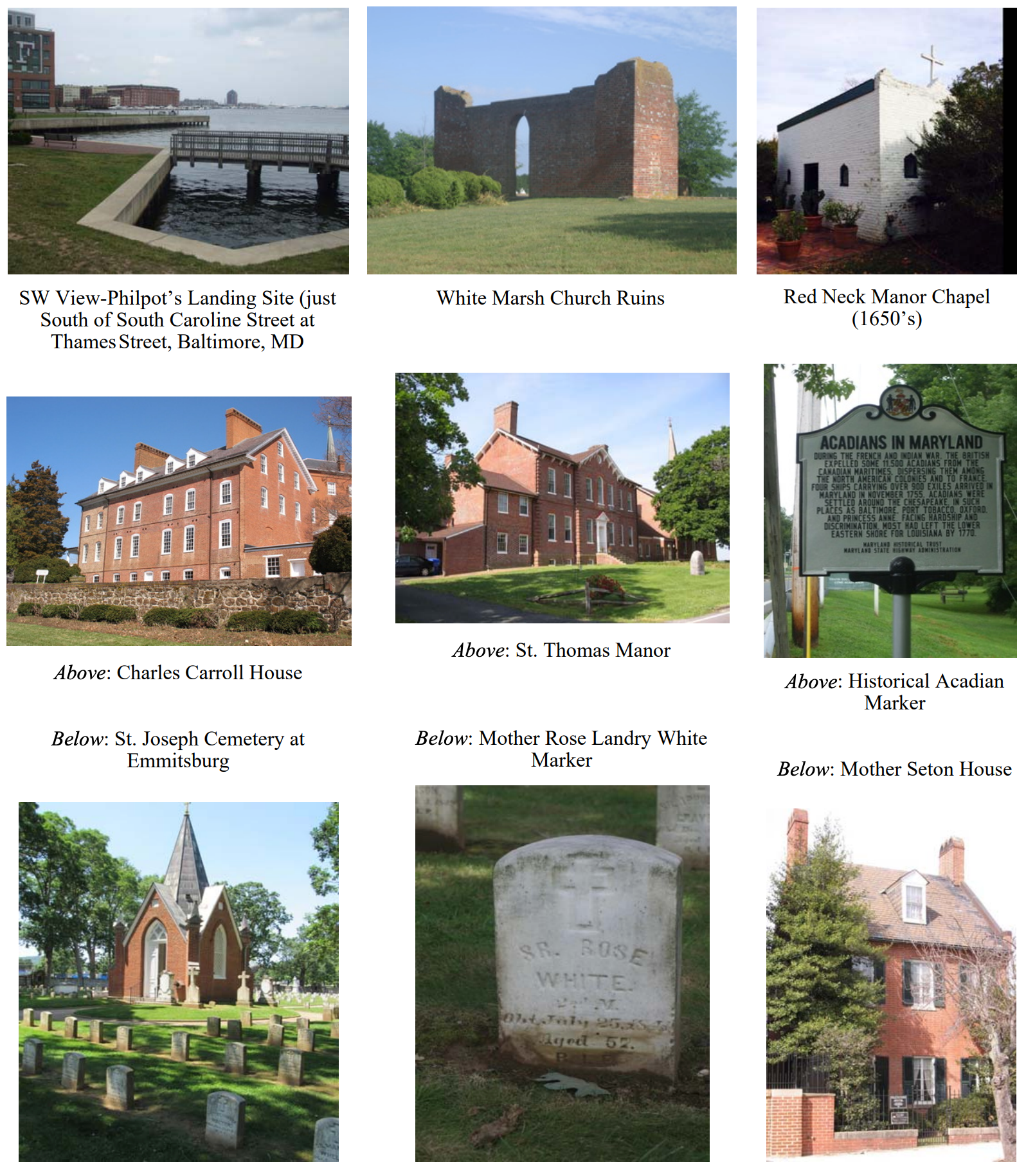
St. Thomas Manor
8855 Chapel Point Road
- Built 1741
Chimney House
Port Tobacco Town Square; Chapel Point Road
- Built 1750
Stagg Hall
Port Tobacco Town Square, Chapel Point Road
- Built ca. 1740
Catslide House
Port Tobacco Town Square, Chapel Point Road
- Built 1720
Port Tobacco River Landing Site for Acadians
Located behind Courthouse
- Acadians departed in December 1767
Christ Episcopal Church Sign and Foundation
Chapel Point Road
- Built 1692
LaPlata (Charles County)
Christ Episcopal Church
E. Charles St. at Calvert St.
- Originally at Port Tobacco and moved to LaPlata
- Built 1692 at Port Tobacco
- Moved to LaPlata in 1904
Elkton (Cecil County)
Elk Landing
590 Landing Lane
Home built in 1780; however, earlier a trading post existed in this location. This location at the head of the Elk River is likely where 30-50 Acadians lived in the late 1750s and early 1760s.
Note: The five locations below may not be associated with the Acadians although in the late 1750s and early 1760s a small number of Acadians did live in the Elkton area. These five locations derive from the north-south travel route and railroad in this area along with the wharf on the Elk River in the late 1700s and early 1800s.
Frenchtown
Toll route from Frenchtown to New Castle
"Frenchtown" Plaque
Highway 213 at Frenchtown Road
Frenchtown Road
Off Highway 213
"New Castle and Frenchtown Railroad" Plaque
Lewis Shore Road West
Elk River
West end of Lewis Shore Road West near site of Frenchtown
Fredericktown (Cecil County)
Sassafras River
Georgetown (Kent County)
Sassafras River
Westminster Presbyterian Church grounds and Georgetown Cemetery
MD Highway 213
Church and Cemetery Founded 1736; Building demolished in 1941
Newtown (Chestertown) (Kent County)
Chester River
Custom House
Washington College - 101 South Water Street
Built ca. 1746. Acadians likely visited the Custom House when first arriving at Newtown.
Queenstown (Queen Anne's County)
St. Peter's Catholic Church
5319 Ocean Gateway; Highway 50
- Founded by Rev. Joseph Mosley in 1765
- Current church built 1823-1827
Oxford (Talbot County)
Tred Avon River
Near confluence with Choptank River
- The Sloop Ranger brought 263 Acadians up Choptank River to Oxford
White Marsh Episcopal Church Ruins and Cemetery
On Route 50 at Hole in the Wall Road or Alms House Road; Oxford, Talbot County, MD just outside Oxford
Stands in ruins; Here Henry Callister convinced Rev. Thomas Bacon to make impassioned plea on 14 Dec 1755 to his parishioners to aid the Acadians. Actual name was St. Peter's Anglican Church
Oxford-Bellevue Ferry and Plaque about Ferry
N. Morris Street at Tred Avon River
- Ferry service continuously operating since November 1683
Robert Morris Inn
N. Morris Street at E. Strand Street
- Built 1710
- Acadians passed near this Inn as they sailed up the Choptank River to the Oxford harbor
Those who provided Acadians housing
Mr. Henry Callister, Rev. Thomas Bacon (Whitemarsh Church); P. C. Blake, Thomas Browning; Jacques Tilghman, Michael Hacket, Jean Caile, Matthew Tilghman ("Rich Neck Manor"), Charles Brown, Guill Goldsborough, Mrs. Sarah Blake, Pollard Edmondson, Philemon Hambleton ("Old Martingham"), David Robinson, Colonel Ennalls, Edward Niel, David Jones, Simon Jones, Samuel Chamberlaine, Mrs. Marguerite Lowe, Thomas Wilson, Colonel Joseph Ennalls, Corneille Daly; Robert Howe, EdwardTilghman, Colonel Edward Lloyd ("Wye House") [Scharf; v. 1 p. 476]
Easton (Talbot County)
Wye House
26080 Bruff's Island Road
Original home, now destroyed, was that of Edward Lloyd III where approx. 50 Acadians housed in 1756; Current old structures are Wye House (1781-1791), Orangerie (1750; 1785), Captain's House (ca 1725-1750), Lloyd Family Cemetery (burials date to 1684). Private property; can only see long entrance road and grounds; need boat to see house
Lloyd Family Cemetery at Wye House
26080 Bruff's Island Road
Has grave of Edward Lloyd III; Burials date to 1684; Private property; Could not access cemetery; Need boat to see cemetery
Wye Miller's House
Route 662 at Route 404 West
- Built ca. 1750
- On Miles Neck River, 6.9 miles northwest of Easton, via U.S. 33, U.S. 370 and Bruff's Island Road
Wye Grist Mill
14296 Old Wye Mills Road (MD Route 662) on west side
- Built 1682 with some parts dating to that period
Old Martingham
MD Route 33 at 0.6 miles southeast of MD Route 579; 9581 Old Martingham Road; St. Michael's, Talbot County, MD
Home of Philemon Hambleton (1697-1757) that housed ca 5 Acadians in 1756; Private property; The center portion of the house was built about 1700 and thus present when Acadians were there; the right (east) wing was built about 1820 as a kitchen and the west wing in 1945. Also ca. 1820 center portion was modified with rear rooms and two additional dormers. Can only see long entrance road and grounds; need boat to see house.
Rich Neck Manor
West side of Rich Neck Road about ¾ mile north of Claiborne; 17010 Rich Neck Road; Claiborne, Talbot County, MD
Home of Matthew Tilghman that housed ca. 5 Acadians in 1756; Has historic plaque at entrance to drive; Current old structures are Rich Neck Manor Home (1830s); Old part of home on right (1740s); Chapel (1650s); Tilghman Cemetery which has grave of Matthew Tilghman (burials date to 1698); Private property; Can only see long entrance road and grounds; need boat to see house
Cordova (Talbot County)
St. Joseph's Mission (Tuckahoe) and Cemetery
13209 Church Lane about 1 mile south of Queen Anne Highway (MD 404) Intersection with Church Lane; North of Easton, MD
- Built in 1765
- Founded by Rev. Joseph Mosley who gave sacraments to some Acadians
Princess Anne (Somerset County)
Manokin River
Dock of 1750's was at headwaters of Manokin River near "Green House" located directly across street from Manokin Presbyterian Church; stand on bridge near church and this is headwaters where dock was
The Sloop Elizabeth went from Annapolis to Chesapeake Bay to Wicomico River where it waited for provisions that never arrived and then up Manokin River to Princess Anne. May have waited on Wicomico River near Whitehaven Inn for provisions. Had 242 Acadians
Almodington
10373 Locust Point Road on Manokin River
- Built ca. 1745
"Arcadia" home
221 Deal Island Road
Snow Hill (Worcester County)
Pocomoke River
All Hallows Episcopal Church
109 West Market Street
- Built 1748-1756
Furnace Town Living Heritage Museum
3816 Old Furnace Road; On Highway 12 between Princess Anne and Snow Hill
On site of Indian trail used by Acadians to go to Snow Hill from Princess Anne; Road called Old Furnace Road
Emmitsburg (Frederick County)
Basilica and National Shrine of St. Elizabeth Ann Seton
339 S. Seton Ave., Emmitsburg, MD
When Mother Elizabeth Ann Seton left Saint Mary's Seminary with her young nuns including Rose Landry White, she moved to this location at Emmitsburg, MD. This is where she and Rose Landry White lived the rest of their lives. Rose Landry White's mother also lived here. All three died here and are buried in St. Joseph Cemetery on the site.
Grave of Rose Landry White and Her Mother
Buried in St. Joseph Cemetery on property of the National Shrine of St. Elizabeth Ann Seton. Several other Acadian women are also buried here
Research Facilities
Washington, D.C.
Joseph Mark Lauinger Memorial Library
Georgetown University37th Street at O Street NW
Washington, D.C. 20057-1174
(202) 687-7607
reference@georgetown.edu
Jesuit Archives
Baltimore, MD
Associated Sulpicians of the United States Archives
5400 Roland AvenueBaltimore, MD 21210-1994
(410) 864-4000
info@stmarys.edu
- Archdiocese of Baltimore Archives
- St. Mary's Seminary & University Archives
- Associated Sulpicians of the United States Archives
Maryland Historical Society Library
201 West Monument StreetBaltimore, MD 21201
(410) 685-3750
Historical documents, Maps
Baltimore City Archives
2615 Mathews StreetBaltimore, MD 21218
(410) 396-3884
Historical documents, Maps
Annapolis, MD
Maryland State Archives
350 Rowe BoulevardAnnapolis, MD 21401
(410) 260-6400
msa.helpdesk@maryland.gov
Civil and Church Records
Easton, MD
Talbot Free County Library
100 West Dover StreetEaston, MD 21601
(410) 822-1626
Maryland Room - Manuscripts, Maps
Salisbury, MD
Edward H. Nab Research Center at Salisbury University
1101 Camden AvenueSalisbury, MD 21801
410-543-6312
Berkeley, CA
Bancroft Library
University of California at BerkeleyUniversity Drive at S. Hall Road
Berkeley, CA 94720-6000
(510) 642-6481 / (510) 642-3781
bancroft.berkeley.edu
Original document on ship "Bretagne" that shipwrecked in 1769 off Texas coast
New Orleans, LA
Louisiana State Museum Collections Historical Center
Old United States Mint400 Esplanade Avenue
New Orleans, LA 70116
(504) 568-3659
ekinchen@crt.la.gov
French Superior Council of Louisiana Records; Document on Sale of "La Vierge" that brought Acadians from MD to LA in August 1767
Baton Rouge, LA
Hill Memorial Library
Louisiana State University LibrariesField House Drive at Darymple Drive
Baton Rouge, LA 70803-3300
(225) 578-6568
- "Cuban Papers"
- Archivo General de Indias, "Papeles Procedentes de Cuba" (P.P.C.) [Seville, Spain]
- Archivo General de Indias, "Audiencia de Santo Domingo" (A.D.S.) [Seville, Spain]
Deportation of Acadians to Maryland
Acadians Arrived in Annapolis, Maryland on:
Schooner Leopard (87-ton; Capt. Thomas Church)
- Left Grand-Pré (Pointe des Boudro) - 27 Oct 1755
- Arrived Annapolis - 20 Nov 1755
- Acadians sent to Annapolis & Baltimore
Acadians: Departed with 178, Arrived with 174
Sloop Ranger (90-ton; Capt. Francis Piercy)
- Left Pisiquid - 27 Oct 1755
- Arrived Boston - 5 Nov 1755 (storms) (25 Acadians removed)
- Arrived Annapolis - 30 Nov 1755
- Acadians sent to Oxford
Acadians: Departed with 263, 25 removed, Arrived with 180
Sloop Dolphin (87-ton; Capt. Zebediah Forman)
- Left Pisiquid - 27 Oct 1755
- Arrived Boston on 5 Nov 1755 (storms) (47 Acadians removed)
- Arrived Annapolis - 30 Nov 1755
- Acadians sent to Lower Marlboro, Upper Marlboro & Port Tobacco
Acadians: Departed with 230, 47 removed, Arrived with 180
Sloop Elizabeth (93-ton; Capt. Nathaniel Millbury)
- Left Grand-Pré (Pointe des Boudro) - 27 Oct 1755
- Arrived Annapolis - 20 Nov 1755
- Acadians sent to Princess Anne & Snow Hill
Acadians: Departed with 242, Arrived with 186 (est.) to 242 (max.)
Ship HMS Nightengale (Capt. Dudley Diggs)
- Ship of War & Escort Vessel
- Left Grand-Pré (Pointe des Boudro) - 27 Oct 1755 (0 Acadians)
- Separated by storm and landed at New York
Acadians: 0
Total Acadians That Arrived in Maryland: 720 (est) - 776 (max)
Several authors have indicated 913 Acadians arrived in MD. This is the number of Acadians that departed Acadia for Maryland on the four vessels that eventually arrived at Annapolis, MD.
Notes
- * The Elizabeth, Leopard, Ranger and Dolphin entered the Bay of Fundy on 27 October 1755. They left their anchorages at Pointe des Boudro (Grand-Pré) and the junction of Avon and St. Croix Rivers (Pisiguit) a few days earlier.
- ** The Schooner Leopard was also called the Leonard and the Leynard.
- *** After encountering a furious gale in the Atlantic the Ranger and Dolphin temporarily anchored in Boston harbor on 5 Nov 1755 for safe shelter. Here inspectors boarded the transports. The number of Acadians onboard the Ranger was 205 and the number of Acadians on the Dolphin was 227. Both vessels were listed as 90-ton ships. Massachusetts authorities removed 25 Acadians from the Ranger to bring its total to 180 Acadians (2 Acadians per ton) and 47 Acadians from the Dolphin bringing its total to 180 Acadians (2 Acadians per ton). They replenished the food supplies, provided fresh water and allowed the vessels to proceed to their port of destination at Annapolis after several days in Boston harbor. The two transports apparently reached Annapolis with no further loss of life.
Distribution of Acadians to Maryland Towns
| County | Town |
|---|---|
| Anne Arundel County | Annapolis (from the Schooner Leopard) |
| Baltimore County | Baltimore (from the Schooner Leopard) |
| Calvert County | Lower Marlboro (from the Sloop Dolphin) |
| Charles County | Port Tobacco (from the Sloop Dolphin) |
| Prince George's County | Upper Marlboro (from the Sloop Dolphin) |
| Somerset County | Princess Anne (from the Sloop Elizabeth) |
| Talbot County | Oxford (from the Sloop Ranger) |
| Worcester County | Snow Hill (from the Sloop Elizabeth) |
| County | Town |
|---|---|
| Cecil County | Fredericktown |
| Elktown | |
| Kent County | Newtown (Chestertown) |
| Georgetown |
Distribution Of Acadians In Maryland In 1763
| Town | Acadians |
|---|---|
| Baltimore | 76 Acadians in 1763 |
| Annapolis | 78 Acadians in 1763 |
| Upper Marlboro | 58 Acadians in 1763 |
| Lower Marlboro | 27 Acadians in 1763 |
| Port Tobacco | 157 Acadians in 1763 |
| Elkton (Frenchtown) | *30-50 Acadians were at Elkton (Frenchtown) sometime between 1756 and 1762 |
| Fredericktown & Georgetown | 66 Acadians in 1763 at these two towns |
| Newtown (Chestertown) | 53 Acadians in 1763 |
| Oxford | 182 Acadians in 1763 |
| Princess Anne | 33 Acadians in 1763 |
| Snow Hill | 68 Acadians in 1763 |
| Total | 798 Acadians in 1763 |
Migration Of Acadians From Maryland To Louisiana
1st Migration
- Left MD on chartered English ship
- Acadians (224) from Snow Hill, Princess Anne & Oxford
- Arrived New Orleans, LA on 29 Sep 1766
- Settled along Mississippi River at 1st Acadian Coast (St. James, Ascension, Cabannocé)
2nd Migration
- Left Baltimore, MD on "Virgin" in Apr 1767
- Acadians (210) from Baltimore, Georgetown, Upper Marlboro, Fredericktown & a few from Newtown, Oxford & Port Tobacco
- Arrived at Balise, LA on 12 Jul 1767 & New Orleans on 27 Jul 1767
- Settled along Mississippi River at 2nd Acadian Coast (St. Gabriel)
3rd Migration
- Left North Potomac (Port Tobacco), MD on "Jane" or "Ginea" on 17 Dec 1767
- Acadians (149) from Port Tobacco & Upper Marlboro
- Arrived at New Orleans, LA on 4 Feb 1768
- Settled on Mississippi River at Fort San Luis de Natchez
4th Migration
- Left MD on "Britannia" on 5 Jan 1769
- Ship went off-course and landed at Espiritu Santo Bay, TX
- Eventually new settlers released by Spanish and they hiked to Natchitoches, LA arriving on 24 Oct 1769. The Acadians (32) settled at St. Gabriel in 1770 and then eventually settled near Opelousas & St. Martinville