Acadian Historical Sites: Pennsylvania and New Jersey
- Connecticut
- Georgia
- Maryland
- Massachusetts
- New Brunswick & Prince Edward Island
- Nova Scotia
- Pennsylvania and New Jersey Current
- South Carolina
We continue our series on historical sites of Acadian significance in various U.S. states and Canadian provinces. In this issue we highlight those historical sites in Pennsylvania and New Jersey. The colony of Pennsylvania received approximately 454 Acadians on three ships from the Grand-Pré and Pisiguit areas. Two additional ships left Acadia from the Chignecto area for Pennsylvania, but there is no record of them arriving. They likely sank on the trip to Pennsylvania. No Acadians were deported to New Jersey; however, several Acadian families migrated from Pennsylvania to New Jersey in the late 1750s and the 1760's.
For all Acadians deported by the British, the experience was both traumatic and inhumane. The Acadian men and boys were locked up while the women, girls and small children were left at the homes to harvest the crops and provide food their imprisoned husbands and boys. When the Acadians were loaded onto the ships, they could bring none of their property except very small items as money and perhaps minimal clothes. The British were supposed to put no more than two Acadians per ship ton into the vessels; however, this was almost always violated and often 20-40 Acadians in excess of this limit were loaded. The Acadians were packed into the dark, lower deck of the ships with no beds or sleeping areas, no access to fresh air, no toilet accommodations and little light. Occasionally, a few (5 or 6) Acadians would be allowed on the main deck for a few minutes to get fresh air. The Acadians were given bad water and little food during the voyage. For a people that were primarily farmers, being on a rolling ship in the ocean was devastating with much sickness - seasickness, diarrhea and other diseases as smallpox which spread quickly among the overcrowded Acadians.
Additionally, for the Pennsylvania Acadians deported in late October 1755, shortly after the ships entered the Atlantic Ocean, they were struck by a very strong gale - likely a hurricane - which compounded the already exacerbating conditions on board. Some Acadians died on this treacherous voyage. Two ships destined for Pennsylvania never arrived nor are there any available records that they reached another colony. These two ships and their human cargo of almost 500 Acadians likely sank with all onboard drowning.
As the three surviving ships sailed up the Delaware River and arrived at Province Island behind today's Philadelphia International Airport between 19 and 21 November 1755, the experience for the Acadians onboard only became more traumatic. Because the colonial government feared the French - especially after General Braddock's humiliating defeat and death, they forced these Acadians to stay onboard their unsanitary ships, placed armed guards on the ships and had the ships stay a safe distance below the town. Disease spread rapidly on the ships so Governor Robert Morris ordered on 24 November 1755 that the Acadians be unloaded onto Province Island and be housed in an abandoned barracks until the diseases ran their course. The Acadians had a special benefactor in Anthony Benezet, a Quaker, who provided food and other aid to them and eventually some small wooden houses on Pine Street in Philadelphia. By February the high cost of caring for the Acadians caused the legislature to pass a law requiring the Acadians to be dispersed between Bucks, Chester, Lancaster and Philadelphia Counties. The Acadians resisted being separated and the towns refused to accept them, but initially they were dispersed to these counties. The government agreed to continue to provide sustenance to the Acadians. This ended in September 1756 and the Acadians were left to their poverty; however, the colonial government relented in November 1756 and public aid for the Acadians continued until 1766.
Through the benevolence of Anthony Benezet and the Quakers the Acadians as a people survived in Pennsylvania although much sickness and death occurred. Because Pennsylvania permitted Catholicism with St. Joseph's Catholic Church in Philadelphia, the sufferings of the Acadians were a bit relieved when they could practice their religion and receive the sacraments
With the end of the French and Indian War, the Acadians in Pennsylvania began to seek ways to leave the colony and return to French soil. Some trekked to Maryland and there boarded ships for Louisiana (thought to still be a French colony) during 1766-1769. Others fell to the salesmen's false promises of a wonderful life in Saint-Domingue (today Haiti) - only to learn on arrival that their suffering would continue under inhumane conditions. A few remained in Pennsylvania.
Acadians began migrating to Salem County, New Jersey before 1759 even though Catholicism was against the law in New Jersey. Likely they went to obtain jobs at the Wistarburg Glass Works in Alloway, Mannington Township in Salem County. For many years Father Farmer of St. Joseph Catholic Church in Philadelphia made periodic missionary trips to Salem County to minister to the Acadians and other Catholics there. He usually held services at the Geiger House, owned by Matthias Geiger, in Sharptown, Mannington Township. Father Farmer did this at great peril to himself as a priest found in New Jersey could see his life taken from him. Some of these Acadians including the Guédry family eventually migrated to Louisiana. Others may have gone to Saint- Domingue.
There were several Guédry families in Pennsylvania and New Jersey during the 1760-1769 period. Among them were Paul Boutin and Ursule Guédry, Jean Guédry and Magdelaine Melancon, Pierre Guédry and the orphaned children of Charles Boutin and Marie-Josephe Guédry. At least one direct descendant of the Guédry family remained in the Philadelphia area after 1770 - Jean-Charles Boutin, the son of Charles Boutin and Marie-Josephe Guédry. This branch of the Guédry family was deported originally to Chowan County, North Carolina in 1756 and migrated to Pennsylvania about 1760.
Houses and buildings present in the area during the period that the Acadians were in Pennsylvania (generally 1755-1770), but not connected directly to the Acadians usually are not mentioned below. Sites associated with Henry Wadsworth Longfellow's epic poem Evangeline are italicized since they have a fictional connection.
Acadian Historical Sites - Pennsylvania & New Jersey
Philadelphia (Philadelphia County)
Site of Acadian Huts
North side of Pine Street from 5th Street to 6th Street; On Powell's Lot
Some Acadians lived on the west side of today's Washington Square
Along then-called Columbia Street; Now South 7th Street between Locust Street and Walnut Street
Walnut Street Prison
Southeast corner of 6th Street and Walnut Street [Used 1776-1838]
Wharton House
336 Spruce Street
Site of old Almhouse Square or City Poorhouse enclosed by 3rd and 4th Streets and Spruce and Pine Streets; here Evangeline found Gabriel dying in 1790's
Apartments of Andrew Ebert's Sons
258 South 4th Street
Catholic Cemeteries of Acadians
Philadelphia
- Potter's Field (Stranger's Burial Ground) & Old Catholic Burying Ground (Southeast corner of Washington Square at S. 6th Street and Locust Street) [Used up to 1740 for non-pauper Catholics; Acadians buried at Potter's Field from late 1755; Potter's Field used from 1704-1794]
- Old St. Joseph's Catholic Cemetery (S. 4th Street at Walnut Street adjacent to church) [Catholics buried in tiny plot adjoining St. Joseph's Catholic Church from 1733 until 1760; Father Farmer buried here in Aug 1786; Shortly after 1824 bodies moved to Bishop's Burial Ground.]
- St. Joseph Catholic Church Cemetery or Bishop's Burial Ground (S. 7th Street at Washington Street) [Used from 1824 to August 1893; Bodies from Old St. Joseph's Cemetery near church were transferred there; In 1905 bodies from this cemetery (Bishop's Burial Ground) were moved to Section 13 Ranges 11, 12 & 13 of Holy Cross Catholic Cemetery.]
- St. Mary's Catholic Cemetery (Behind Old St. Mary's Church at 252 South 4th Street between S. 4th Street & S. 5th Street) [Established 1760; Still used in 2022]
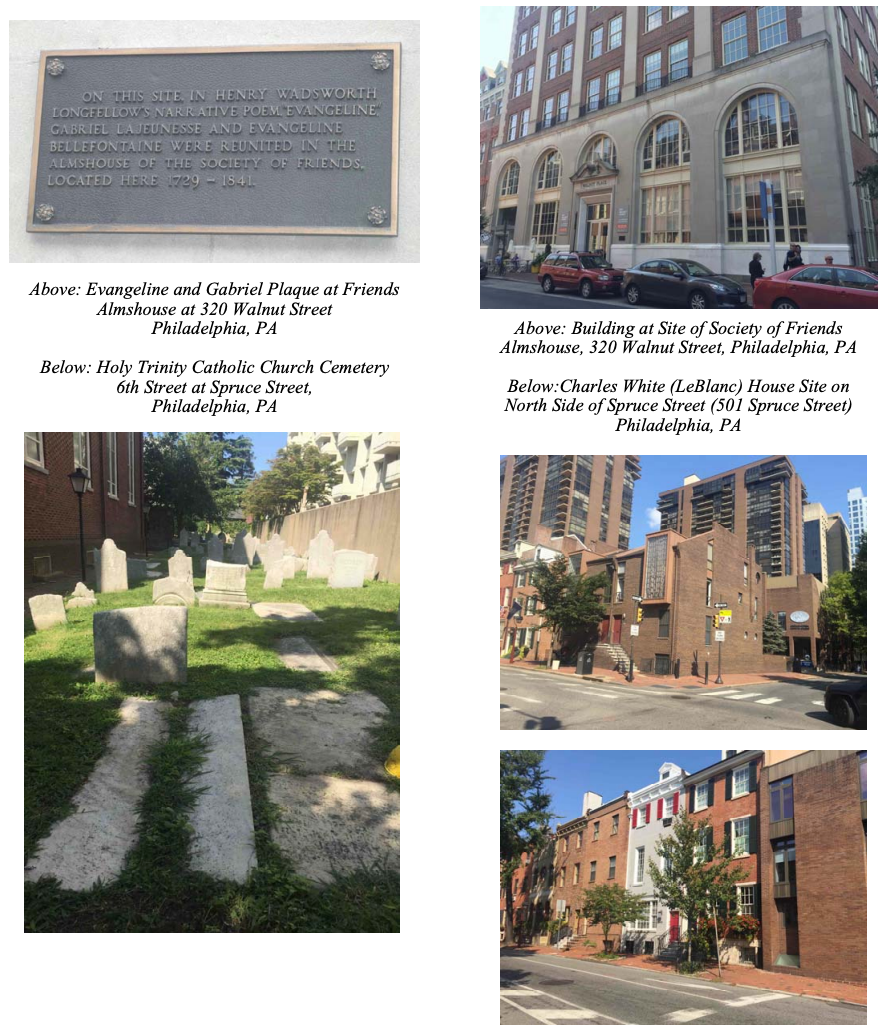
- Holy Trinity Catholic Cemetery (Along north side of Holy Trinity Catholic Church at 613 Spruce Street between S. 6th Street and S. 7th Street) [Established 1791; Still used in 2022
- Holy Cross Catholic Cemetery (626 Baily Road/Baily Road at Yeadon Avenue; Yeadon, PA) [Established 1890; Still used in 2022; Burials from Old St. Joseph's Catholic Cemetery and Bishop's Burial Ground moved here after 1893]
Old St. Mary's Catholic Church & Cemetery
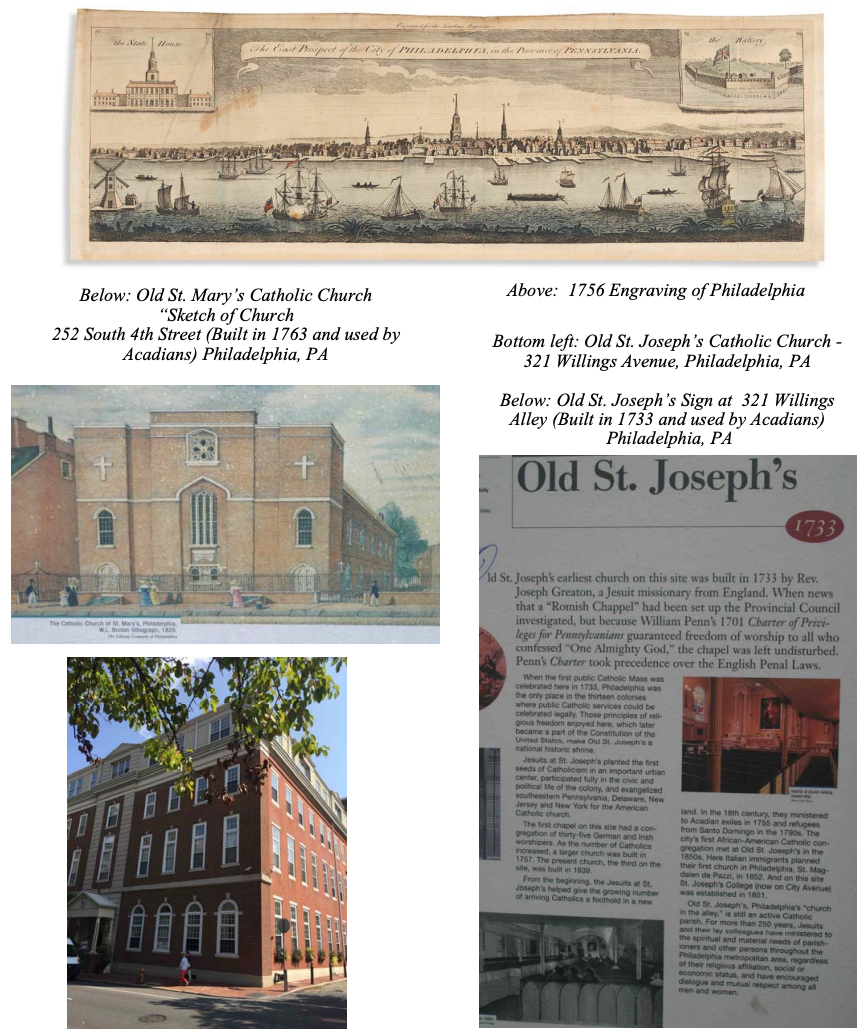
252 South 4th Street
- Built in 1763 and used by Acadians
- Burial Site of Gregory Strahan (b. 1752; d. 1811), wife Margaret Bourque (b. ca. 1757; d. 1852) and infant daughter (1790-1793); Section X, Graves 12-13; No tombstones left after 1891; Very back of graveyard from church on right side of graveyard with the observer's back to the church; at 5th street;
- [See Records of the American Catholic Historical Society of Philadelphia; Society; Philadelphia, PA; 1891; Volume III - 1888-1891; pp. 253-294; Strahan at p. 287]
Old St. Joseph's Catholic Church
321 Willings Alley
- Built in 1733 and used by Acadians
- Was parish church from 1733 until 1763 and from 1821 until now; From 1763 to 1821 parishioners used St. Mary's Catholic Church or Holy Trinity Catholic Church; St. Joseph's during 1763 - 1821 only used for the priest's weekday masses and special services for the Negroes from Saint-Domingue; St. Joseph's became a separate parish again in 1821.
- Has records of baptisms and marriages of Acadians including marriage of Joseph Guédry and Magdelaine Melancon and the baptisms of children of Paul Boutin and Ursule Guédry. [Now housed at the Drexel University Library Archives in Philadelphia, PA]
- 'Old St. Joseph's 1733' Plaque mentions the Acadians
Holy Trinity Catholic Church & Cemetery
6th Street at Spruce Street
- Built in 1789
- 'Holy Trinity 1789' Plaque mentions Evangeline & Acadians
- Folklore says Evangeline buried in cemetery
- Charles (LeBlanc) White buried here; Have not located gravesite
Society of Friends Almshouse Site
320 Walnut Street
- Plaque proclaims this is site where Evangeline & Gabriel reunited
- Original building torn down in 1874
- Longfellow may have had in mind the City Almshouse on Spruce Street to Pine Street, southside, between 10th Street & 11th Street.
Pennsylvania Hospital
Spruce Street between 8th Street & 9th Street
May have been where Longfellow thought Gabriel and Evangeline met
Liberty Bell
6th Street and Chestnut Street
- Cast in 1752 in England and recast locally in Philadelphia in 1753 after cracking
- Hung in tower of State House then and likely heard by Acadians in area
Washington Square
Originally contained Potter's Field (6th Street at Locust Street)
- Laid out in 1682 as Southeast Square
- Many Acadians buried here
- Catholic Burial Ground (1704-1794) - Southeastern Section of the Square at 6th Street and Locust Street.
- Potter's Field - Acadians buried here. Within Washington Square; probably in Catholic Burial Ground
Province Island on Delaware River
Behind today's Philadelphia International Airport (Near Island Avenue at Enterprise Avenue) (Lat: 39.885280; Long: -75.229440)
- Also called Fisher's Island (Had about 342 acres)
- Site where deported Acadians disembarked and initially housed in abandoned barracks
Homes and Businesses of Charles (LeBlanc) White
On 21 October 1755 seven-year-old Charles LeBlanc arrived in Philadelphia from Pisiquit on the Sloop Three Friends with his father Charles, mother Marguerite Vincent and brother François. Shortly after arriving, his mother died of smallpox in the barracks of Province Island. Charles, his father and his brother then rented a small apartment in Philadelphia near St. Joseph's Catholic Church. He spent a lot of time, however, at the small French houses on Pine Street near Sixth Street where there was a school run by the Acadian women. His father, being an Acadian activist, was arrested with four other Acadian men. Accused as spies, they were banished from the colony and sent on the Sutherland to England - never to be heard from again. At ten years of age Charles was an orphan. Initially Charles and François lived with their aunt. Charles soon got a job as a shoe boy at a store near the wharf. François learned the carpenter trade and about 1763 moved to Port-au-Prince, SaintDomingue where he earned a very good living. He died there after a few years and left a nice inheritance to Charles who used the money wisely in establishing a mercantile business on Water Street in Philadelphia and also became a landlord. In the late 1770s he also changed his name from LeBlanc to White to blend with the English of Philadelphia. Charles became quite wealthy and by 1816, when he died, his estate was worth over $20,000 - a very wealthy sum for the day. He never married and left no will. For many years LeBlanc's throughout North America tried to claim kinship to Charles (LeBlanc) White to gain part of the estate.
[Note: Street names beginning with 'Delaware' as 'Delaware Front Street' refer to the side of the street closest to the Delaware River] [Powell Street today is Delancey Street; Delaware Street today is Seventh Street; High Street today is Market Street]
- East side of Delaware Front Street near High Street - Brick house and land owned in 1816 by Charles (LeBlanc) White & being lived in by Peter Stephen du Ponceau ($7000 in 1816)
- South side of Margent Street (?) near Market Square - Brick house and land owned in 1816 by Charles (LeBlanc) White ($800 in 1816)
- Delaware Fifth Street - Ground rent of land by Charles (LeBlanc) White in 1816 ($666 in 1816)
- East side of Delaware Fifth Street near Spruce Street - Brick house and land owned by Charles (LeBlanc) White in 1816 ($1800 in 1816)
- North side of Spruce Street near Fifth Street - Ground rent of land by Charles (LeBlanc) White in 1816 ($833 in 1816)
- Corner of Spruce Street and Delaware Street - Brick house and land owned by Charles (LeBlanc) White in 1816 ($3000 in 1816)
- North side of Powell Street near Delaware Fifth Street - Brick house and land owned by Charles (LeBlanc) White in 1816 ($6000 in 1816)
- North side of Powell Street - Brick house and land owned by Charles (LeBlanc) White in 1816 ($600 in 1816)
- Corner of Powell Street and Sixth Street - Brick house and land owned by Charles (LeBlanc) White in 1816 ($800 in 1816)
- East side of Delaware Sixth Street near Powell Street - Brick house and land owned by Charles (LeBlanc) White in 1816 ($600 in 1816)
- Corner of Delaware Fourth Street and Spruce Street - Brick home and land owned by Charles (LeBlanc) White in 1816. He lived here in August 1816 at time of his death. ($3500 in 1816)
- North side of Powell Street - Ground rent of land by Charles (LeBlanc) White in 1816 ($660 in 1816)
- Fifth Street one block west of Fourth Street at Spruce Street - Home of Elizabeth Cross and Benjamin Cross where Charles (LeBlanc) White lived briefly and died in 1816 in the parlor.
- 6 South Water Street (two doors below Market Street) - Charles (LeBlanc) White's store and home (1777)
- Water Street - House where post office kept in 1790. It was just up the street from his store. [Charles (LeBlanc) White rented this house to others.]
- Bainbridge Street (Nos. 115, 117, 119, 121) - Formerly called Shippen Street (sometimes incorrectly called Shipping Street); Charles (LeBlanc) White owned two blocks of buildings (one of brick, the other of wood; both in dilapidated condition; one of worst streets in city) here valued at $5400 in 1816. In 1840s Rev. Frederick Plummer of Philadelphia acquired this property. About 1850 he moved to Freetown, Massachusetts and at his death in 1854 his second wife Rachel Hathaway Plummer inherited this property. She died in Freetown, MA in 1893 and willed the property to The First Christian Society in Freetown. (Note: She may have lived at some time in Fall River, Massachusetts.) Between 1920 and 1930 the City of Philadelphia took this property for taxes owed. ($5400 in 1816)
- 6th Street at Spruce Street - Charles (LeBlanc) White buried in Holy Trinity Catholic Cemetery; however, have not been able to locate gravesite.
Bucks, Chester and Lancaster Counties
Acadians were present at least a short while in the mid-1750s and perhaps 1760s in these counties; however, no relics of their stay have been located.
Salem County, NJ
Sharptown, Mannington Township
Geiger House
Kiger House; Robinson-Kiger House - Private Home
Mannington Township, Salem County, NJ - On Major's Run, a branch of Salem Creek; Once called Goch's Landing; On boundary with Pilesgrove
[Mailing address is: 140 Warner Road; Mannington Township; Pilesgrove, NJ]
[Take Kings Highway (Sharptown-Pointers Road) north from Salem, NJ about 8 miles; when you see the huge overhead conveyors of Atlantic City Electric Company high tension wires, you are nearing the turn; On the left, facing north, is a lane with a mailbox on the road (Hackett is on mailbox); Take that lane which leads straight across the Hackett lawn, bearing left and then by devious turns pass a second big old frame farm house; Take some more devious turns north, east and west over a lane until you end up in the Geiger yard.]
[From Woodstown, take Pointers-Sharptown Road (King's Highway). About a mile north of Sharptown, a road to left leads past two farm houses across the front lawns of both of them. After several turns it ends at Geiger House.]
- From 1744 until after American Revolution mass, baptisms, marriages and other Catholic services were held in this house. Father Schneider and Father Farmer came in disguise from Philadelphia to perform the sacraments and services. Several Guédrys were baptized here.
- Oldest existing building where Catholic services held in New Jersey; Built ca. 1720 by Richard Robinson; Occupied by Matthias Geiger by 1744 and later his son Adam Geiger
- Historic Marker
Alloway, Mannington Township
Wistarburgh Glass Works (Casper Wistar)
Casper Wistar [Northwest corner of Glass House Lane and E. Main Street - north of Alloway, NJ]
- Begun in 1739, Wistarburgh Glass Works was the oldest successful glass factory in America.
- Acadians likely worked here including some Guedry's in the 1760s.
- Historic Marker
Research Facilities
Philadelphia, PA
St. Joseph University Archives and Special Collections
Drexel University LibraryDrexel University
5600 City Avenue
Philadelphia, PA 19131-1395
(610) 660-1904
https://sites.sju.edu/library/collections/archives-special-collections/noteworthy-collections/osj/
(Has original baptismal, marriage and burial records of St. Joseph Catholic Church from 1758-1917)
Historical Society of Pennsylvania
1300 Locust StreetPhiladelphia, PA 19107-5699
(215) 732-6200
https://www.portal.hsp.org/visit
(Has significant original records of Acadians in Pennsylvania; small fee to do research)
Philadelphia City Archives
548 Spring Garden StreetPhiladelphia, PA 19123
(215) 685-9401
https://www.phila.gov/departments/department-of-records/city-archives/
(May contain some records on the Acadians - especially land records and civil court records)
Harrisburg, PA
Pennsylvania State Archives
350 North StreetHarrisburg, PA 17120
(717) 783-3281
https://www.phmc.pa.gov/Archives/Pages/default.aspx
(Legislative and other governmental records on Acadians)
Deportation of Acadians to Pennsylvania
Acadians Arrived at Philadelphia, PA (Province Island) on:
Sloop Hannah (70-ton; Capt. Richard Adams)
- Left Grand-Pré (Pointe des Boudro) - 27 Oct 1755
- Arrived Philadelphia, PA - 19 Nov 1755
Acadians: Departed with 140, Arrived with 137
Sloop Swan (80-ton; Capt. Jonathan Loviett)
- Left Grand-Pré (Pointe des Boudro) - 27 Oct 1755
- Arrived Philadelphia, PA - 19 Nov 1755
Acadians: Departed with 168, Arrived with 161
Sloop Three Friends (69-ton; Capt. Thomas Curtis)
- Left Pisiquit - 27 Oct 1755
- Arrived Philadelphia, PA - 21 Nov 1755
Acadians: Departed with 156, Arrived with 156
Ship Union (196-ton; Capt. Jonathan Crathorne)
- Left Chignecto - 13 Oct 1755
- Likely sank on trip to Philadelphia, PA
Acadians: Departed with 392, Arrived with 0
Schooner Boscawen (95-ton; Capt. David Bigham)
- Left Chignecto - 13 Oct 1755
- Likely sank on trip to Philadelphia, PA
Acadians: Departed with 190, Arrived with 0
Total Acadians That Arrived in Philadelphia, PA: 454
Distribution of Acadians to Pennsylvania Counties
Original Distribution of Acadians in 1756
| County |
|---|
| Philadelphia County |
| Bucks County |
| Chester County |
| Lancaster County |
It is uncertain how many Acadians were distributed to each county and how long the Acadians remained in Bucks County, Chester County and Lancaster County. The Acadians did not want to be dispersed, but rather remain in a single group where they could support each other. The county residents did not want the Acadians due to the high maintenance cost.
Acadians In Pennsylvania In Ensuing Years
"List of Families Acadiennes en Pennsylvania au Début de l'Année 1757" (421 Acadians in 1757)
[At end of the 1757 "census" is the statement: "Note about 80 Persons have died since last fall." There also must have been some births to account for the final total of 421 Acadians on the "census".]
"20 Juin 1763 - Liste des noms et nombres de tous les accadiens que sont dans la pinsilvenia" (378 Acadians in 1763)
[Note: Acadians from other colonies such as North Carolina and Maryland relocated to Pennsylvania between 1757 and 1763 - perhaps because of the acceptance of Catholicism in Pennsylvania. Likely, for many this occurred after the Fall of Montréal on 8 September 1760 when movement by Acadians became less restrictive]
Acadians In New Jersey
Sometime between 1756 and 1759 some Acadians began moving from Pennsylvania to Salem County, New Jersey - southwest of Philadelphia. The hope of jobs at the Wistarburgh Glass Works, founded and owned by Caspar Wistar, likely drew them to Salem County. The Glass Works were in Alloway, Mannington Township. Practicing Catholicism was banned in New Jersey; however, Father Farmer made missions routinely from St. Joseph's Catholic Church in Philadelphia to the Geiger House in Sharptown, Mannington Township where he would offer mass, baptize babies, marry young couples and occasionally bury someone. The Geiger House was owned by Matthias Geiger and later by his son Adam. Father Farmer faced great peril to himself in these missions. To not draw attention to himself during his travels, he disguised himself as a botanist since botany was his hobby. He planted a number of plants around the Geiger House that were not native to Salem County. Many still remain today.
The number of Acadians that migrated to New Jersey is not known although the number was small. Several members of the Guédry family received Catholic sacraments at the Geiger House in the 1760s.