Emery Louis Geddry - A Canadian Soldier Who Gave The Ultimate Sacrifice (World War II)
- Emery Louis Geddry - A Canadian Soldier Who Gave the Ultimate Sacrifice (World War II) Current
- Emery Louis Geddry - A Canadian Solider Who Gave The Ultimate Sacrifice (World War II) - An Update
Emery Louis Geddry was the only Canadian of the Guédry family to give his life in combat during World War II. 1 , 2
Born about 1922 at St. Alphonse, Nova Scotia, Emery Louis Geddry was the son of Joseph Isaac Geddry and Frances (Françoise) Marie Dugas. Little is known of Emery's early life in the St. Alphonse area.
With the outbreak of World War II in 1939 and Hitler threatening England, Emery enlisted during the early 1940s in "The Johns" of the Canadian Army as the Regina Rifle Regiment was affectionately known. Called "The Johns" because of the high proportion of "Farmer Johns" in the Regiment, the men of the Regina Rifles proudly embraced the moniker. During World War II the Regina Rifle Regiment was part of the 7th Canadian Infantry Brigade, 3rd Canadian Infantry Division, II Canadian Corps of the 1st Canadian Army. Based in Regina, Saskatchewan, the Regina Rifles had four companies (A, B, C, D) and support troops.
Interestingly, during WWII the Canadian Army assigned Military Service Numbers based on the geographical area in which the enlistee lived. The Saskatchewan area was part of Military District 12 and enlistees from this district were assigned an "L" as the initial letter of their service number. Nova Scotia and Prince Edward Island were part of Military District 6 and enlistees from these two provinces were assigned an "F" as the initial letter of their service number. Emery Geddry's Service Number was F8819. He was the only member of the Regina Rifles with an "F" designation. Most enlistees in the Regiment had either an "L" or "M" designation with "M" representing Military District 13 (Alberta).
In early 1940 the 1st Battalion of the Regina Rifle Regiment inducted enlistees from three Saskatchewan communities - Regina, Prince Albert and North Battleford. The Regina enlistees were organized into Companies A and C, the new soldiers from Prince Albert formed Company B and those from North Battleford became Company D. By July 1940 the 1st Battalion was training at Dundurn, Saskatchewan; however, in September of that year they moved to Debert, Nova Scotia.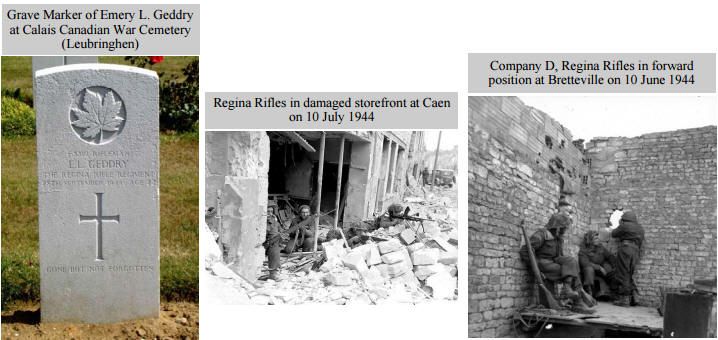
It was at this time that Emery Geddry probably traveled from St. Alphonse to Debert (just northwest of Truro) and enlisted in "The Johns". The 1st Battalion trained at Debert between September 1940 and August 1941.
In August 1941 the 1st Battalion, Regina Rifle Regiment departed for the United Kingdom and landed in Scotland in September. During the remainder of the year the Regina Rifles trained and defended the southern coast of England. During 1942 and early 1943 their training began to focus on offensive strategies rather than the earlier defensive tactics.
As planning for Operation Overlord (the code name for the Normandy Invasion) began in 1943, the generals chose the Regina Rifles as one of the assault battalions. Demanding training to prepare for their new role began in earnest during the spring of 1944 and completed in May. During the first days of June "The Johns" loaded onto the invasion craft waiting for the word from General Eisenhower. Finally, in the very early hours of June 6th, General "Ike" gave the "GO" and the invasion fleet headed across the English Channel to France. The men of the Regina Rifles now had to face two difficulties - that of the rough seas causing havoc with their stomachs and the uncertain welcome they would receive on the French shores.
At 0805 hours on 6 June 1944 the men of the Regina Rifles tasted battle for the first time when A Company disembarked from the "Isle of Thanet" and waded toward the shore on Juno Beach in the sector designated NAN GREEN. Juno Beach at Courseulles sur Mer, Normandy was the designated landing site for the Canadian forces. B Company followed to the left of A Company at 0815 hours. Companies C and D landed at 0835 hours and 0855 hours respectively. Two of Company D's landing craft were blown up by mines causing many casualties.
The Johns encountered heavy fighting as the trudged ashore through the heavy seas and suffered 128 casualties in the first hour of the battle. By 0900 hours "The Johns" had cleared the beach and began their assault on the designated target - the town of Courseulles. By evening the 1st Battalion, Regina Rifles Regiment had moved inland and consolidated their position at Reviers. Rifleman Emery Geddry had experienced fierce battle firsthand this day and helped his unit breakthrough the beaches.
And so began the first of many battles the Regina Rifles and Rifleman Geddry would fight during the ensuing months. Between 6 June 1944 and 5 May 1945 the regiment would suffer 1,831 casualties including 463 fatalities - including the death of Rifleman Emery Louis Geddry.
On 8-9 June the Regina Rifles counter-attacked the German forces at Bretteville-l'Orgueilleuse - a critical crossroad town on the march to Caen. During heavy night fighting they drove back the Panther tanks and secured the town.
The battle for Caen commenced on 4 July with heavy peripheral fighting and softening up of German positions with bombs and artillery. The Regina Rifles did not engage in the fighting until 8 July when they joined British and other Canadian forces in the invasion force. As they marched toward Caen, the Canadians attacked Gruchy and Buron and retook Authie and the Abbaye d'Ardennes. When the Regina Rifles captured the Abbaye d'Ardennes, they silenced a hornet's nest and deprived the Germans of their bird's nest view of the Canadian positions below. The fighting was slow and fierce with landmines tearing flesh from the body and schrapnel penetrating the bodies of soldiers. Early on 9 July the Germans evacuated Caen on the north side of the Orne River. Canadian casualties were higher in the fight for northern Caen than on D-Day.
On 18 July the Regina Rifles and other Canadian forces crossed the Orne River after heavy bombing and artillery fire onto southern Caen. The Canadians captured Colombelles and then Faubourg-de-Vaucelles on the outskirts of Caen. The Germans remained strong in their positions with well-concealed tanks and guns. They continually harassed the advancing Canadian forces causing heavy casualties. On 10 July Caen fell. In just 33 days this band of untried young Canadians had turned into battle-hardened soldiers fighting their way through France.
After assisting in the capture of Caen, the Regina Rifles and most other Canadian units were placed in reserve for a bit of rest. Operation Spring began on 18 July in the Canadian push to Falaise. On 19 July 1944 the Regina Rifles helped capture the villages of Bourguébus and Faubourg de Vaucelles.
On 8 August the British and Canadians finally broke out of the Caen region and headed to Falaise. Fighting was heavy on this 'Corridor of Death', but the Canadians persisted. Finally on 20 August the Allied forces shut the gate on Falaise and captured a significant part of the German Army and equipment in Normandy.
With the fall of Falaise the Normandy campaign came to an end and a new phase of the war began. During the last days of August, the 1st Canadian Army was designated to clear the coastal area of Northern France. The Regina Rifles and other Canadian units accomplished the Seine phase during 25-28 August.
As September began the 3rd Canadian Infantry Division prepared for the battle to take the fortified French port city Calais - a key supply depot. On 24 September 1944 Allied forces began softening the German defenses with naval and aerial bombardments as well as artillery assaults. Earlier the 7th Canadian Infantry Brigade with the Regina Rifles had sealed off Calais. During this period the Regina Rifles captured the coastal town of Wissant - isolating the Cap Gris Nez batteries of the Germans and capturing the Batterie Wissant with its four guns.
On 25 September the 7th and 8th Canadian Infantry Brigades began the assault on Calais. Initial operations on Cap Blanc Nez went smoothly and German soldiers began surrendering. The Regina Rifles with other Canadian units began the attack through the Belle Vue fortifications to the seafront east of Sangatte. Initially "The Johns" progressed rapidly on the target; however, soon the fighting became fierce and the Reginas suffered heavy casualties. Sangatte was reached on the morning of 26 September.
Next the Regina Rifles were to advance through Coquelles to Fort Nieulay and conduct a direct attack on Calais. The advances were difficult because of flooded ground and "The Johns" had to withdraw temporarily to allow Allied bombing. Together with other units the Reginas captured Fort Nieulay and reached their immediate target - the factory district. The Regina Rifles made further advances toward Calais on 28 September and after a brief truce Calais fell on 1 October.
During the fighting on 28 September 1944 near Les Fontinettes on the southern outskirts of Calais Riflemen Emery Louis Geddery was fighting from a house. The house was hit by shelling - seriously wounding Rifleman Geddry. He was immediately taken by stretcher to the Regimental Aid Post; however, he died on the way to the Post. Rifleman Emery Louis Geddry served Canada bravely - dying at the young age of 22 years.
Shortly after the battle ended, Rifleman Geddry's platoon brought him and two other casualties, Riflemen Donald M. Darby and Russell L. Finner, to a Roman Catholic Church cemetery in the nearby town of Coquelles, southeast of Calais, where the pastor of the church performed the funeral. The three were buried in the church cemetery, which was probably the Assumption Catholic Church Cemetery in Coquelles.
A brief note written about this incident shows the gratitude of the French people for the Allied soldiers. Captain Graham Jamieson, the chaplain of the Regina Rifles, had been trying to arrange a funeral for the three young soldiers recently killed. A French priest agreed to arrange burial services at the local Catholic church and the mayor of Coquelles delivered an inspiring homily to the many local residents and soldiers attending. The homily was so inspiring that Captain Jamieson provided each member of the 1st Battalion wih a copy:
Ladies and gentlemen:
Seldom on this earth is there any joy which is not mingled with sorrow. Thus today, although we are very happy, we must dim the brightness of our joy to take part in mourning and sorrow - the price of restored liberty.
Is it not a gracious gesture of Providence to have sent to liberate us from the clutch of strangers, Canadian soldiers, sons of Canada, distant from yet dear to French people; from Canada where the memory of France is always fresh, where numerous are those who speak our language: from Canada loyal to England and faithful to France?
Also it is with deep feeling that I bow my head to the glorious remains of these courageous soldiers who have fallen on our soil. I do it on behalf of the municipal authorities of Coulogne and of the entire population.
Rest in peace, noble sons of Canada. May the soil of France lie lightly on you. You lie at rest among our ancestors and near the French and English soldiers who found death on our soil in 1940.
Your remembrance among us is assured and your more happy comrades who live to carry on the fight may rest assured that our hearts beat in unison with theirs so valiant. May they soon, victory having been assured and peace brought to the peoples of the world, be enabled to return to their beloved country and carry with them a mark of recognition of France's debt of gratitude to Canada.
Across the seas we send our sincere and affectionate sympathy to the families of the three soldiers whom we honour today. We salute the glorious armies of the allied nations and we look forward with complete confidence to total victory.
Glory to the valiant fallen on the field of honour. Long live Canada. Long live the allied nations. Long live France.
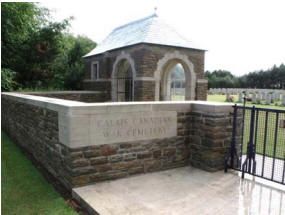
After the war ended Emery Geddry's remains were removed from the small Catholic cemetery and reinterred at the Calais Canadian War Cemetery (Leubringhen). This Canadian military cemetery is located about 16 kilometers (10 miles) southeast of Calais on the east side of Road A16 from Calais to Boulogne. The grave of Rifleman Emery Louis Geddry is in Plot 7, Row D, Grave 5 - just below and to the right of the Cross of Sacrifice.
Shortly after the fall of Calais on 1 October 1944, Emery Geddry's platoon leader Lieutenant C. C. Williams wrote a short letter to Emery's mother explaining the circumstances of her son's death. This is one of the toughest jobs a military leader must do, yet it brings great relief and closure to the mother and family of the young man who gave his life for his fellow countrymen. The letter, shown below, reads:
Regina Rifle Regt.
5th Oct. 44
Dear Mrs. Geddry:Unfortunately, Lieutenant Cameron Collin Williams died less than a month later on 2 November 1944 at the age of just 24 years at Breskens Pocket during the Battle of the Scheldt. He is buried at the Adegem Canadian War Cemetery.
As your son was in my platoon I am writing to inform you of the circumstances regarding his death. At the time we had moved into the outskirts of Calais and were gathering our forces for an attack on the city itself.
During this time there was considerable shelling on both sides and the house in which your son's section was at the time was hit. This was on the afternoon of 28th Sept. We immediately called a stretcher and took him to the Regimental Aid Post but he died on his way.
I had the honour of having your son In my platoon for only a short time but during that time he proved himself a good soldier. He was very reliable and any job he was given to do was well done. He was well liked by the rest of the men he fought with.
It's men like him, Mrs. Geddry that will, & are making victory possible. He was buried in a Roman Catholic church in the town of Couquelles just outside of Calais. The Priest of that church performed the ceremony.
To you his mother & all his loved ones I send my deepest sympathy. If there is anything I can do or anything more I can tell you, please don't hesitate to write.
Sincerely
C. C. Williams
Lieut.
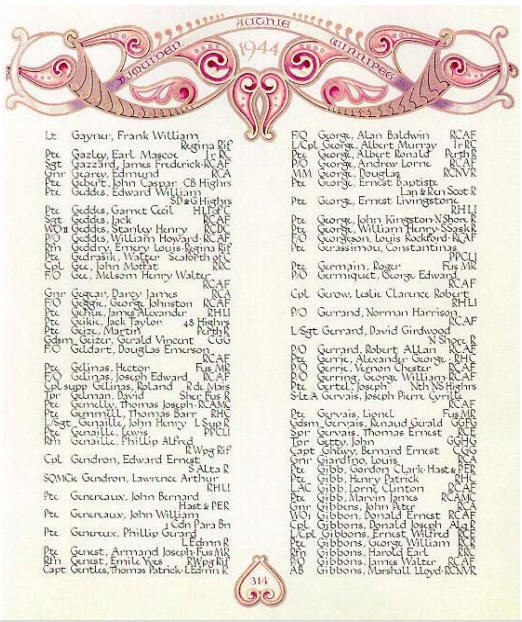
Emery Geddry has been honored by Veteran Affairs Canada with the placing of his name in the Books of Remembrance for Canadians who fought in wars and died during or after them. Emery is remembered on Page 314 of the Second World War Book of Remembrance. The Books of Remembrance for each war are kept in the Memorial Chamber in the Peace Tower on Parliament Hill. Each morning at eleven o'clock a member of the House of Commons Protective Staff turns the pages of the Books of Remembrance. The ceremony is quite elaborate as a uniformed guard marches to the first Book, bows, salutes and turn the page. He then proceeds to the next Book and repeats the ceremony. This continues until all the pages to be turned are done. The guard then marches to the center of the room, bows and salutes a last time.
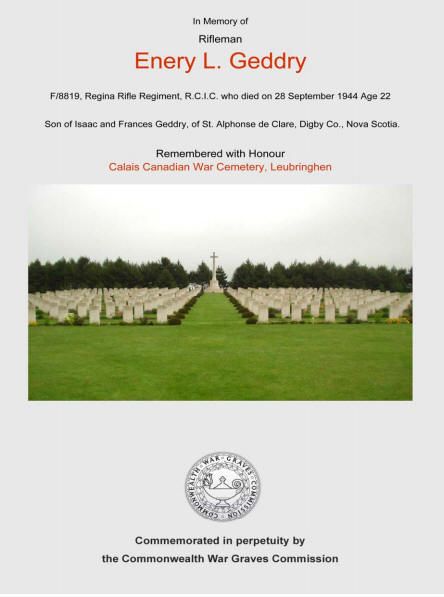
The Commonwealth War Graves Commission, which cares for the Canadian military cemeteries, commemorated the service of Rifleman Emery Louis Geddry with a Memorial Certificate.
The town of Saulnierville, Nova Scotia and Branch 52 of the Canadian Legion in Saulnierville have erected a beautiful monument on the Branch grounds to honor local Canadians who served during World War I, World War II and the Korean War. The name of Emery Geddry is embossed on the plaque commemorating soldiers who fell during World War II.
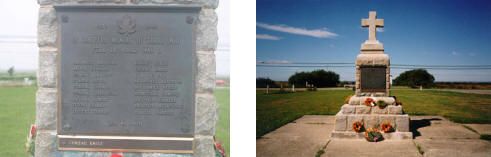
Although he only lived a brief time, Emery Louis Geddry gave the ultimate sacrifice so that his family, his countrymen and free peoples throughout the world could live in peace and prosperity.
Special thanks to Ms. Lorraine Geddry Dunleavy for providing a copy of Lieutenant C. C. Williams' letter and sharing information on Emery Geddry's service and life. Emery Louis Geddry is Lorraine's uncle and also her godfather. Lorraine is an active member of Les Guédry et Petitpas d'Asteur and the daughter of Benoît Geddry, brother of Emery Geddry, and Rita Deveau.
Guédry Genealogy of Emery Louis Geddry
- Emery Louis Geddry (b. ca. 1922)
- Joseph Isaac Geddry m. Frances (Françoise) Marie Dugas
- James (Jacques) M. Geddry m. Rosalie Maillet
- Maximin (Mark) Geddry m. Marie Seraphie Babin
- Philippe Gedree m. Angélique Theriau
- Augustin Guédry dit Grivois m. Marie-Françoise Jeanson
- Pierre Guédry dit Labine m. Marguerite Brasseau
- Claude Guédry dit Grivois m. Marguerite Petitpas
Footnotes
- In the Canadian military records Emery L. Geddry's name often is incorrectly spelled as Enery L. Geddry.
- Eight Candian members of the Petitpas family died in combat during World War II - Emile Petitpas, James Joseph Petitpas, Raymond Edmund Petitpas, Guy Dennis Pettipas, Leonard Francis Pettipas, Wilfred Benvie Pettipas, William Harold Pettitpas and Robert Michael Pitts.