J. Alfred Jeddry - Meteghan, Nova Scotia
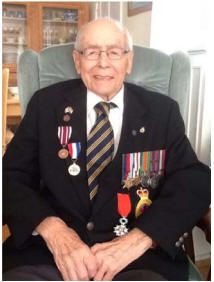
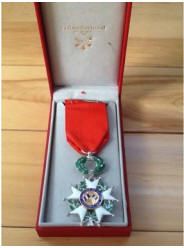
J. Alfred Jeddry of Meteghan, Nova Scotia was recently awarded the rank of Knight of the National Order of the Legion of Honour by the French Republic in recognition of his participation in the Normandy campaign in 1944. The Legion of Honour was created by Napoleon Bonaparte in 1802 and is awarded for excellent civil or military conduct.
Alfred was born in 1921 in Meteghan Station, Nova Scotia. After graduating from school he took a job at the Meteghan shipyard as a welder during which time he met his future wife Marie Stella Comeau.
With WW2 taking place, rather than wait to be drafted, Alfred enrolled in the Canadian Army in 1942 as a welder. He received basic training in Halifax and became a member of the Royal Canadian Ordnance Corps and later a front line member of the new Royal Canadian Electrical and Mechanical Engineers, a specialist engineering corps supporting army equipment.
In 1943 he received his orders to go overseas, but was granted military leave to get back to Meteghan and marry Stella before being deployed. After a short honeymoon, he returned to Halifax and sailed away on the liner Queen Elizabeth along with 17,000 other service personnel. After an uneventful crossing the troops landed in Glasgow, Scotland.
He was then posted to the Elgin Regiment, part of 4 Canadian Armoured Division, and crossed the English Channel to Normandy in July 1944. He participated in the breakout from Caen and the closing of the Falaise Gap and in the slow and fierce fighting in the hedgerows of Normandy.
Every soldier got some leave and Alfred remembers his nine days off in Paris - the food, the Moulin Rouge and the fact that if you were in uniform it opened many doors.
By February 1945 Alfred and 4 Canadian Armoured Division were heavily engaged in battle in the Hochwald area and soon after the Division crossed the Rhine River. Alfred describes the crossing:
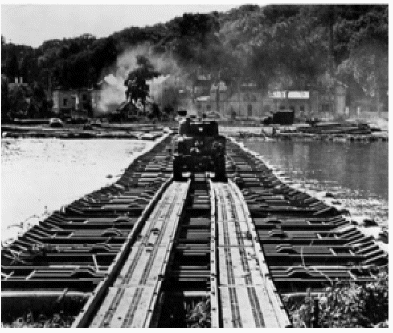
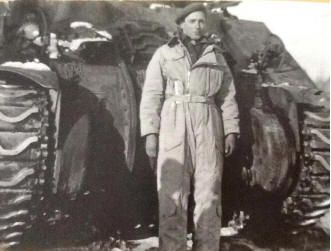
"I was driving a tank and we came to the Rhine. All bridges were down in the river and we had to cross on a pontoon bridge. The officer told me to put the tank in the lowest gear and floor it! As we advanced, the tank’s weight caused each pontoon to sink a fair amount and this was repeated for the whole crossing. It was an unforgettable experience - quite a thrill actually!"
By the end of April 1945, 4 Canadian Armoured Division was well into Germany and on 5 May 1945 the war ended with Alfred at Meppen, Germany. He was then sent to Holland where a technical training school was set up to offer trades training to returning Canadian soldiers. He remained there as a welding instructor until February 1946 when he sailed for Halifax and to his wife Stella.
He returned to Meteghan Shipyards as welding foreman, then partnered with his brother Gus to create a short lived beverage cooler manufacturing business and then to work at Halifax Shipyards.
After a few years the family migrated to the New Haven, Connecticut area where Alfred worked at a bridging company for some years.
He then joined the A.W. Wright Nuclear Structure Laboratory at Yale University as a technician, which meant learning the practical aspects of nuclear physics in a heavy ion accelerator. After 33 years at Yale Alfred retired as a Senior Technical Specialist Supervisor from the same lab. Upon Alfred’s retirement, Dr. Alan Bromley, former Yale Engineering Dean, stated:
‘You can be justly proud of the part that you have played in making this one of the world’s best research centres in nuclear physics and of the part you have played in the education of over 100 graduate students who have received their degrees from this Laboratory and who time and again have called on you for help. These individuals are now spread around the world in positions of responsibility as part of the WNSL family; recently we discovered, for example, that more than 50% of all Directors of the major nuclear physics laboratories in the world have spent time in WNSL as graduate students, as postdocs or as junior faculty. All of them came to know that they could always count on you for advice, for help and for friendship. The vitally important role that this plays in the education of our students and postdocs is all too often left unspoken but I want you to know that it is very real and very much appreciated.’
Alfred is now 94 years old, living in Meteghan and is in fairly good health. Some years ago, he and Stella retired in Meteghan, but regrettably Stella, passed away in 2007. Alfred has three children, Paul, James and Janet, who all live in the United States and frequently visit their Dad in Nova Scotia.