The D-Day Landing and POW Experience of Emery J. Guidry from Cow, Island, LA
The following information was given to me over the years that I lived & worked with Uncle Emery and the many nights he spent at our home.
When Emery J. Guidry enlisted in the Army, his father (Malcolm Guidry) had to sign for him since all of his brothers were already in the service and he was the only remaining son on the farm. Grandpa Malcolm told him it was a dumb thing to do and he was going to get himself killed in a foreign country. But he said I can’t stay home and not help out like my brothers! My Dad (Kerney Guidry) was in the Army in the Phillipines, Malcolm Jr. (Malcolm Guidry Jr.) was in England with the Air Force, Vern (Vern Guidry) was in the Army in California and Harry (Harry Guidry) was in the Army in Oklahoma.
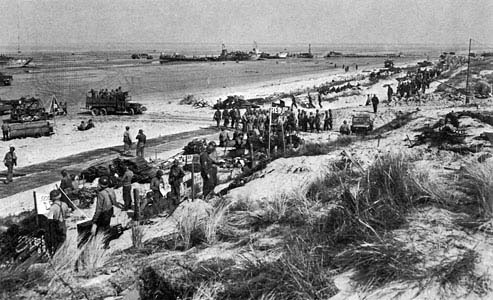
Uncle Emery said on D-Day that he was all too happy to get off that darn boat and head to land even if he got killed! They landed at Utah Beach, walked ashore and never had a shot fired at them, He could hear a lot of firing down the beach in the distance, but it was three days before someone shot in his direction -- a machine gun was firing from behind a hedgerow and he fired back, but does not remember hitting anything except trees and dirt flying from around the position.
His unit moved up towards Cherbourg and he said the Germans were fleeing because they were trapped! There were a lot of firefights and Uncle Emery thinks he did kill some Germans, but there was so much firing and Germans falling everywhere that he could not remember actually shooting and seeing someone go down from his fire.
After Cherbourg they walked south for months, but he did not remember the names of any towns or places. He knew his unit never got close to Paris.
The next thing Uncle Emery remembered is that they were in the woods in Luxembourg in December, 1944 and it was the coldest place he had ever been. He was sent up front as a forward observer (two men to a foxhole with binoculars). They had been there about two weeks when one night it went wild! Artillery fire was falling all around their foxhole and German tanks were coming out of the woods behind them. He said it looked like at least 100 tanks headed right towards them. His foxhole buddy said “I better look and report back to HQ”. He stuck his head out of the foxhole, was shot right through the head and dropped back into the hole. Uncle Emery said “I got as low as I could in that hole”. A few minutes later a German stuck his gun into the hole and said “raus” (get out!). Would you believe that at the time I was thinking Poppa was right; I was going to get killed in a foreign country! I was scared out of my skin and knew that guy was going to blow my head off, but he lined me and about ten other observers up and started marching us back towards the German lines.
About an hour before the attack a friend (Winston Foreman) from Kaplan was in one of the foxholes and he yelled for me to go get coffee for the other guys. When I got back, I went to foxhole #1 to bring them coffee (my foxhole was #3) and that’s when the shelling started. An 88mm round hit right in my old foxhole (#3)! Winston took off for HQ as soon as the shelling started and he reported me dead since he thought I was in my old foxhole (#3). The War Department sent my wife Willie Mae & Poppa (Malcolm Guidry) a letter saying I was killed in action!
The German guard walked us about four hours through their lines. There were Germans and tanks everywhere you looked, but he kept us walking until daylight. Once there was enough light we saw the black uniforms of the mean, dreaded Panzers and felt we were definitely going to be executed. Then he stopped and we fell asleep in a forest until dark. This went on for days. One night, while we were walking, a German patrol did not see our guard and started shooting at us. I got hit in the left hip and the buttock and two other guys were shot dead before the guard finally got the Germans to quit shooting. I was hurting terribly, but not bleeding that much so the guard put a crude bandage on me and told me to keep walking. We finally got to a prison camp somewhere in Germany and an American doctor patched me up best he could. I had been running a high fever for about a week and infection had set into the wounds. We were all starving as the guard gave us a can of potted meat to share amoung the eight of us. I was down to 118 lbs from 160 lbs a few weeks earlier! I was in such bad shape at the prison camp that I did not know if it was day or night or how long we stayed there -- maybe a week at the most. When we arrived at the camp, all the prisoners came out to see what was going on.
A big guy with black curly hair hollered at me “Guidry, Where you from? ” I said “Cow Island, Louisiana”. He said “I am from Lyons Point, Louisiana. And I will take care of you”. He got my name from the nametag on the fatigue uniform that I was wearing, but he had a prison suit so I never got his name. That night the big guy brought us some potato peelings soup which tasted great! It was dark and he had snuck into our barracks so we had to whisper. I was so bad off and never thought to ask him his name and really couldn’t tell what he looked like in the dark. But that guy sure saved my life! The U. S. Air Force started dropping bombs on the camp and probably killed more POW’s than Germans so our old guard decided it was time to move on.
AN ASIDE - JEFF’S UNLIKELY STORY ABOUT THIS INCIDENT
Jeff Guidry (Emery Guidry’s nephew) worked for Allstate Insurance Company in Crowley, LA and he had a customer by the name of Julius Lamperez who lived in Crowley. He was a famous Cajun musician who went by the stage name of “Pappa Cario” (the King of Diamonds). Pappa would come to my office every month and he would start telling me music and war stories. He said he was a prisoner of war for two years in Germany and talked about how bad it was. Or he would tell me he played the Louisiana Hayride in Shreveport with Elvis Presley, Farron Young and George Jones and how he was the best steel guitar player EVER! I really thought most of it was lies, but, after he died, the Morning Advocate newspaper in Baton Rouge, LA listed his playing history and sure enough he played background steel guitar for all those singers.
One day out of the blue he says”Guidry, Where you from?” I said “Kaplan, but I was born in Cow Island”. He said “I met a Guidry from Cow Island when I was in the prison camp, but I don’t know what his first name was”. He said “I saw his name on his field jacket the day they brought them in and I asked him where he was from. He said Cow Island and I told him I was from Lyon’s Point”. I was a cook and took care of my Lousiana boys. That first night I brought him some potato peelings soup because he was in really bad shape.
I could not believe what I was hearing!
I picked up the phone and called Uncle Emery and said I want you to talk to somebody you met many years ago. I handed the phone to Pappa and, as they talked, Pappa started crying and he kept saying “I ain’t no hero” and to come see him in Crowley or at his nightclub in Houston. They talked for about 30 minutes and, when they hung up, Pappa gave me the phone back and said “ That sure was the fellow from the prison camp, but when you see him you tell him that I ain’t no hero, but I am one hell of a steel guitar player!”
Pappa died about two months later at the age of 81. He and Emery never got to see each other.
EMERY’S STORY CONTINUES
When we left the prison camp, we now had about 15 guys with that one guard and we started walking at night and sleeping in train tunnels during the day. It wasn’t long before we could hear our artillery shells falling all around us and our planes were overhead all day. Some of the guys started working on the guard - telling him to give up because, when the Americans caught up to us, it would be better for him to be our prisoner. After two or three days the German guard could see we were right and he handed us his gun and told us where our frontlines were. We walked about 3-4 hours before we ran into some Americans from the Big Red One (U. S. 1 st Infantry Division). They called HQ and told them to send an ambulance as there were a couple of us in really bad shape. One of the medics gave me a cigarette and a morphine shot. My legs were numb and still infected and I was in pain the whole time. Boy, when he gave me that shot of morphine, I thought I had died and gone to heaven. I passed out and the next thing I remember was waking up in a hospital somewhere in France. I don’t remember anything during that time - guess they kept me full of morphine until I got to the hospital. When I woke up, the first thing I noticed was the ceiling fan and I looked down at clean white sheets! The bad part was hearing all the guys that were really bad off crying and yelling. I tried to get out of the bed, but I couldn’t move. I thought I must be paralyzed. But a nurse came by and said I was fine. They had strapped me to the bed to keep me from moving since they had removed the three bullets from my back. Boy, was I relieved! About two weeks later they brought me to the front office and gave me a telephone to call home. I had the operator call the little grocery store in Cow Island (as my family had no phone). The old man at the store was so excited; he keep asking me if it was really me because they told him I was dead! I assured him I was alive and that I would call back in two days at 2:00 pm their time and asked him to get my wife and Dad there.
When I finally talked to them, Pop (Malcolm Guidry) spoke only French and one of the French nurses said “Is that a local call?” I explained and she could not believe it. I did not know how long it would be before they shipped me home so I told everyone to hang in there cause “This old boy is coming home”. It took about two months of rehabilitation before I could fully walk again and another month to put me on a boat back to the States. When we finally landed in New York, I was sent to another hospital for a complete checkup and was diagnosed as 30% disabled and that I would get a monthly check of $32 for the rest of my life with free medical care. I thought ”Wow! I am fixed for life.
I am going to send that money directly to the bank and that’s gonna be my retirement.”
(Uncle Emery was re-evaluated ten years later and upgraded to 63% disabled. He received about $1200-1800 per month until he died.)
THE CONCLUSION
Emery (or EJ as he was called) worked as a bartender in Sulphur, LA for a couple of years after returning home then got a job building the large Citgo refinery in Lake Charles, LA. After it was completed, he was offered a job in the labatory at Jefferson Chemical Company in Port Neches, Texas where he worked for 43 years before he retired.
He and his wife Willa Mae had five children. They were married for 26 years, then they divorced. He later married a former schoolmate from Cow Island. She was with him until the end. Uncle Emery died in 2002 at the age of 78.
ADDITIONAL INFORMATION PRIVIDED BY EMERY J. GUIDRY’s CHILDREN DAVID GUIDRY AND MIKE GUIDRY
Hitler’s Youths were trained (brainwashed) at a very early age and were gruesomely cruel. One day the POWs were standing in line and one of the Youths threw a cigarette butt on the ground by the line of American POWs. When the guy in front of Dad reached down to pick it up, the young German smashed his hand with a rifle butt. The American soldier raised up in pain and was immediately shot and killed. Dad started to instinctively react and was quickly grabbed by the man behind him - saving him from being shot by the Youth.
Dad was captured in the woods of the Ardennes Forest near Luxembourg following the Battle of the Bulge. The German bombs that exploded in the trees killed many Americans. The bombed timber became shrapnel which created havoc and caused many injuries and deaths.
The POWs were being moved aboard a German train one day in Belgium when the train stopped and the prisoners heard a battled all around them. Once it got quiet, they carefully opened the boxcar door and were greeted by American soldiers responsible for liberating them. People from a nearby village in Belgium welcomed the former POWs and opened their homes in the nearby mountains to the GIs. Dad said many guys got sick from eating the rich foods since they had had none while imprisoned. He said they were a little sick, but soon recovered - more importantly they were finally FREE. A Belgian woman gave Dad a special pistol as a souvenir. Dad was the one that primarily communicated with the villagers since he was fluent in French - that is, Cajun French - and this made him very proud.
After the war Dad, one of his brothers and his brother-in-law went to the Mardi Gras in New Orleans. The servicemen were treated as royalty everywhere. Business owners gratefully set up tables outside their cafes and bars with food and liquor for the servicemen. Since it was so crowded, Dad, his brother and his brother-in-law tied themselves together with a rope so they’d not be separated. It worked fine until someone cut the rope. Three days later they finally found each other. Dad loved telling that story.
Emery J. Guidry
Born: 29 May 1923 at Cow Island, LA
Inducted into U. S. Army: 9 April 1942
Discharged from U. S. Army: 13 December1945
Served in 1 st Army, 101 st Infantry Division, Company A
Landed at Utah Beach on D-Day (6 June 1944)
Captured in Ardennes Forest during the Battle of the Bulge
Held as a POW for eight months
Medals: Silver Star, Bronze Star, Purple Heart, Croix de Guerre, and others
Emery J. Guidry’s Memorial Brick at the National World War II Museum in New Orleans
EMERY J. GUIDRY
UTAH/BASTOGNE/POW
1942 -- 1945
Genealogy of Emery J. Guidry
- Emery J. Guidry
- Malcolm Guidry m. Blanche Guidry
- Duessard Guidry m. Marguerite Idolie Hargrave
- Edmond Guidry m. Marie Aurelia Dartes
- Francois Guidry m. Celeste Dartes
- Jean-Baptiste Guedry m. Marguerite Lebert
- Claude Guedry m. Anne LeJeune
- (Unknown) Guedry {possibly Augustin Guedry & Jeanne Hebert or Paul Guedry & Anne Mius}
- Claude Guedry m. Marguerite Petitpas
[Note: Jeffrey Guidry is the son of Kerney Guidry & Mable Hebert. Kerney Guidry is the brother of Emery J. Guidry]