Survival of a Family: The Family of Jean-Baptiste Guédry and Madeleine Mius d'Azy
- The Migration of the Guédry Family during the 18th Century
- The Family of Jean-Baptiste Guédry and Madeleine Mius d'Azy Current
- The Family of Augustin Guédry and Jeanne Hebert
- Update - The Family of Augustin Guédry and Jeanne Hebert
- The Family of Marie-Joseph Guedry and Phillipe Dorion
- The Family of Pierre Guidry and Marguerite Brasseau
- Update - The Family of Pierre Guidry dit Labine and Marguerite Brasseau
- The Family of Paul Guidry dit Jovial and Anne Mius d'Entremont d'Azit de Pobomcoup
- The Family of Francoise Guedry & Jean LeJeune
- The Remaining Sons of Claude Guedry and Marguerite Petitpas
During the first half of the eighteenth century life at Merligueche, Acadie (today Lunenburg) was difficult for the family of Claude Guedry and Marguerite Petitpas. They continually struggled to survive as fishermen, coasting pilots and woodsmen with help from their friends the Mi'kmaq. Constantly harassed by the English during this period, they overcame adversity and excelled at their trades. Living through these difficult times prepared their children for the tragedies awaiting them during the 1750's and 1760's when the English forced the Acadians from their homes and deported most to the colonies of the Atlantic seaboard and France.
Born in 1684, 1 Jean-Baptiste Guedry, son of Claude Guedry and Marguerite Petitpas, was a young man of 14 living with his parents at Port Royal, Acadie in 1698. 1 , 2 , 3 In the spring and summer of 1705 Father Felix Pain of Port-Royal conducted a mission in the Cape Sable area. On 8 September 1705 he baptized the two youngest children of Claude Guedry and Marguerite Petitpas near Merligueche. Jean Baptiste Guedry served as parrain at the baptisms of his brother Paul and his sister Francoise. 4 , 5 , 6 On 10 September 1705 he sponsored the twins Paul LeJeune and Martin LeJeune, sons of Martin LeJeune and Marie Godet of Port Maltois, at their baptisms. 4 , 5 , 6
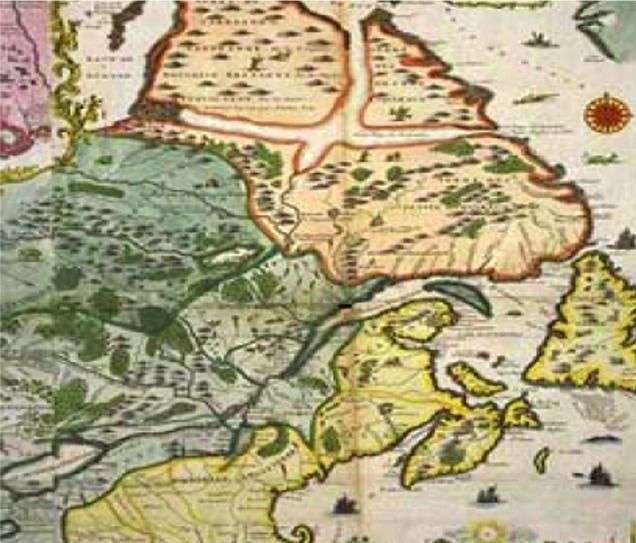
About 1708 Jean-Baptiste Guedry married Madeleine Mius d'Azy, daughter of Philippe Mius d'Azy and Marie, an Amerindienne. 7 , 8 , 9 Jean-Baptiste was 24 years old and Madeleine Mius was only 14 when the young couple was censused at La Heve (today LaHave, Nova Scotia near Lunenburg) in November 1708. 7
They had no children at this time. During the following eight years Madeleine apparently bore three children: Jean-Baptiste fils, Marie and Joseph; however, only for Jean-Baptiste fils and Joseph are we certain of the parentage. Marie Guedry was born about 1712; however, no direct record of her parents has been found.
Marie's grandparents Claude Guedry and Marguerite Petitpas had several sons who were old enough to be her father. They include Claude Guedry, born about 1682; Jean-Baptiste Guedry, born about 1684; Charles Guedry, born about 1686; Alexis Guedry, born about 1688; Augustin Guedry, born about 1690; Claude Guedry, born about 1694 and Joseph Guedry, born about 1695. 1 Of these only Jean-Baptiste is known to have married before 1715. Augustin married Jeanne Hebert about 1721 and Pierre married Marguerite Brasseau about 1722. Several researchers believe that Charles married an Amerindienne; however, no record of their marriage has been located. A brief reference in one record indicates that one of the two Claude's married before 1723. 10 Although any of the above sons of Claude Guedry and Marguerite Petitpas could be the father of Marie Guedry, Mr. Stephen White, genealogist at the Centre d'Etudes Acadienne at the University of Moncton in Moncton, New Brunswick and one of the foremost authorities on early Acadian genealogy, believes Jean-Baptiste Guedry is the one most likely to be her father. 11
In early summer 1722 the Indians of Maine initiated war on New England after the English had doublecrossed their highest chief, Joseph d'Abbadie de Saint-Castin, seized the possessions of Father Sebastien Rasle, and burnt the church, rectory and thirty-three wigwams at Nanrantsouak (today Old Point in Somerset County, ME). Governor Shute issued a declaration of war on 25 July 1722 causing a major disruption in the lives of the Guedry family of Merligueche. The war was variously known as the The Three Year's War, Rale's War, Lovewell's War and Governor Dummer's War. The English blamed not only the Indians, but also the Acadians of the East Coast, especially those of Merligueche, which was considered an Indian village. The families of Claude Guedry, Philippe Guedry, Augustin Guedry and Paul Guedry, sons of Claude Guedry and Marguerite Petitpas, were captured and sent first to New Hampshire and then to Boston. Could Philippe Guedry have been Baptiste (i.e., Jean-Baptiste) Guedry as this is the only time we encounter a son of Claude Guedry named Philippe. At the time of their capture only Philippe (Baptiste) and Augustin had children. By September 1723 the Guedry family had returned to Acadia. 9 , 12 , 13
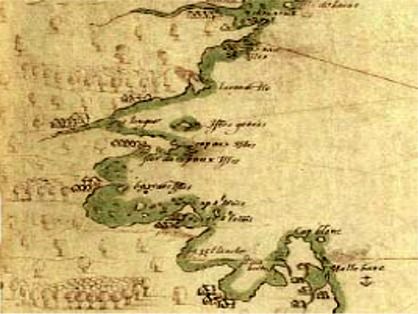
Shortly after their marriage Jean-Baptiste Guedry and Madeleine had a son Jean-Baptiste Guedry fils. Along with his parents, he was captured and sent to New Hampshire and then Boston in 1722 - returning to his native Acadia by September 1723. 9 , 12 , 13 During the fall of 1726 a tragic incident shook the small Acadian community of Merligueche. On 4 September 1726 Joseph Decoy, an Acadian coasting pilot from Ile Royale, stopped at the Merligueche harbor and related to the residents that the English at Boston had detained his son and would not release him. He was desperate and convinced the Guedry men and others of Merligueche that his only hope was to capture one of the New England fishing boats and hold that boat and its crew as ransom until the English returned his son. The very next day Captain Samuel Daly of Plymouth, MA entered Merligueche harbor to replenish his water supply. Captain Daly, seeing Jean-Baptiste Guedry ashore, invited him aboard. Sensing an opportunity, Jean-Baptiste and his son Jean-Baptiste fils, a lad of sixteen or seventeen years of age, launched their canoe and paddled to Daly's vessel. Once aboard, Jean-Baptiste pere joined Captain Daly for a drink in his cabin while the younger Jean-Baptiste returned to shore in the canoe. Shortly, Daly and his crew of four also went to shore to get a supply of water. Jean-Baptiste pere stayed aboard saying he'd call to his son to come and get him. Soon after he called in French to his son and Jean-Baptiste fils returned to the ship with several Acadians and Mi'kmaq. Immediately Jean-Baptiste pere took charge - lowering the English flag and wrapping it around his waist in which he placed a pistol. Daly, seeing what was occurring, sought Marguerite Petitpas, the mother of Jean-Baptiste Guedry pere, and asked her help. She tried to convince Jean-Baptiste to abandon his plans, but to no avail.
Jean-Baptiste ordered Captain Daly to sail. He and his crew returned to the vessel and set sail. The next morning Jean-Baptiste pere went down into the cabin with three Mi'kmaq. Captain Daly, sensing an advantage, shut the cabin door, trapping the four men inside. He and his crew then quickly overcame the young Jean-Baptiste fils and the other Acadians and Mi'kmaq on the upper deck. The three Mi'kmaq in the cabin jumped into the water escaping capture; however, Daly did capture Jean-Baptiste pere, Jean- Baptiste fils and three Mi'kmaq.
Sailing westward, Daly brought his five captives to Boston where the Court of Admirality quickly tried them for piracy on 15 October 1726, found them guilty and sentenced them to die by hanging. The three Mi'kmaq, desperate for their lives, claimed the two Acadians incited them to commit this terrible act - all to no avail. On 13 November 1726 the English hung Jean-Baptiste Guedry pere, Jean-Baptiste Guedry fils and the three Mi'kmaq at Boston. As the tragic news of the hanging reached Merligueche days later, the community must have been devastated to lose five men - one so very young. 14 , 15 , 16
In April 1752 Germain LeJeune and Marie Guedry were residing at Baie des Espagnols, Ile Royale (today near Sydney, Cape Breton) with their five children: Joseph, age 22 years; Marguerite, age 16 years; Chrisostome, age 12 years; Germain, age 11 years and Paul, age 5 years. This census records Germain LeJeune's age as 50 years (born in 1702) and Marie Guedry's age as 40 (born in 1712). They moved from their home in Acadia to Baie des Espagnols about November 1750 to avoid the persecution of the English. Germain had made a small farm where he could grow one-half barrel of wheat and had sown good crops of cabbage, turnips, beans and pumpkins. He had one cow and one pig. The family also owned six to seven arpents of uncultivated land. 18 , 19
Marie Guedry's husband Germain LeJeune dit Briard was the son of Pierre LeJeune dit Briard and Marie Thibodeau. The Census of Ile Royale and St-Jean erred in his age. He was born about 1693 and spent his youth at Port Royal and LaHeve, Acadia. He first married Marie-Anne Trahan, daughter of Alexandre Trahan and Marie Pellerin, about 1717 by whom he had two children: Marie-Josephe, born in 1718, and Jean-Baptiste, born in 1722. After the death of Marie-Anne Trahan, Germain married Marie Guedry. 2 Although the Census of Ile Royale and St. Jean in 1752 often has incorrect ages recorded for the persons censused, it is the only record that we have of Marie Guedry where her birth year can be determined. Based on this census, Marie Guedry was born about 1712 and married Germain LeJeune about 1729. 18 , 19 , 20 The only son of Claude and Marguerite Petitpas that is known to have married before 1715 was Jean-Baptiste Guedry; therefore, it seems highly probably that Marie Guedry was the daughter of Jean-Baptiste Guedry and Madeleine Mius d'Azy.
Settled in the immediate vicinity of Germain and Marie at Baie des Espagnols was the family of Paul Guedry and Anne Mius (Marie's uncle and aunt), Jean LeJeune and Francoise Guedry (Marie's uncle and aunt), Jean Cousin and Judith Guedry (Marie's first cousin) and Joseph Guedry and Josette Benoit (Marie's brother and sister-in-law) as well as several children of Augustin Guedry and Jeanne Hebert who were first cousins of Marie Guedry. 21
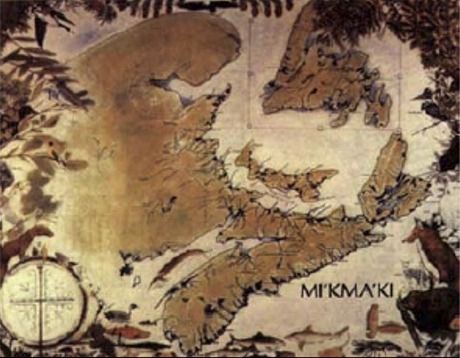
Few records about the lives of Germain LeJeune and Marie Guedry exist, however, it appears that they, like their children, remained in the vicinity of Ile Royale during the remainder of their lives. On 27 August 1771 Germain and Marie attended their son Paul LeJeune's marriage rehabilitation to Helene, a Mikmaq, at Labrador, just off the coast of Ile Royale. 22 Remaining near Ile Royale throughout their lives, the children of Germain LeJeune dit Briard and Marie Guedry had very close ties with the Mi'kmaq.
Joseph LeJeune dit Briard, born about 1730, married Martine Roy, probably the daughter of Charles Roy and Marie-Charlotte Chauvet. On 25 August 1771 their daughter Radegonde LeJeune, born 4 December 1770, was baptized by Abbe Charles-Francois Bailly during a missionary visit to Petite Bras d'Or, Ile Royale (French Village; today Little Bras d'Or, Cape Breton). 23 On that same date Joseph LeJeune dit Briard witnessed the baptism of his nephew Stanislas LeJeune, son of Christophe LeJeune and Louise Galand, at Petite Bras d'Or, Ile Royale and became the parrain of Stanislas. 24 He then attended his brother Paul LeJeune's marriage rehabilitation to Helene, a Mi'kmaq, at Labrador on 27 August 1771. 22 In 1811 Francis LeJeune, son of Joseph LeJeune dit Briard and Martine Roy, filed a petition to Nepean stating that he had eleven children as well as his father and mother living with him and that he owned 250 acres of land. He requested further land at French Village, Little Bras d'Or, Cape Breton adjoining the land granted to Francis Marche. 25
Christophe LeJeune dit Briard (sometimes called Chryostome LeJeune dit Christophe), born about 1740, married Louise Gallant, daughter of Pierre Gallant and Osite Lavergne, about 1767; however, there was no priest in the vicinity so they took their marriage vows in the presence of witnesses only. 20 Their marriage was rehabilitated by Abbe Charles- Francois Bailly on 6 August 1771 at Petite Bras d'Or, Ile Royale during his missionary visit to Ile Royale from Caraquet, New Brunswick. Their names are recorded as Chrytophe Lejeune dit Briard, son of Germain Lejeune dit Briard and Marie Guetri, with Louise Galand, daughter of Pierre Galand and Cecile Laverne. 26 On 25 August 1771 at Petite Bras d'Or, Ile Royale Abbe Bailly baptized two sons of Christophe and Louise: Bernard, born 7 February 1768, and Stanislas, born 22 March 1769. Bernard LeJeune's parrain was Etienne and his marraine was Marie Anne Bouche. Stanislas LeJeune's parrain was his uncle Joseph LeJeune dit Briard and his marraine was Marie Joseph Bouche. 24 In 1805 in a Petition to Despard, Chrisopher LeJeune Sr. asks for a lease of Lot 7 at French Village, Petite Bras d'Or, Ile Royale on which he had resided for many years. 27
Germain LeJeune, born about 1741, married Marie- Anne Lasonde, daughter of Marc Lesonde and Judith Petitpas, about 1766. Again, as with his brother Christophe, Germain found no priest in the area when he wanted to wed Marie-Anne; therefore, they wed in the presence of witnesses only.
On 6 August 1771 at Petite Bras d'Or, Ile Royale Abbe Charles-Francois Bailly, while on a missionary visit to Ile Royale from Caraquet, rehabilitated their marriage. In the rehabilitation record their names are recorded as Germain LeJeune dit Briard, son of Germain LeJeune dit Briard and Marie Guetri, with Marie Anne La Sonde, daughter of Marius La Sonde and Judith Petitpas. 22 On 25 August 1771 Abbe Bailly baptized Felicite LeJeune, daughter of Germain LeJeune dit Briard and Marie Anne Lasonde, at Petite Bras d'Or, Ile Royale. Her godparents were her uncle Christophe LeJeune and Marie Canada. 24 On this same date Germain LeJeune served as godfather at the baptism of Lyduvine Benoit, daughter of Boniface Benoit and Marie Joseph Bouche. 24 With several other members of his family Germain LeJeune attended the marriage rehabilitation of his brother Paul LeJeune and Helene, a Mi'kmaq, at Labrador on 27 August 1771. 22
Born about 1747, Paul LeJeune married Angelique-Helene, daugther of Joseph and Jeanne who were Mi'kmaq, about 1765. They wed in the presence of witnesses awaiting the arrival of a missionary priest who would rehabilitate their marriage. On 27 August 1771 Abbe Charles-Francois Bailly during a missionary visit to Labrador rehabilitated the marriage of Paul LeJeune dit Briard, son of Germain LeJeune dit Briard and Marie Guitri, and Helene, daughter of Joseph and Jeanne, Mi'kmaq. Present at the ceremony were Germain LeJeune dit Briard, father of Paul LeJeune; Marie Guitry mother of Paul LeJeune; his brothers Germain LeJeune and Joseph LeJeune; his cousin Joseph LeJeune dit Briard; his sister-in-law Louise Galand and several other witnesses. 22 Earlier on 10 August 1771 at Neireichak, Ile Madame, Ile Royale (today Arichat, Isle Madame, Cape Breton) Abbe Bailly baptized two children of Paul LeJeune dit Briard and Angelique. They were Pulcherie LeJeune dit Briard, age 5 years, and Pelagie LeJeune dit Briard, age 18 months. At this time Paul LeJeune dit Briard and Angelique promised to take the vows of marriage - which they did 17 days later. 28
On 10 November 1716 Madeleine Mius d'Azy gave birth to her third child Joseph Guedry. Evidently Joseph was born in the area of Merligueche as he was baptized shortly after his birth by his grandfather Claude Guedry since no priest was available. Eight months later on 10 July 1717 he was baptized by a priest in the presence of his godparents Jean Babin and Marguerite Landry, wife of Pierre Richard. 29 , 30 , 31 In July 1722 Joseph must have been captured and sent to New Hampshire and then Boston with his parents. He and his family returned to Acadia by September 1723. 9 , 12 , 13
About 1738 Joseph Guedry married Marie-Josephe (Josette) Benoit and in 1750 they leftAcadia with their two daughters Perrine, age 11 years and Jeanne, age 1 year, and fled to Baie des Espagnols, Ile Royale. In early April 1752 Joseph had a small farm of twelve arpents at Baie des Espagnols on which he grew very fine turnips, cabbage and beans. He had one pig. Josette Benoit, his wife, and his three children Perrine, age 13 years, Jeanne, age 3 years, and Servant, 10 days old, were living with him. 18 , 32
The English deported Joseph Guedry and his family to Port Tobacco, MD where on 7 July 1763 he was censused with his wife Marie Benoit and their three children Genevieve, Gabriel and Joseph. 33 , 34 , 35 , 36 Apparently Joseph and his family left Baie des Espagnols after 1752 and resettled in Pisiguit, Acadia (today Windsor, Nova Scotia). There on 27 October 1755 they were forced aboard the Sloop Dolphin holding 227 Acadian exiles. The Dolphin arrived at Annapolis, MD on 30 November 1755 with 180 Acadians aboard.
While at sea, the sloop encountered a furious gale and had to seek harbor at Boston along with five other transports on 5 November 1755. At Boston 47 Acadians were disembarked from the Dolphin due to overcrowding and poor health conditions. After finally reaching Annapolis, the exiles were forced to remain aboard the sloop, sail to the western shore of the Chesapeake Bay and up the Patuxent River to Lower Marlboro, MD, which they reached in early December 1755. Joseph Guedry and his family then traveled, probably overland, to Port Tobacco, MD where they settled.
Although most of the Acadians in Port Tobacco left Maryland in December 1767 for the promise of a better life in Louisiana, Joseph Guedry and his family do not appear to have done so. No further record after 1763 could be found of Joseph Guedry and his family. According to Stephen White, Joseph Guedry died before 27 August 1783. 2
Jean-Baptiste Guedry, Madeleine Mius and their family suffered tremendously during their lives with the tragic death by hanging of Jean-Baptiste pere and Jean-Baptiste fils, the oldest child in the family. It must have been heart-wrenching for Madeleine, Marie and Joseph to watch as their husband, father, son and brother were captured and taken to Boston. Even greater sorrow certainly followed with the devastating news that both had been hung.
With the cruel treatment that the English imposed on the Acadians and the final act of the deportations, tragedy again struck this small family as Marie and Joseph, one sent to Maryland and the other remaining at Ile Royale, never saw each other again during the remainder of their lives. Only their strong Catholic faith and hardy stock helped these siblings survive the tragic events that they faced.
References
- "Census of Acadia in 1698 (Recensement des habitans du .. leurs familles terre en valeur Bestiaux Arbres fruitiers et fusils Pour l'année 1698), [Port Royal, Beaubassin, Rivière St-Jean]", (Archives Nationales de France - Le Centre des Archives d'Outre-Mer, Col, G1 466, Nos. 18-20 - 29 Chemin du Moulin-Detesta, Aixen-Provence, France, 13090; National Archives of Canada (transcribed copy), MG1, Series G1, Vol. 466, Nos. 18-20 [Microfilm No. C-2572], 395 Wellington Street, Ottawa, Ontario, Canada, K1A 0N3).
- White, Stephen A., Dictionniare Généalogique des Familles Acadiennes - Première Partie 1636 á 1714 en Deux Volumes (Centre d'Etudes Acadiennes - Université de Moncton, Moncton, New Brunswick, Canada, 1999), pp. 771-774, 1051-1052.
- Casgrain, Abbé H. R. and Rameau de Saint-Père, François-Edme, Collection de Documents Inédits sur le Canada et L'Amérique Publiés par Le Canada-Français (L.-J. Demers et Frére, Québec, Québec, Canada, 1888-1890), v. 3 pp. 169.
- Rieder, Milton P., Jr. and Rieder, Norma Gaudet, Acadian Church Records - Volume III - Port Royal 1702-1721 (Metairie, LA, 1977), pp. 17-18.
- Registres des baptêmes mariages et sepultures de la paroisse de St Jean Baptiste du Port Royal 1702-1728 (Public Archives of Nova Scotia - Nova Scotia Archives and Records Management, Halifax, Nova Scotia) Available online at: http://www.gov.ns.ca/nsarm/cap/acadian/
- d'Entremont, Father Clarence-Joseph, Histoire du Cap-Sable de L'An Mil au Traité de Paris, 1763 (Hebert Publications, Eunice, LA, 1981), pp. 1927-1929, 1932, 1939-1940, 1942-1943.
- "Census of Acadia in 1708 (Recensement genal fait au mois de Novembre mile Sept cent huit de tous les Sauvages de l'Acadie qui resident dans la Coste de L'Est, Et de ceux de Pentagouet et de Canibeky; famille par famille, Leurs Ages Celuy de Lerus Femmes et Engants avec une Recapitulation a la fin de la quantite d'hommes et de garcons capables d'aler a La guerre Comme aussy Le recensement des francois Establis a La ditte Coste de L'Es)"' (Newberry Library (E. E. Ayer Collection), 60 W. Walton Street, Chicago, IL, 60610-7324; National Archives of Canada (395 Wellington Street, Ottawa, Ontario, Canada, K1A 0N3) (transcribed copy), MG18, F18; Unpublished transcription at Centre d'Etudes Acadiennes (Université de Moncton, Moncton, New Brunswick, Canada E1A 3E9), p. 42 (La Hève).
- White, Stephen A., Op. cit., pp. 772-774, 1206.
- d'Entremont, Father Clarence-Joseph, Op. cit., pp. 1013-1014, 1033-1034, 1042.
- d'Entremont, Father Clarence-Joseph, Op. cit., pp. 1595-1597, 1615-1616, 1622-1623, 1625.
- White, Stephen A., Op. cit., pp. 773-774.
- Daigre, Una F. and Pastorek, John J., Diocese of Baton Rouge Catholic Church Records - The Registers of St. Charles aux Mines in Acadia, 1707-1748 (Diocese of Baton Rouge-Department of Archives, Baton Rouge, LA, 1978, 1999), v. 1 p. 59; v. 1a p. 88.
- "Registers of Baptisms, Marriages and Funerals of the St. Charles-aux-Mines Catholic Church, Grand-Pre, Acadia from 1707-1749" (Currently archived at the Diocese of Baton Rouge-Department of Archives in Baton Rouge, LA), Register 2, Entry 4.
- "Archives of the Supreme Court of the County of Suffolk", (Suffolk Court Files - 14th Floor of New Building, Boston, MA), vol. 211, document 26283, nos. 4 & 5; vol. 216, no. 28868.
- d'Entremont, Father Clarence-Joseph, Op. cit.; pp. 1042, 1601-1604, 1617-1618, 1623, 1625.
- Coleman, Benjamin, Collections of the Massachusetts Historical Society (Boston, MA), vol. 6 (1799), pp. 108-112.
- d'Entremont, Father Clarence-Joseph, La Societe Historique Acadienne (Moncton, New Brunswick, Canada), v. 16, no. 1, p. 31.
- "Voyage d'Inspection du Sieur de La Roque, Recensement 1752, Ile Royale et Ile Saint-Jean", Archives Nationales de France, Archives des Colonies, G1 466, no. 81, (Original); Microfilm copy at the Centre d'Etudes Acadiennes (Université de Moncton, Moncton, New Brunswick, Canada E1A 3E9), Microfilm No. F1802.
- Gaudet, Placide, Report Concerning Canadian Archives for the Year 1905 in Three Volumes. - Journal and Census of Ile Royale, prepared by le Sieur de la Roque under the Direction of M. le Comte de Raymond, in the Year 1752, with Plan and Index , (S. E. Dawson, Printer; Ottawa, Canada; 1906). Volume II, Appendix A, Part I, p. 46.
- Arsenault, Bona, Histoire et Genealogie des Acadiens (Les Editions Lemeac Inc., Ottawa, Canada, 1978), pp. 1416, 1418.
- Gaudet, Placide, Op. cit., pp. 45-47.
- White, Stephen A., Registre de L'Abbe Charles-Francois Bailly 1768 a 1773 (Caraquet) (Centre d'Etudes Acadiennes, Moncton, New Brunswick, Canada, 1978), p. 66 (Register Entry 51).
- Ibid., p. 101 (Register Entry 82).
- Ibid., p. 100 (Register Entry 82).
- Szick, Larry, Internet site: http://www.rootsweb.com/~nscbgha/LeJeunePetitions.htm (Viewed 25 June 2006). Also on Microfilm 15791.
- White, Stephen A., Registre de L'Abbe Charles-Francois Bailly 1768 a 1773 (Caraquet) (Centre d'Etudes Acadiennes, Moncton, New Brunswick, Canada, 1978), p. 65 (Register Entry 51).
- Szick, Larry, Op. cit., Also on Microfilm 15794.
- White, Stephen A., Registre de L'Abbe Charles-Francois Bailly 1768 a 1773 (Caraquet) (Centre d'Etudes Acadiennes, Moncton, New Brunswick, Canada, 1978), p. 64 (Register Entry 49).
- Daigre, Una F. and Pastorek, John J., Op. cit., v. 1 p. 59, v. 1a p. 88.
- "Registers of Baptisms, Marriages and Funerals of the St. Charles-aux-Mines Catholic Church, Grand-Pre, Acadia from 1707-1749" (Currently archived at the Diocese of Baton Rouge-Department of Archives in Baton Rouge, LA), Register 2, Entry 2.
- d'Entremont, Rev. Clarence-Joseph, Op. cit., pp. 1013-1014, 1033-1034, 1042.
- Gaudet, Placide, Op. cit., Volume II, Appendix A, Part I, pp. 46-47.
- Jehn, Janet, Acadian Exiles in the Colonies (Janet Jehn, Covington, KY, 1977), p. 152.
- Rieder, Milton P. Jr. and Rieder, Norma Gaudet, The Acadian Exiles in the American Colonies 1755-1768 (Milton P. Rieder Jr. and Norma Gaudet Rieder, Metairie, LA, 1977), p. 33.
- "Census Returns of Acadians in Maryland 1763" (National Archives of Canada, Ottawa, Canada), M.G. 5, volume 450, folio 442.
- Wood, Gregory A., A Guide to the Acadians in Maryland in the Eighteenth and Nineteenth Centuries (Gateway Press, Inc., Baltimore, MD, 1995), p. 122.